

.svg)
 Healthcare
 Finance
 Retail
 SaaS & Digital
 eCommerce
 Education
 Salesforce
  HubSpot
 Pipedrive
 Mailchimp
 Klaviyo
 Zendesk
  Intercom
 Freshdesk
 HelpScout
  Front
Front Jira
Jira Slack
Slack  MS Teams
 Zoom
Zoom Google Sheets
  Zapier
  Integrately
 Make
Make  Webhooks




 MS Teams


The best product feedback tools in 2026 include Zonka Feedback, Pendo, Refiner, Canny, Sprig, and Hotjar. The right choice depends on your use case: in-app surveys, feature requests, user research, visual bug reporting, or behavior analytics.
TL;DR
- This guide covers 16 product feedback tools across 6 use cases: all-in-one platforms, in-product microsurveys, feature request management, user research, visual bug reporting, and behavior analytics.
- Tools are grouped by primary use case, not ranked by preference. Each entry includes positioning, key features, pricing, and G2 rating.
- Zonka Feedback is one of the tools included. This guide is written by the Zonka team but is based on independent research and verified user reviews. No tool is included because it paid to be here.
- For teams focused specifically on in-app survey mechanics, the dedicated best in-app survey tools guide covers that category in more depth.
- Jump to the comparison table or tool listings directly.
Most product teams don't have a feedback problem. They have a feedback-going-nowhere problem.
The input exists. Users fill out surveys. They post on Slack. They tell CS. They submit feature requests nobody reads again. But the signal never makes it to the decision. Not because the tools failed. Because the system around them did.
Product feedback tools exist to close that gap. Not just by collecting responses, but by giving those responses structure: a place to land, a way to surface patterns, and a path to the person who can actually do something about them. The goal is to turn raw user feedback into customer insights that drive real decisions at every stage of the user journey.
This guide covers 15 tools across five feedback workflows: in-product collection, feature request management, user research, visual bug reporting, and behavior analytics. It focuses on the tools themselves: what each does best, where it falls short, who it's built for, and what it costs.
What Are Product Feedback Tools?
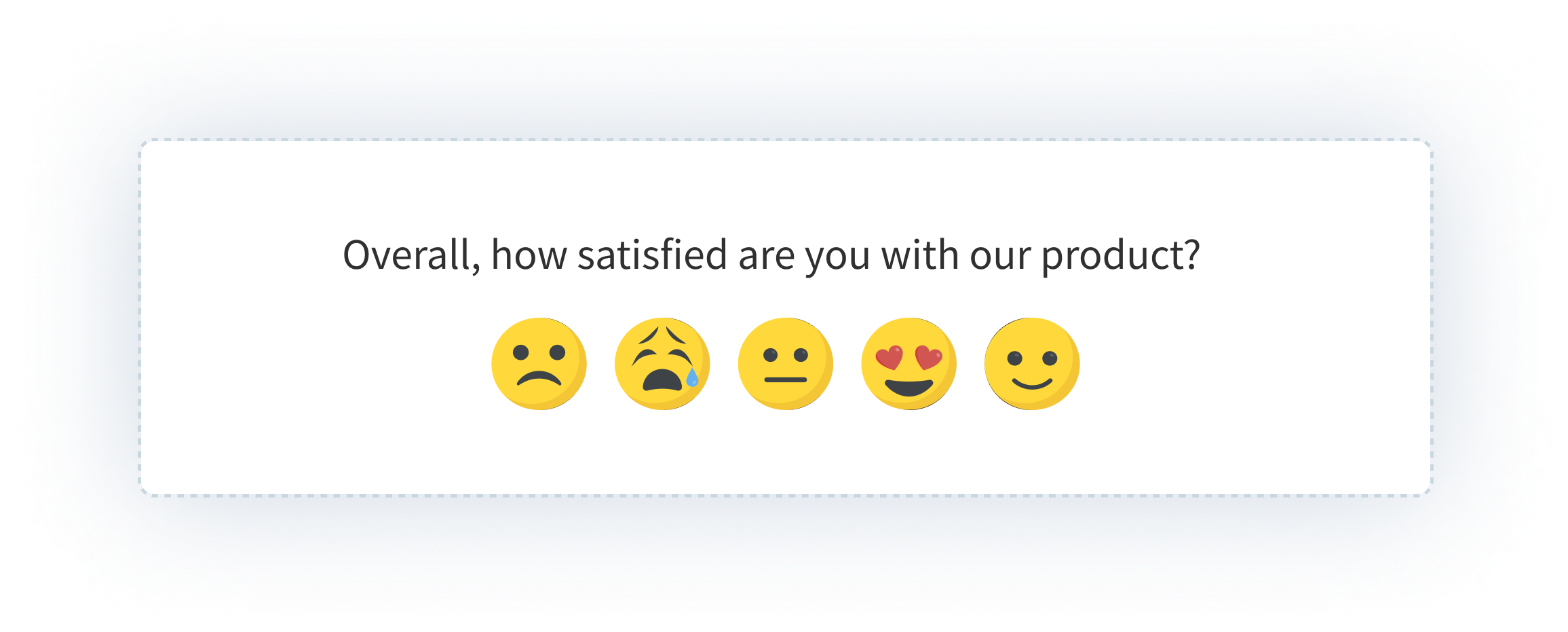
Product feedback tools are platforms that help teams gather feedback, organize it, and act on it to better understand customer needs. They capture feedback through in-app microsurveys, feature request boards, usability tests, visual bug reports, and behavior analytics, typically while users are actively engaging with the product.
The six main types:
- In-product feedback and microsurvey tools: contextual prompts triggered by user behavior inside the app
- All-in-one platforms: combine collection, analysis, and loop-closing in a single system
- Feature request and roadmap tools: structured collection, voting, and prioritization of product ideas
- User research and testing tools: deeper discovery through usability tests, interviews, and session analysis
- Visual feedback and bug reporting tools: screenshot and annotation-based issue capture with technical metadata
- Behavior analytics tools: heatmaps, session replays, and click maps showing where users actually go
Most teams use more than one type. Which combination makes sense depends on product stage, team size, the feedback channels you need to cover, and whether there's a real feedback management process behind it.
How Did We Evaluate These Product Feedback Tools?
This guide is written by the team at Zonka Feedback. Zonka is included in the list as one of the tools being evaluated, not as the default recommendation. Every tool was assessed using the same criteria.
Evaluation is based on public product documentation, official pricing pages, and G2 ratings verified as of May 2026. Where pricing was undisclosed or had changed, that's noted rather than guessed.
What we evaluated:
- Primary use case: what the tool is actually built to do
- In-product feedback capabilities: microsurvey support, behavioral triggers, targeting
- Feature request and prioritization support: voting boards, roadmap visibility, changelog
- User research depth: usability testing, session analysis, AI insights
- Visual and contextual feedback: screenshot, annotation, session replay
- Segmentation and targeting: user attributes, lifecycle triggers, device
- AI-assisted qualitative analysis: theme detection, sentiment scoring
- Workflow and loop-closing: alerts, routing, follow-up support
- Integration ecosystem: analytics, support, CRM, project management
- Pricing transparency: publicly listed tiers vs. sales-quoted
Tools are listed in category groups, not strict ranking order.
What Are the Best Product Feedback Tools in 2026?
The best product feedback tools in 2026 include Zonka Feedback, Pendo, UserGuiding, Refiner, Qualaroo, Typeform, Survicate, Canny, UserVoice, Sprig, UserTesting, Usersnap, Userback, Marker.io, and Hotjar. Here's a quick comparison of the top 10.
| Tool | Best For | Key Feature | G2 Rating | Starting Price |
| Zonka Feedback | All-in-one feedback management + AI analysis | Behavioral targeting, AI sentiment, closed-loop workflows | 4.7/5 | Custom pricing |
| Produktly | Product adoption + in-app feedback collection | No-code product tours, in-app NPS & micro-surveys | 4.5/5 | Free trial available |
| Pendo | Product analytics + in-app feedback | Usage analytics, in-app polls, free tier | 4.4/5 | Free up to 500 MAUs |
| Refiner | In-app microsurveys for SaaS | Precise targeting, recurring surveys, CX metrics | 4.6/5 | $79/month |
| Qualaroo | Contextual nudge-based surveys | IBM Watson sentiment, behavior triggers | 4.3/5 | Free plan available |
| Typeform | Conversational survey experiences | Engaging forms, logic jumps, high completion rates | 4.5/5 | Free plan; from $29/month |
| Canny | Feature voting and roadmap management | Voting boards, public roadmap, auto-notifications | 4.6/5 | Free plan; from $79/month |
| UserVoice | Enterprise feature request management | Idea consolidation, continuous discovery, prioritization | 4.5/5 | $16,000/year |
| Sprig | In-product qualitative research | Session replay + survey combo, AI theme detection | 4.5/5 | Free tier; from $175/month |
| Marker.io | Website bug reporting with technical metadata | Auto-captured metadata, session replay, dev integrations | 4.8/5 | $39/month |
| Hotjar | Heatmaps, session replay, lightweight surveys | Heatmaps, recordings, on-site surveys | 4.6/5 | Free plan; from $39/month |
a. What Are the Best All-in-One Product Feedback Platforms?
The best all-in-one product feedback platforms are Zonka Feedback and Pendo. Both cover the full feedback workflow: collection, analysis, and loop-closing, inside a single system, so you're not stitching together three separate tools every time you want to answer one question about your users.
1. Zonka Feedback: Best for All-in-One Feedback Management and Loop-Closing
Zonka Feedback covers the full feedback lifecycle in one platform: in-app microsurveys via behavioral triggers, AI-assisted sentiment detection and theme clustering, and closed-loop workflows that route low scores to the right person automatically. It's built for teams that treat feedback as a continuous system, not a quarterly exercise. For teams building a structured product feedback loop, this is where Zonka earns its all-in-one label.
The platform handles real-time feedback collection across multiple feedback channels: in-app, website widget, email, SMS, WhatsApp, kiosk, and shareable link. NPS, CSAT, and CES surveys are natively supported. User segmentation targets by lifecycle stage, device, plan tier, or event-based behavior. It's not the right tool for teams who just need a quick NPS survey. The platform rewards teams with a real process behind it.
.png?width=7352&height=4511&name=Product%20Feedback%20Tools%20-%20Zonka%20Feedback%20(2).png)
Key features
- In-app microsurveys across web and mobile with behavioral triggers
- AI sentiment analysis software: thematic clustering and impact scoring across open-text responses
- Closed-loop workflows: route alerts, assign ownership, automate follow-up
- Mobile SDK for in-app surveys (React Native, iOS, Flutter, Android)
- Explore the full list of top AI-powered feedback analysis tools for deeper intelligence use cases
Pricing
- Custom pricing; trial available on request
G2 Rating: 4.7/5 on G2
Best for
SaaS and digital product teams who need feedback collection, AI analysis, and loop-closing in one place, with a real process for acting on what they find.
2. Produktly: Best for Product Adoption and In-App Feedback
Produktly is a no-code product adoption platform that helps SaaS teams guide users, collect feedback, and drive feature adoption, all without writing code. It combines product tours, onboarding checklists, in-app announcements, and changelogs with built-in micro-surveys and NPS widgets, making it a solid pick for product teams that want to collect feedback in the same tool they use for user onboarding.
Where Produktly stands out is the bundled approach: instead of piecing together a separate onboarding tool and a feedback tool, teams get sentiment capture right inside the product flow, so feedback is tied to real user behavior, not sent in isolation over email.
.png?width=1366&height=616&name=Screenshot%20(48).png)
Key features
- Interactive product tours and onboarding checklists (no-code)
- In-app NPS and micro-surveys tied to user behavior
- In-app announcements, changelogs, and roadmaps
- Feedback widgets for collecting open-ended product input
- Segment-level analysis and automated detractor follow-ups
Pricing
- Starts at €19/month with a 14-day free trial. All plans include NPS and micro-survey features.
G2 Rating: 4.5/5 on G2
Best for
SaaS product teams that want to collect user feedback as part of the onboarding and adoption flow, rather than as a standalone survey tool.
3. Pendo: Best for Product Analytics and In-App Feedback Combined
Where Zonka focuses on the full feedback loop, Pendo takes a different angle: pairing behavioral analytics with in-app feedback natively so you see what users say and what they do, in the same view.
A 3/5 CSAT score means almost nothing without knowing which users gave it and what they were doing beforehand. Understanding user behavior alongside what users say is the core Pendo proposition. You can see a user complained about the export button and then watch that they spent three minutes clicking around settings looking for it. That context changes what you prioritize. The free plan covers up to 500 monthly active users with core analytics and in-app guides.
.png?width=7345&height=4516&name=Product%20Feedback%20Tools%20-%20Pendo%20(2).png)
Key features
- Usage analytics: feature adoption, engagement, and drop-off by user segment
- In-app polls and surveys triggered by product behavior
- Segmentation by cohort, lifecycle stage, or custom attributes
- Session replay and NPS trend tracking (paid tiers)
Pricing
- Free up to 500 MAUs; paid plans require a sales conversation
G2 Rating: 4.4/5 on G2
Best for
Product teams already tracking usage analytics who want feedback in the same system, without managing two separate data pipelines.
b. What Are the Best In-Product Feedback and Microsurvey Tools?
The best in-product feedback and microsurvey tools are UserGuiding, Refiner, Qualaroo, Typeform, and Survicate. Each collects feedback while users are actively inside the product. The core value is context: a question triggered right after a user completes onboarding captures something different than an email survey sent the next day. For a broader comparison of in-product survey platforms by capability and pricing, that guide covers the category. For mechanics and setup options, the in-app surveys guide goes deeper.
4. UserGuiding: Best for In-App Onboarding and Microsurveys
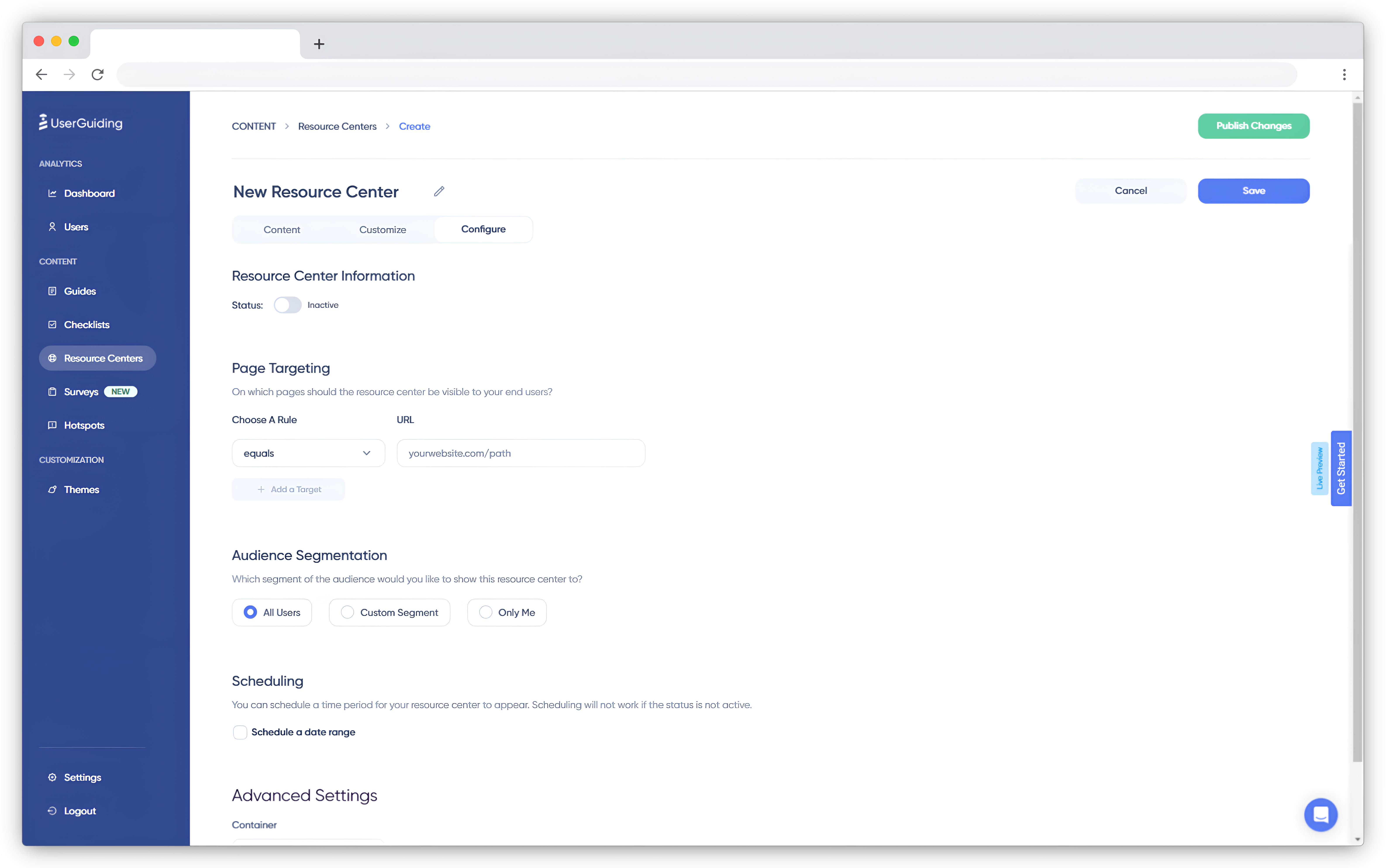
UserGuiding is built for teams that need to guide new users through the product AND collect NPS/CSAT without maintaining two separate tools or writing a line of code.
Its no-code editor lets non-technical team members build product tours, tooltips, and onboarding checklists without engineering support. NPS surveys and in-app polls live in the same platform as onboarding analytics, so you can see whether users who finished the setup checklist give higher NPS than those who didn't. That pairing is underrated. For teams needing pure survey mechanics with deep targeting rules, UserGuiding isn't the right fit, but for managing onboarding and feedback under one roof, it removes a lot of coordination overhead.
Key features
- No-code product tours, tooltips, hotspots, and checklists
- In-app NPS and survey collection within onboarding flows
- Onboarding analytics: completion rates, drop-off points, feature engagement
- Segmentation by behavior, role, or lifecycle stage
Pricing
- $174/month (billed annually); 14-day free trial
G2 Rating: 4.7/5 on G2
Best for
Product teams managing user onboarding who also want to collect NPS or CSAT without a separate survey tool.
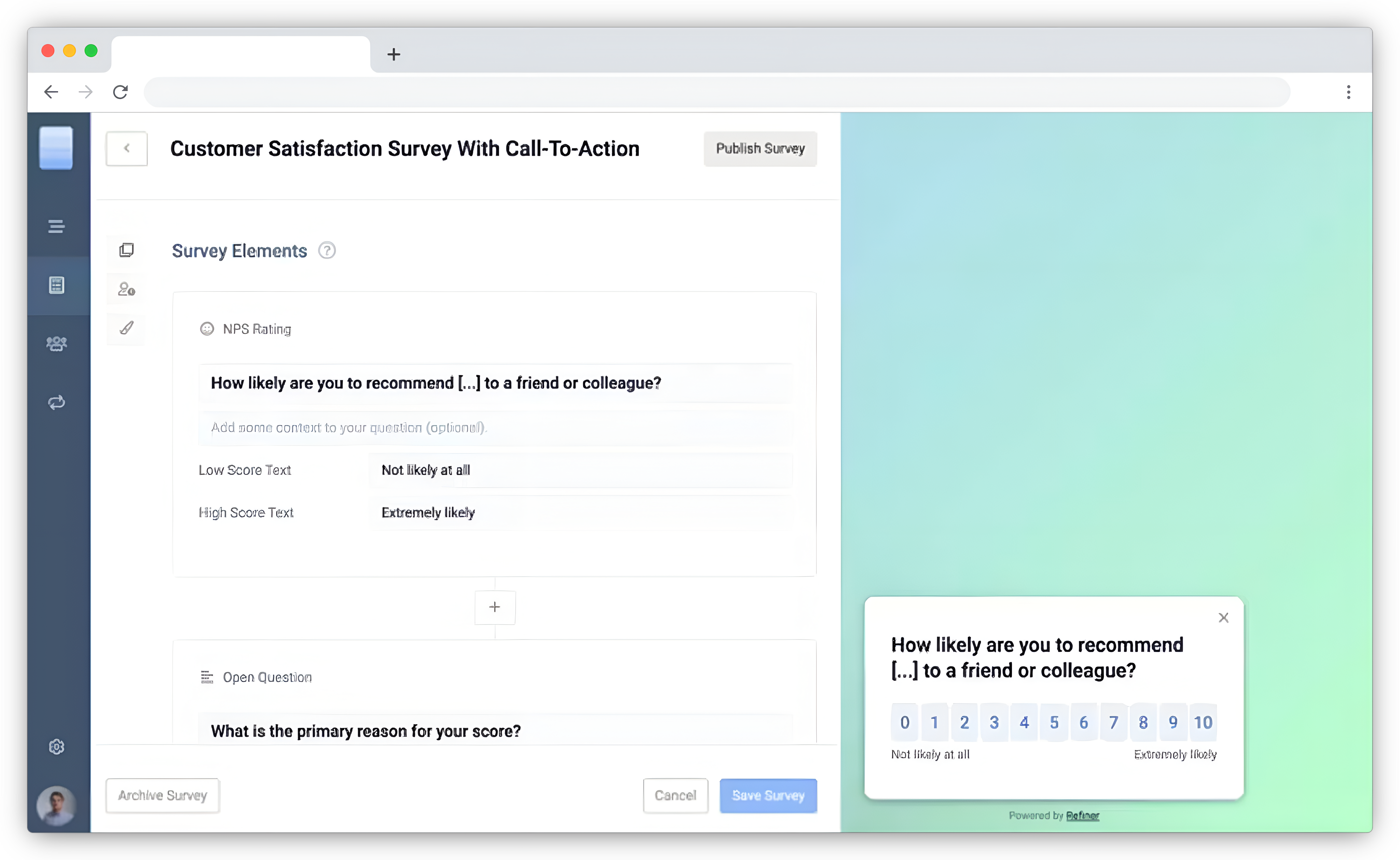
5. Refiner: Best for In-App Microsurveys and Precise User Segmentation
Refiner holds 4.6 stars from 100+ G2 reviews, with reviewers consistently citing targeting precision as the standout. That tracks.
Refiner's core strength is giving SaaS teams granular control over who sees a survey, when, and why. Rather than sending the same targeted surveys to everyone, you define specific user segments by plan tier, days since signup, feature usage, or custom attributes, triggering surveys at specific moments rather than on a timer. For a deeper look at how user segmentation works in practice, that guide covers the mechanics. For teams measuring PMF, churning users, or feature-specific satisfaction, that precision matters. Scoped to web and mobile apps; teams that need to reach users outside the product will need a second tool.
Key features
- In-app microsurveys with precise behavioral and attribute-based targeting
- NPS, CSAT, CES surveys plus custom question types
- AI response tagging for automated open-text categorization
- Recurring surveys for tracking satisfaction trends over time
Pricing
- $79/month
G2 Rating: 4.6/5 on G2
Best for
SaaS teams that need precise control over which users see which survey, when. Targeting rules that go beyond "show to everyone."
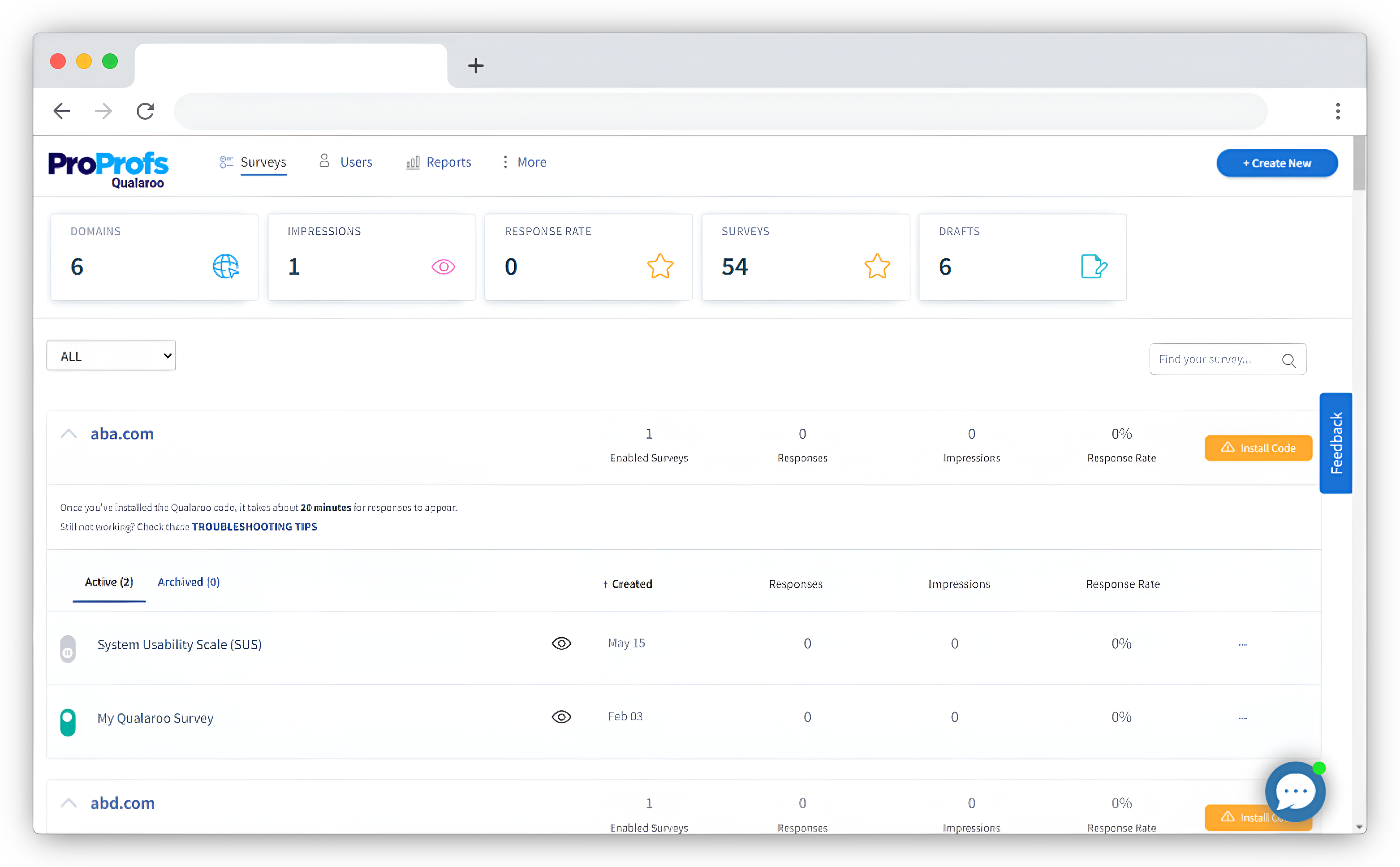
6. Qualaroo: Best for Contextual Nudge-Based Surveys
Qualaroo is the lowest-friction entry point in this category. A free plan, a $19.99/month paid tier, and a lightweight install that doesn't require developer setup make it the most accessible option for teams starting with in-product feedback.
Its "Nudge" feedback widget is a small, non-blocking prompt triggered by user behavior or scroll depth. IBM Watson scores user sentiment on open-text responses, which is unusual value at this price point. The tradeoff is visible in the ratings: 4.3/5 is the lowest G2 score in this list, with recurring notes about support quality. Strong for getting started; teams scaling past basic use cases often outgrow it.
Key features
- Behavior-triggered "Nudge" prompts for web and mobile
- IBM Watson sentiment analysis on open-text responses
- Prototype testing: collect feedback on UI changes before launch
- 100+ survey templates including NPS, CSAT, onboarding, and exit intent
Pricing
- Free plan available; paid from $19.99/month per 100 responses
G2 Rating: 4.3/5 on G2
Best for
Teams starting out with in-product feedback who need a low-cost, low-friction entry point with no deep integrations required.
7. Typeform: Best for Conversational Survey Experiences
Typeform takes a different approach to feedback forms: one question at a time, in a conversational flow built on interactive forms that feel less like a survey and more like a dialogue. That presentation drives higher completion rates than traditional multi-question surveys, particularly for standalone surveys and email-embedded links.
It's not built for in-app behavioral triggering in the same way as Refiner or Qualaroo. For product teams running onboarding surveys, churn interviews, or feature validation studies, where the survey lives in an email or a dedicated link not inside the product, Typeform's completion rates and design quality are hard to match at this price. Logic jumps let you build conditional flows that adapt based on responses, so users only see questions relevant to them.
Key features
- Conversational one-question-at-a-time format with high completion rates
- Logic jumps: conditional branching based on previous answers
- 800+ templates including NPS, exit surveys, and PMF
- Integrations with HubSpot, Salesforce, Zapier, Slack, Notion
Pricing
- Free plan available; paid from $29/month
G2 Rating: 4.5/5 on G2
Best for
Product teams running email-distributed or standalone surveys: onboarding feedback, churn reasons, PMF. Not the primary choice for behavioral in-app triggering.
8. Survicate: Best for In-App and Website Surveys with Native CRM Integrations
Survicate sits between lightweight tools like Qualaroo and fuller platforms like Refiner or Zonka. Its standout is integration depth: native two-way sync with HubSpot and Intercom means survey responses flow directly into your CRM and support tool without manual exports or Zapier workarounds.
The AI analysis layer automatically tags and categorizes open-text responses. Surveys run across in-app, website, email, and link channels, a broader app feedback distribution surface than most pure in-app tools. The jump from the free plan (25 responses/month) to the first paid tier is steep at $114/month, which makes it harder to evaluate properly before committing.
Key features
- Multichannel surveys: in-app, website, email, and shareable link
- Native two-way HubSpot and Intercom integration
- AI-powered response tagging and categorization
- NPS, CSAT, CES, and behavioral trigger support
Pricing
- Free plan (25 responses/month); paid from $114/month
G2 Rating: 4.6/5 on G2
Best for
Teams already on HubSpot or Intercom who want survey responses to sync directly into their CRM without custom integrations.
c. What Are the Best Feature Request and Roadmap Tools?
The best feature request and roadmap tools are Canny and UserVoice. Unlike survey tools that measure how users feel about what exists, these tools capture what users want built next and help teams communicate back what's actually in progress. Canny and UserVoice are the two tools in this category worth evaluating for most product teams and are only covered here, not elsewhere in this cluster.
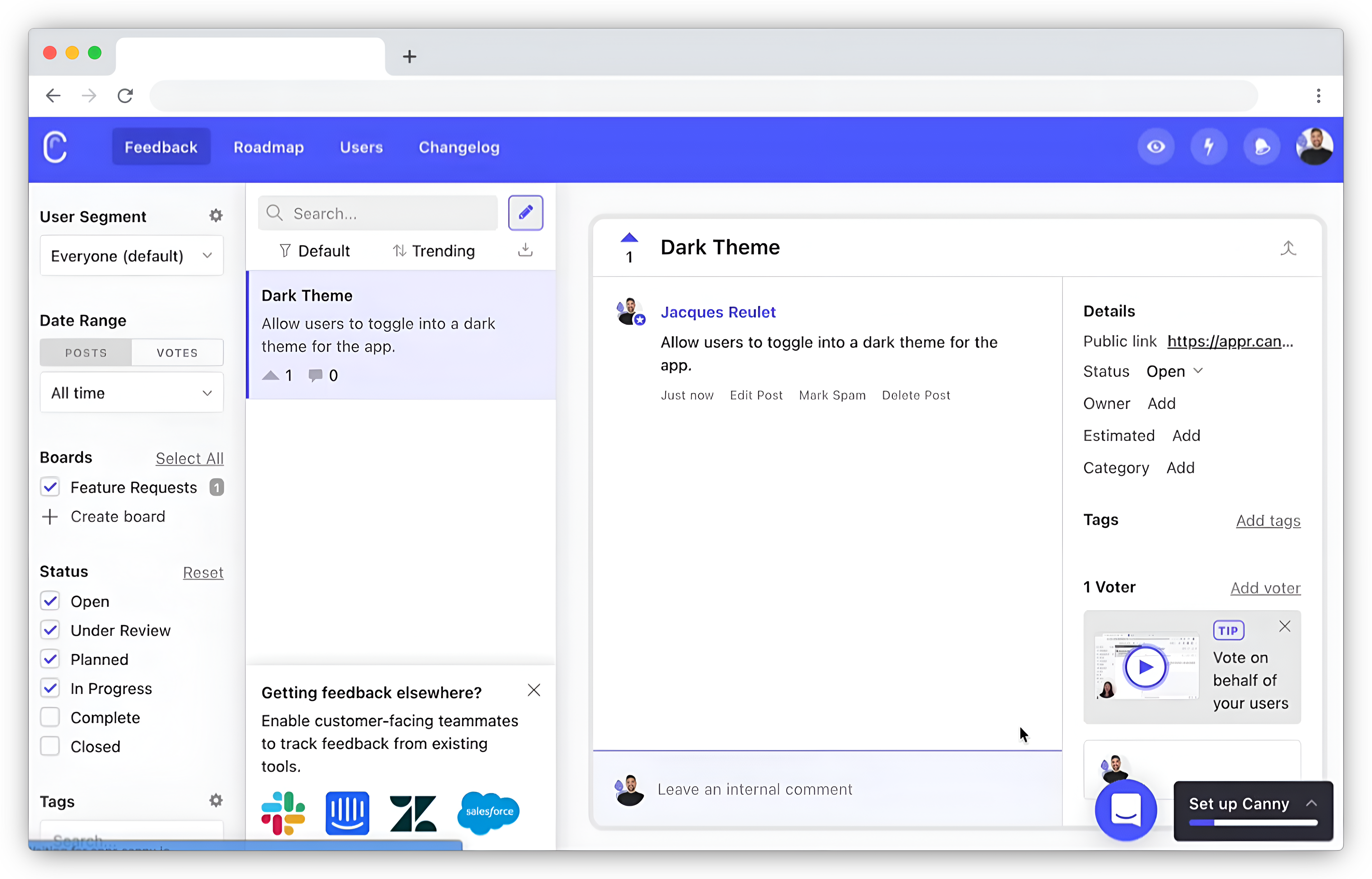
9. Canny: Best for Feature Voting and Roadmap Transparency
Canny is built for product teams that want users to see their feature requests go somewhere, not disappear into a black hole.
Its feedback boards let users submit ideas, upvote existing requests, and comment. Product teams organize submissions by status and trigger automatic notifications when a requested feature ships. That last part, telling users their request was actually built, is where most teams fail, and Canny handles it without any manual effort. In February 2026, Canny launched an MCP server allowing AI tools to query feedback data and automate workflows. Voting boards require active user engagement to function well; they don't work passively.
Key features
- Feature voting boards (public or private) with comment threads
- Automated user notifications when requested features ship
- Public roadmap with status tracking: planned, in progress, complete
- MCP server integration for AI tool access (launched Feb 2026)
Pricing
- Free plan available; paid from $79/month
G2 Rating: 4.6/5 on G2
Best for
Product teams that want users to feel heard, with a transparent roadmap and automatic updates when their requests ship.
10. UserVoice: Best for Enterprise Feature Request Management
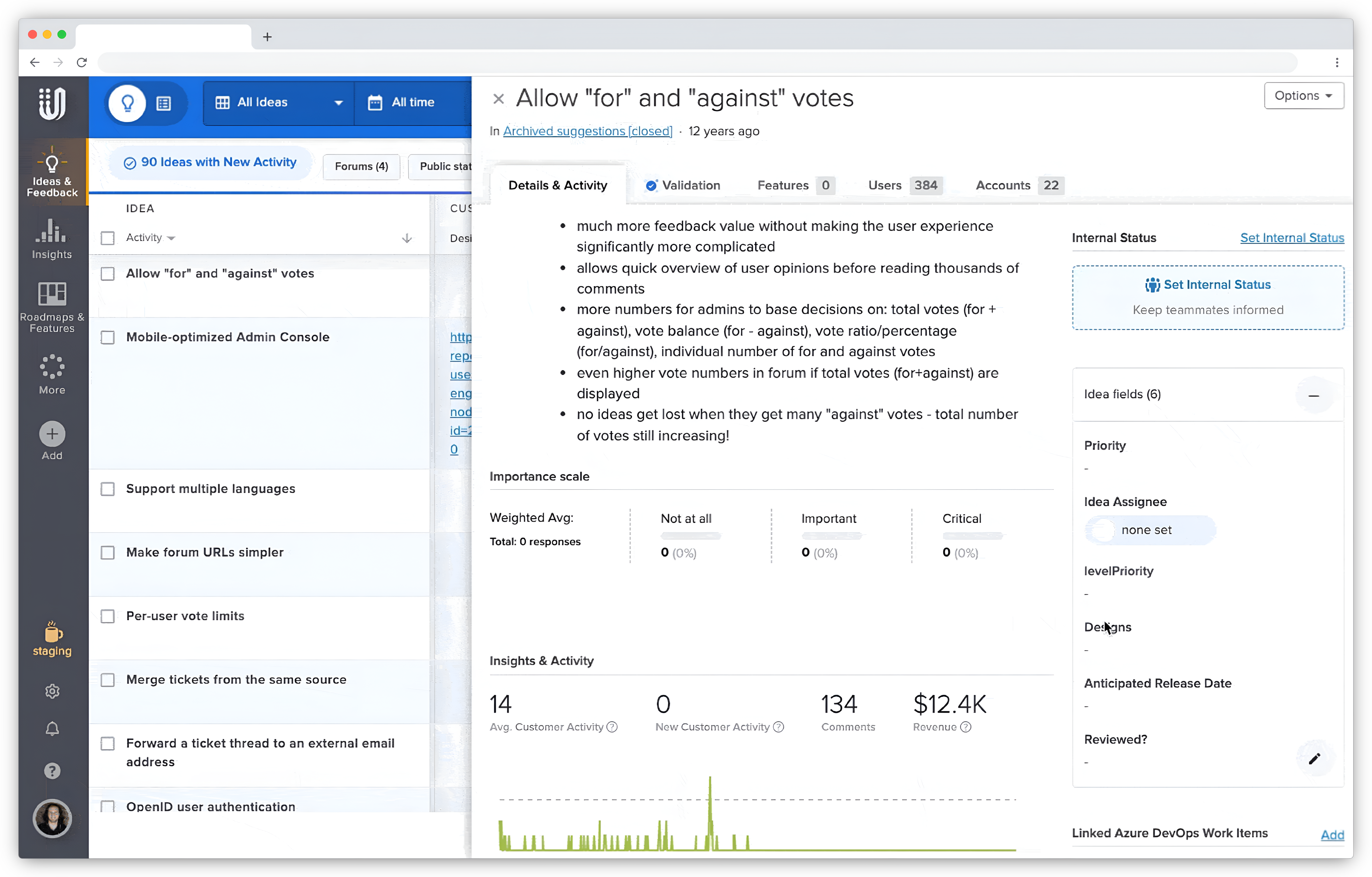
UserVoice is what Canny looks like when the use case is a 200-person product org, not a 20-person startup.
The platform handles structured feedback collection, idea consolidation, and stakeholder alignment across multiple product lines. The consolidation engine identifies duplicate requests across support tickets, sales calls, and direct submissions, rolling them up so product teams see true demand, not just the loudest voices. At $16,000/year to start, it prices for organizations where feedback management is a formal, cross-functional process. For teams not yet at enterprise scale, start with Canny and revisit when the complexity warrants it.
Key features
- Idea consolidation across support tickets, sales notes, and direct submissions
- Feedback prioritization scoring based on request volume, revenue impact, and strategic fit
- In-app feedback widgets for contextual collection
- Stakeholder alignment tools for cross-team roadmap visibility
Pricing
- $16,000/year (per official pricing page, March 2026)
G2 Rating: 4.5/5 on G2
Best for
Enterprise product teams managing feedback across multiple product lines where consolidation and alignment matter more than collection mechanics.
d. What Are the Best User Research and Testing Tools?
The best user research and testing tools are Sprig and UserTesting. Where surveys tell you what users think, research tools tell you why they behave the way they do, which is the question that needs answering before building, not after shipping.
11. Sprig: Best for In-Product Qualitative Research
If there's one tool in this list that's evolved the most in the last two years, it's Sprig.
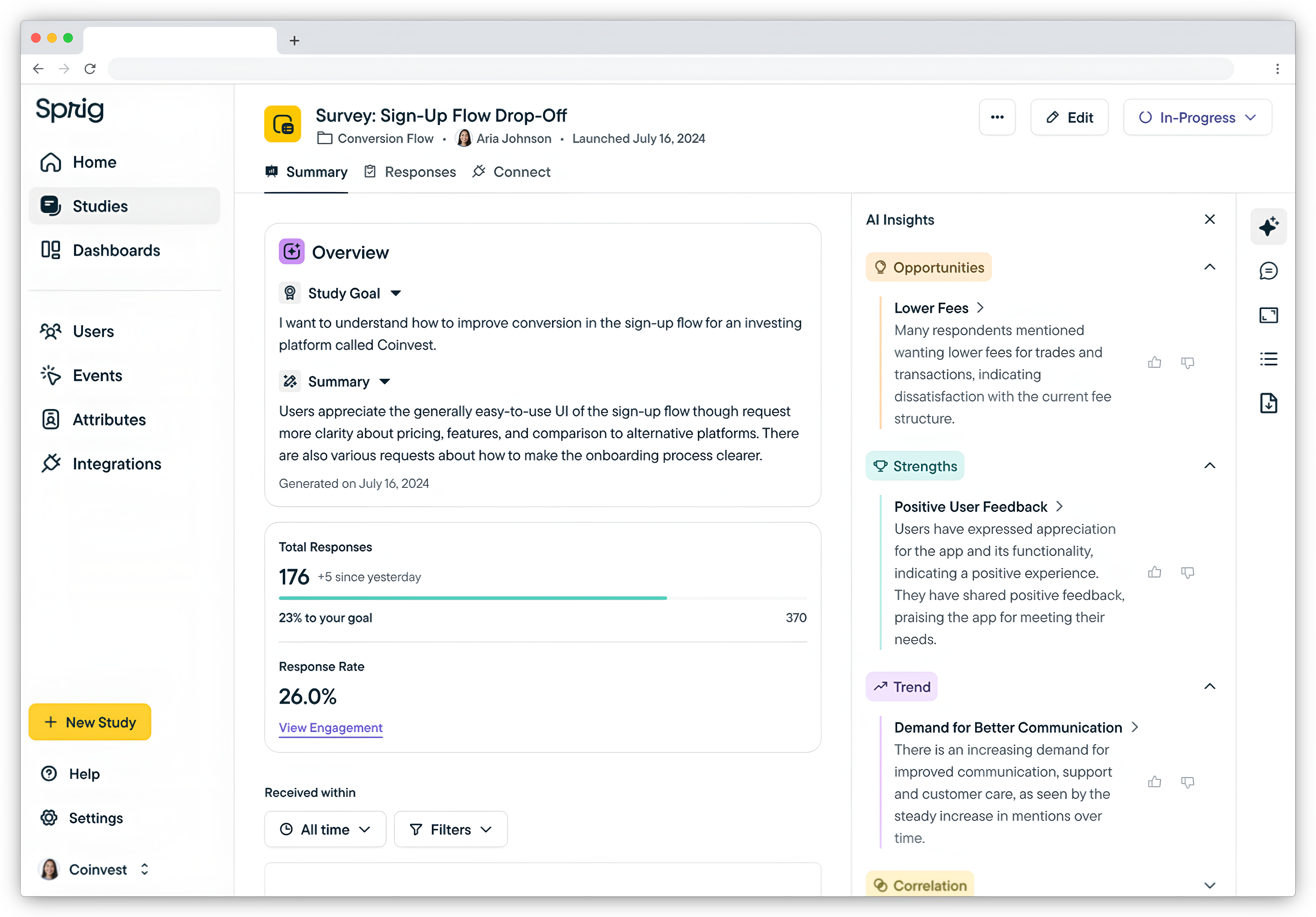
What started as an in-product survey tool is now closer to a research platform: in-product surveys combined with session replays, heatmaps, and AI that summarizes findings in real time. Instead of reading 300 survey responses and watching 50 session replays separately, Sprig connects them: you can see exactly what users were doing when they gave a specific rating. The AI summary layer clusters open-text responses into themes automatically and surfaces what's changed across runs without manual comparison. Usage-based pricing means costs scale quickly at volume, worth factoring in if you run beta testing survey programs at scale.
Key features
- In-product surveys with behavioral triggers and session replay in one platform
- AI theme detection and real-time summaries across open-text responses
- Heatmaps for feature-level interaction analysis
- Continuous feedback: run recurring studies and track changes over time
Pricing
- Free tier available; paid from $175/month
G2 Rating: 4.5/5 on G2
Best for
Product teams running continuous discovery who want to understand both what users say and what they do, without toggling between two systems.
12. UserTesting: Best for Moderated Usability Testing
UserTesting is not a survey tool. Don't evaluate it like one.
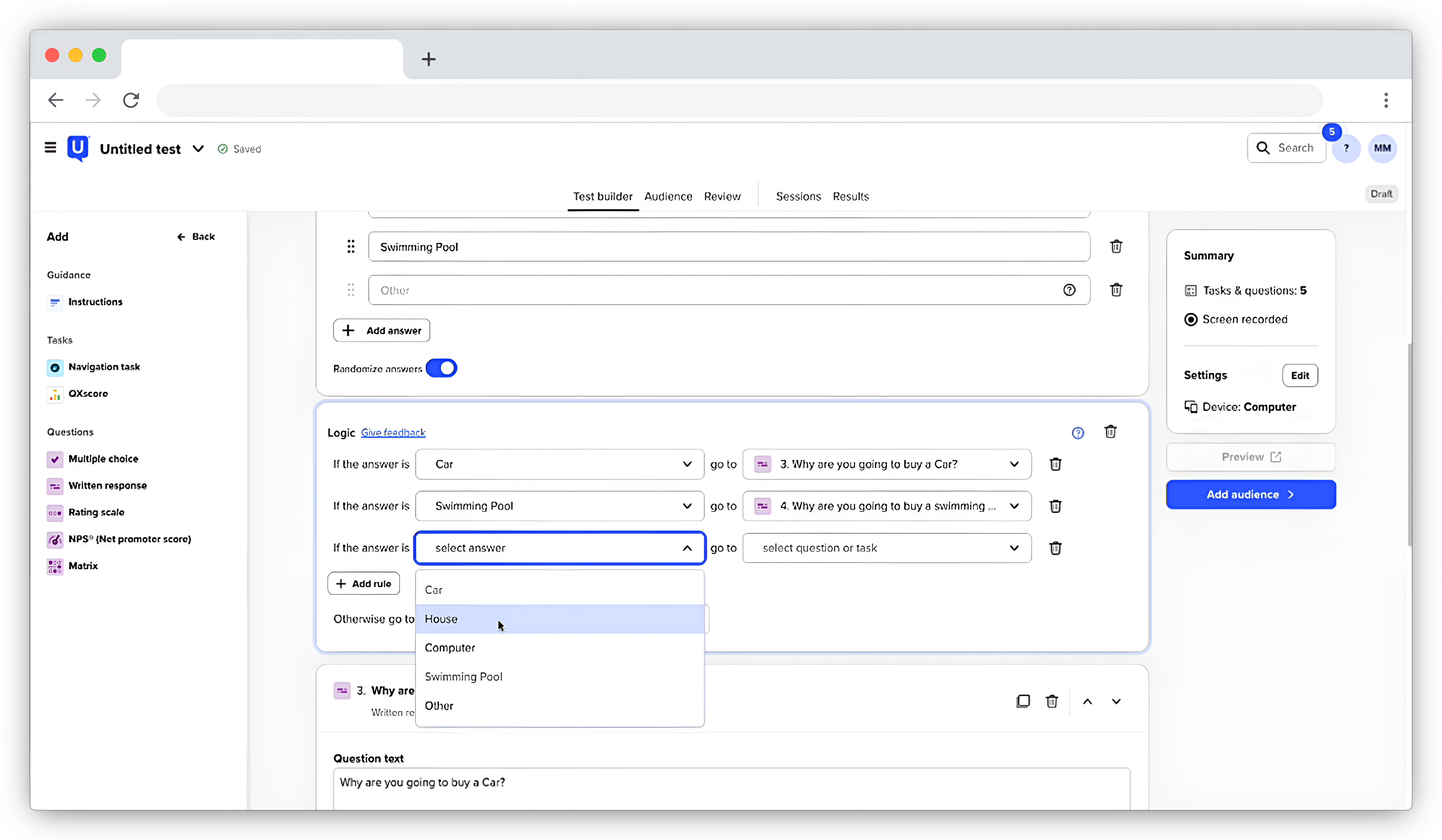
It's built for one thing: watching actual users use your product on camera. That's the fastest way to find problems no survey would ever surface: the confusion on a user's face when they can't find a button, the hesitation before they abandon a workflow, the workaround nobody on the product team knows exists. The platform handles participant recruitment, study design, moderated and unmoderated sessions, and analysis tools for reviewing recordings. If you're a 10-person startup, start with Sprig. If you're a 200-person org with a research function, UserTesting operates at a different level entirely.
Key features
- Live moderated testing sessions with real users on camera
- Unmoderated studies with recorded sessions and automatic transcripts
- Participant recruitment from UserTesting's panel or your own users
- AI analysis: auto-highlights, sentiment markers, clip reels from sessions
Pricing
- Contact sales
G2 Rating: 4.4/5 on G2
Best for
Mid-to-large product teams with a research function who need direct observation of real users, especially before major launches or redesigns.
e. What Are the Best Visual Feedback and Bug Reporting Tools?
The best visual feedback and bug reporting tools are Usersnap, Userback, and Marker.io. Instead of asking someone to describe a problem in text, these tools let them show it: annotated screenshots, screen recordings, and automatically captured technical metadata. No more "what browser were you using?" back-and-forth.
13. Usersnap: Best for Screenshot-Based Bug Reporting and In-App Feedback
Usersnap does two things in one tool that most teams handle separately: visual bug reporting and in-app NPS/CSAT collection. For teams that don't want separate platforms for QA and satisfaction tracking, that combination has real operational value.
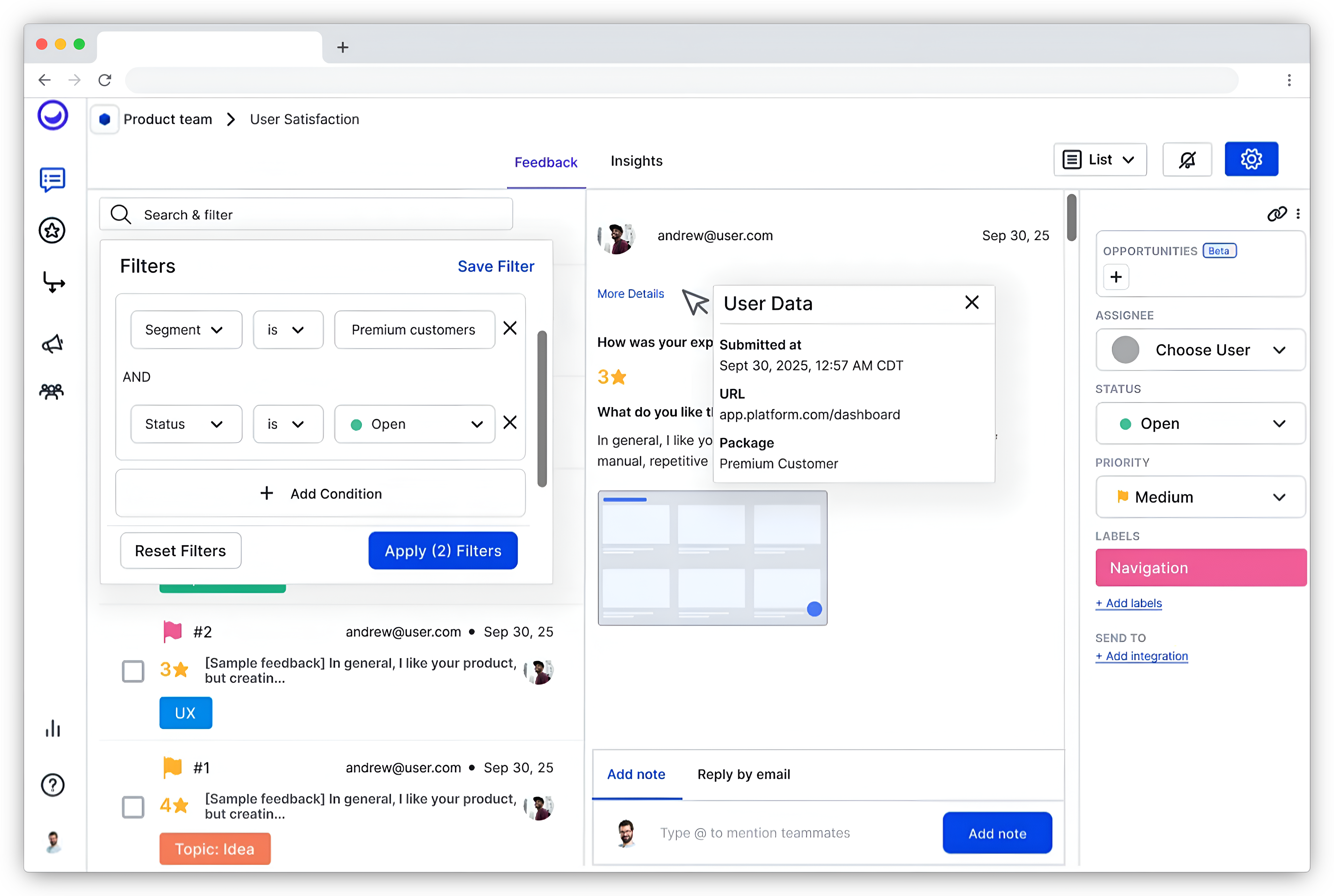
Users annotate screenshots directly in the product, add comments, and submit, with browser, OS, and URL metadata captured automatically. Feedback widgets are customizable and targetable by user segment. G2 reviewers consistently cite setup speed and report clarity as strengths. The recurring critique is navigation: multiple reviewers describe the interface as functional but unintuitive on first setup.
Key features
- Annotated screenshot and screen recording capture with automatic metadata
- Customizable NPS, CSAT, and feedback widgets
- User targeting: show feedback prompts to specific segments
- Integrations with Jira, Asana, Slack, GitHub, Trello
Pricing
- $42/month; free trial available
G2 Rating: 4.5/5 on G2
Best for
Small to mid-sized product teams that want visual bug reporting and NPS/CSAT collection in one tool, without separate platforms for each.
14. Userback: Best for Visual Feedback and Issue Tracking
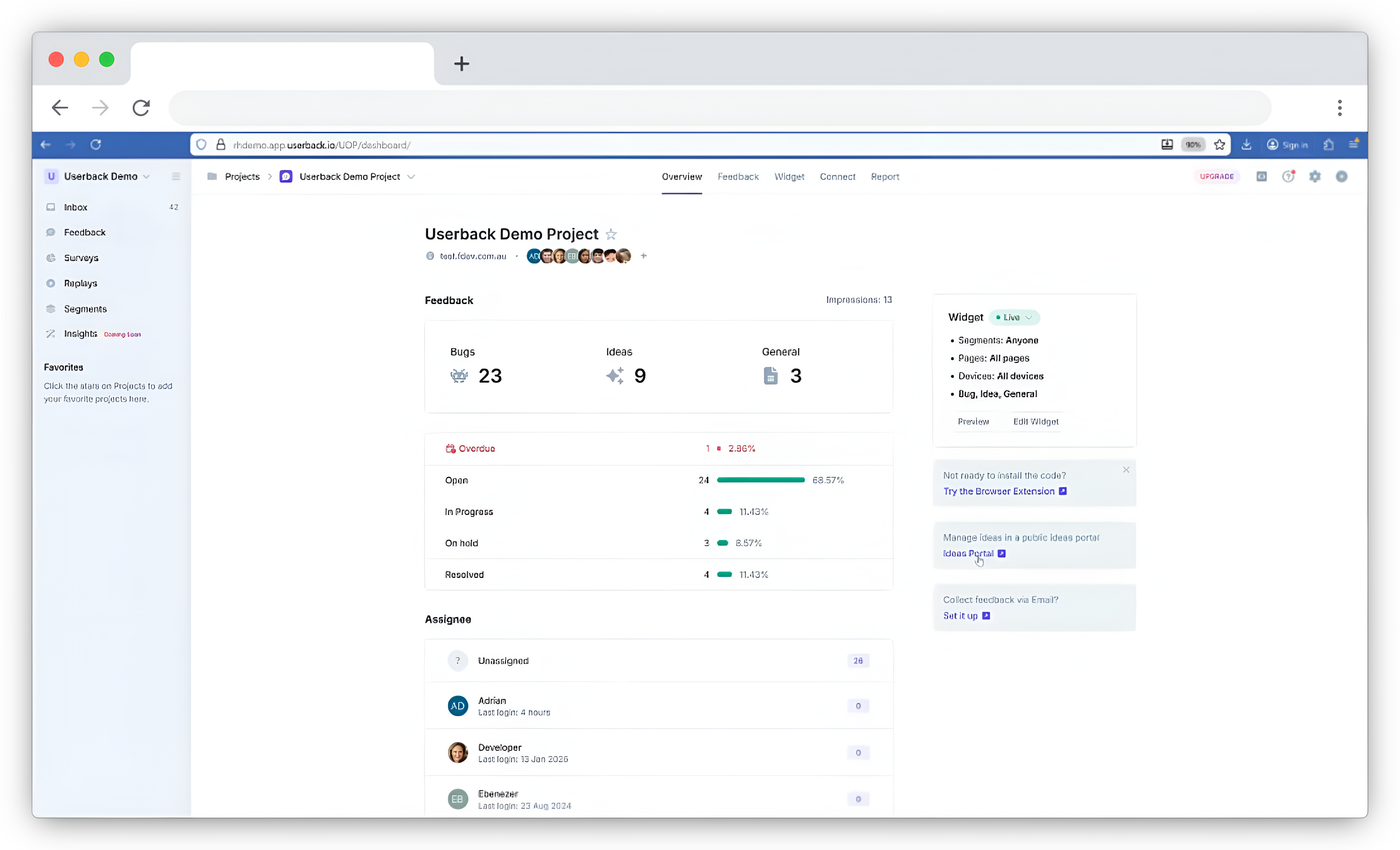
Userback has the richest feature set in the visual feedback category: annotated screenshots, session replays, video recordings, customizable feedback widgets, and a REST API for custom integrations.
The session replay is particularly useful for issue resolution. It shows exactly what the user was doing before the bug occurred, not just the error screenshot, which cuts back-and-forth between users and developers significantly. The REST API sets it apart from most tools at this price point. Where others limit you to their existing integration list, Userback lets teams build whatever connection they need for non-standard stacks.
Key features
- Annotated screenshots, video recordings, and session replays
- REST API for custom integrations
- Session replay tied to specific feedback submissions
- Integrations with Jira, Slack, Trello, ClickUp, GitHub, Monday.com
Pricing
- $49/month; free trial available
G2 Rating: 4.7/5 on G2
Best for
Product and engineering teams that need visual context in bug reports, especially those with non-standard tool stacks who need API flexibility.
15. Marker.io: Best for Website Bug Reporting with Technical Metadata
Marker.io has the highest G2 rating in this entire list: 4.8/5. And the tightest scope.
It does one thing exceptionally well: capturing website and app bugs with complete technical context, automatically. When a user submits feedback through the widget, Marker.io captures the screenshot, browser type, OS, screen resolution, URL, and browser console logs. No follow-up questions. Everything arrives in your project management tool the moment they submit. Not a survey platform: no NPS, no CSAT. Teams needing both visual bug reporting and satisfaction surveys will need a second tool for the survey side.
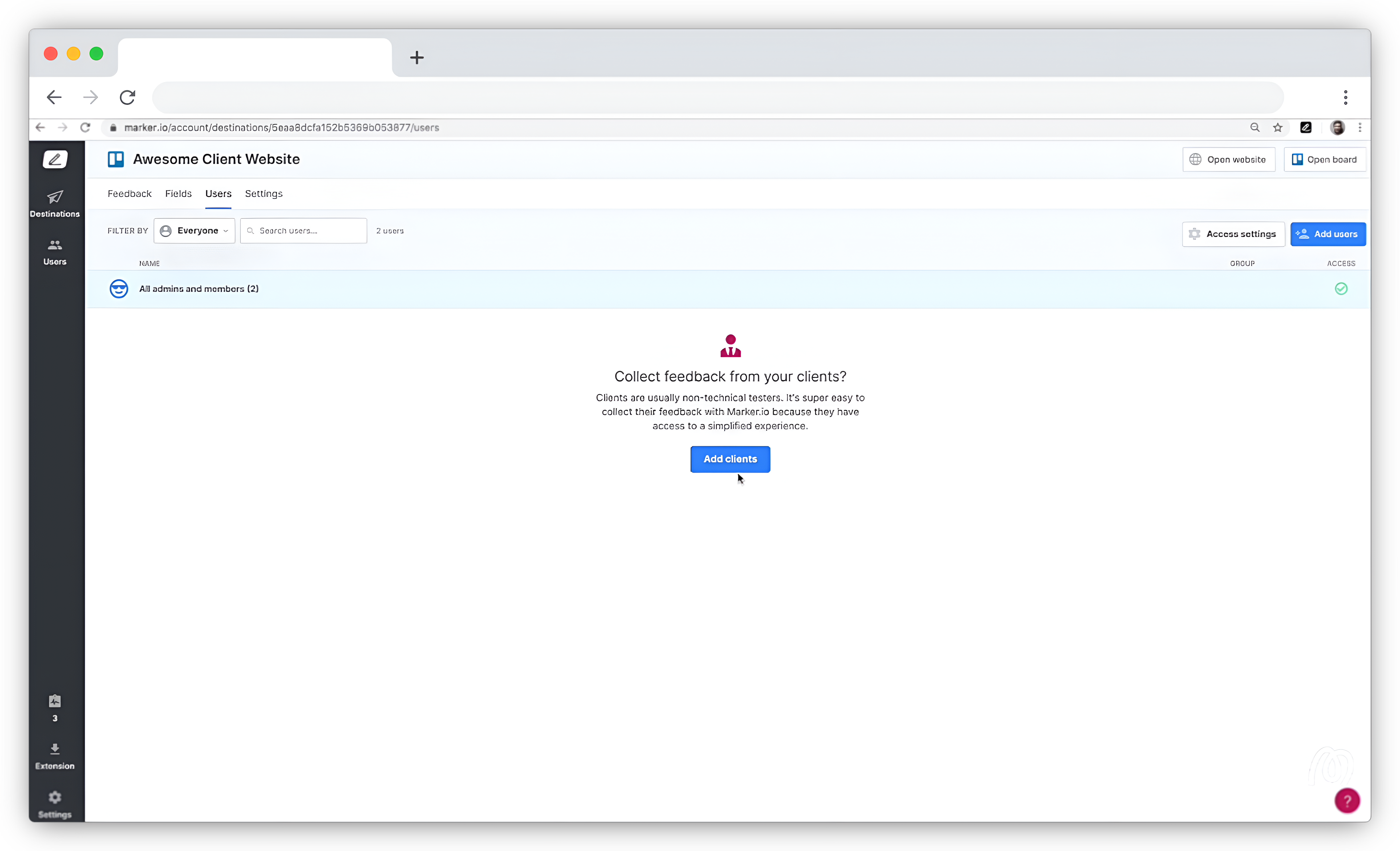
Key features
- Widget-based screenshot capture with annotation tools
- Automatic capture of browser, OS, URL, screen resolution, and console logs
- Session replay for reviewing the user journey before the issue occurred
- Direct integration with Jira, Trello, GitHub, Asana, ClickUp
Pricing
- $39/month; free trial available
G2 Rating: 4.8/5 on G2
Best for
Digital agencies, QA teams, and product teams doing client review cycles who need bug reports with complete technical context, without the screenshot back-and-forth.
f. What Are the Best Behavior Analytics and Session Replay Tools?
The best behavior analytics and session replay tool for product teams is Hotjar. Rather than asking users what they think, it shows you what they actually do: where they click, where they stop, where they drop off. Heatmaps tell you where the problem is; surveys tell you why it exists.
16. Hotjar: Best for Heatmaps, Session Replay, and Lightweight In-App Surveys
Hotjar is the default starting point for behavior analytics, present in every major product feedback comparison for a reason.
Heatmaps show where users click, move, and scroll. Session recordings let you watch exactly how individual users navigate your product. Together they're the clearest tool available for understanding user behavior without asking a single question. The on-site survey and feedback widgets layer lightweight prompts on top of the behavioral data. In July 2025, Hotjar merged into Contentsquare. The product continues to operate as Hotjar by Contentsquare, with legacy plans still available and a new unified Contentsquare Growth tier rolling out. Hotjar's surveys are lightweight, best for quick exit-intent questions or NPS prompts, not complex multi-branch feedback programs. For teams that need in-app feedback tools with full mobile SDK support, other options in this list (Zonka Feedback, Refiner, Sprig) have stronger mobile coverage.
Key features
- Heatmaps (click, move, scroll) for any page
- Session recordings to watch individual user journeys
- On-site surveys and feedback widgets with targeting rules
- Funnel analysis to identify where users drop off
Pricing
- Free plan (35 sessions/day); Observe Plus from $32/month (annual); unified Contentsquare Growth from $49/month
G2 Rating: 4.6/5 on G2
Best for
Product and UX teams that want to understand where users struggle before designing surveys to find out why. Pairs naturally with any survey tool in this list.
When Should You Use Multiple Product Feedback Tools?
Most tool comparison guides assume you're picking one. Most product teams end up running two or three. The combination matters as much as the individual tools.
The pairings that actually work:
- In-app microsurveys + feature request board. Zonka Feedback or Refiner for capturing NPS/CSAT in the product, plus Canny for structured feature management. If you're evaluating dedicated customer satisfaction tools alongside these, that comparison covers the CSAT-specific category. These solve different problems: one measures sentiment at a moment in time, the other captures ideas and communicates what you're building. The overlap is minimal.
- Behavior analytics + survey layer. Hotjar for heatmaps and session replay, plus Qualaroo or Refiner for contextual surveys. Hotjar shows you where users stop. The survey asks why.
- Product analytics + lightweight survey layer. Pendo handles both natively. But teams already on Amplitude or Mixpanel often prefer keeping their existing analytics stack and adding a dedicated survey tool on top, with less migration overhead and a similar outcome.
- Microsurveys + visual bug reporting. A survey tool covers satisfaction and friction signals; Marker.io or Usersnap handles the specific "something is broken right now" moment. These categories don't compete. They cover different user moments entirely.
Where teams go wrong:
Over-stacking is more common than under-buying. The warning sign: feedback lives in more places after buying the new tools than before. That's not a tooling success. It's fragmentation with a higher invoice.
A useful test before adding another tool: can you name who reviews feedback from each existing tool, and what action they take when something comes in? If the answer is unclear, no new tool fixes that. Start with how to close the feedback loop before adding to the stack. If you can name that person and that action, the tool is earning its place. If you can't, buying something additional won't fix it.
Which Product Feedback Tool Is Right for Your Team?
There's no single best product feedback tool. The right choice depends on what you're actually trying to do with user input and whether your team has the bandwidth to act on it consistently.
For in-app feedback with AI analysis depth, look at Pendo or Zonka Feedback. For NPS tools for SaaS teams specifically, that guide narrows the field to loyalty-focused use cases. For managing feature requests transparently, Canny at low volume or UserVoice at enterprise scale. For understanding why users behave a certain way before you build, Sprig and UserTesting give you that depth. For capturing UI bugs with technical context so developers can reproduce them fast, Marker.io and Usersnap are the tightest fit. For behavior analytics layered with lightweight surveys, Hotjar is the lowest-friction starting point.
For teams building out a full product feedback program, not just picking tools, the framework around how you collect, route, and act on feedback matters as much as the tools themselves.
The tool only does its job when the habit behind it does too.