.svg)
 Healthcare
 Finance
 Retail
 SaaS & Digital
 eCommerce
 Education
 Salesforce
  HubSpot
 Pipedrive
 Mailchimp
 Zendesk
  Intercom
 Freshdesk
 HelpScout
  Front
Front Jira
Jira Slack
Slack  MS Teams
 Zoom
Zoom Google Sheets
  Zapier
  Integrately
 Make
Make  Webhooks




 MS Teams


TL;DR
- NPS tools for Salesforce help you measure customer loyalty, trigger automated surveys from CRM events, and sync scores and comments directly to Contacts, Accounts, Opportunities, and Cases.
- This guide reviews 12 NPS tools grouped into two categories: Native Salesforce tools (10) and iPaaS/Middleware tools (2).
- Top picks by use case:
- Zonka Feedback: best for AI feedback intelligence with native multi-object Salesforce mapping
- Survicate: best for email-embedded NPS with flexible field-level Salesforce sync
- SurveyVista: best for 100% Salesforce-native data residency (data never leaves your org)
- SurveySparrow: best for conversational NPS surveys via AppExchange
- Each tool is evaluated for Salesforce integration depth, trigger automation, AI capabilities, multi-channel coverage, and pricing.
Most teams searching for NPS tools for Salesforce already know they need one. The question isn't whether to measure loyalty inside your CRM. It's which tool actually writes scores back to the right objects, fires surveys from the right triggers, and gives your team something to act on: not just a number in a dashboard nobody checks after the first week.
That distinction matters more than it sounds. We've evaluated Salesforce NPS integrations across dozens of implementations, and the gap between tools that connect to Salesforce and tools that work inside Salesforce is where most programs quietly fail. A score that lands on the wrong object, a survey that fires too late, a Detractor alert that routes to nobody: these aren't edge cases. They're the default outcome when the integration is shallow.
IDC's 2025 Worldwide Semiannual Software Tracker ranked Salesforce the #1 CRM provider for the 12th consecutive year, with a 20.7% global market share and over 150,000 customers worldwide. In simple terms: if you're running CX, sales, or service operations, the odds are strong that Salesforce is already your system of record. Your NPS tool needs to meet you there.
This guide compares the 12 best NPS tools for Salesforce in 2026, grouped by integration type (native vs. iPaaS), and evaluated for mapping depth, trigger reliability, AI capabilities, and closed-loop workflows inside the CRM.
Best NPS Tools for Salesforce in 2026: Quick Comparison
The strongest Salesforce NPS tools in 2026 are Zonka Feedback for AI-powered feedback intelligence with native multi-object mapping, Survicate for email-embedded NPS with flexible field-level Salesforce sync, SurveySparrow for conversational surveys distributed through AppExchange workflows, and SurveyVista for teams that need 100% Salesforce-native data residency with zero third-party transfers.
| NPS Tool | Category | Best For | Integration Type | G2 Rating | Pricing |
| Zonka Feedback | Native | AI feedback analysis + native Salesforce mapping | Native, bi-directional | 4.7/5 | Custom quote |
| Survicate | Native | Email-embedded NPS + Salesforce field mapping | Native, bi-directional | 4.6/5 | From $56/mo |
| SurveySparrow | Native | Conversational NPS + AppExchange distribution | Native (AppExchange), bi-directional | 4.4/5 | ~$19–$49/mo |
| SurveyVista | Native | 100% Salesforce-native (data stays in your org) | 100% native, built on Salesforce | 4.9/5 | Annual per org |
| Typeform | Native | On-brand NPS forms + lead capture | Native (AppExchange), bi-directional | 4.5/5 | From $25/mo |
| Sogolytics | Native | Enterprise feedback with bi-directional sync | Native (AppExchange), bi-directional | 4.6/5 | Contact for quote |
| Delighted | Native | Simple NPS (sunsetting — migration needed) | Native package, bi-directional | 4.7/5 | ~$25–$100/mo |
| GetFeedback | Native | Salesforce-native CX surveys (sunsetting Dec 2026) | Native (Salesforce-built) | NA | Legacy pricing |
| Alchemer | Native | Enterprise workflows + compliance | Push-pull native | 4.4/5 | Contact sales |
| QuestionPro | Native | Flexible multi-metric CX programs | Push-pull native, AppExchange app | 4.5/5 | Contact sales |
| Retently | iPaaS | B2B SaaS and ecommerce NPS with AI insights | Native on Enterprise; Zapier on lower plans | 4.7/5 | $49–$99/mo |
| SatisMeter | iPaaS | In-app NPS for PLG SaaS teams | Zapier/Segment (no native connector) | 4.7/5 | From $49/mo |
How We Evaluated These NPS Tools for Salesforce
We're the team behind Zonka Feedback, so we want to be upfront about that. This guide is based on hands-on research, official documentation, recent G2 reviews, and real feature testing. Tools are not ranked: we aimed for a research-driven evaluation that helps you pick the right fit for your team.
Every tool was assessed on five criteria: Salesforce integration depth (native vs. iPaaS, object mapping, bi-directional sync), survey trigger flexibility (event-driven automation from Flows, Process Builder, or Apex), AI and analytics capabilities (sentiment, themes, urgency detection), multi-channel coverage (email, SMS, in-app, web, WhatsApp), and pricing transparency.
We evaluated each tool's actual Salesforce connector, not just its marketing claims. That meant testing how responses map to standard objects (Contacts, Accounts, Cases, Opportunities) and custom objects, how triggers fire from Salesforce Flows, and whether NPS scores, comments, and metadata sync in real time or with delay. We also checked G2 reviews for integration-specific feedback and cross-referenced current pricing from official sources.
For a broader view of how surveys work inside the CRM, our complete guide to Salesforce surveys covers the full landscape beyond NPS.
What Is an NPS Tool for Salesforce?
An NPS tool for Salesforce is a survey platform that connects directly to your Salesforce CRM to measure customer loyalty, trigger automated Net Promoter Score surveys, and sync feedback into the objects your teams use daily: Contacts, Accounts, Opportunities, and Cases.
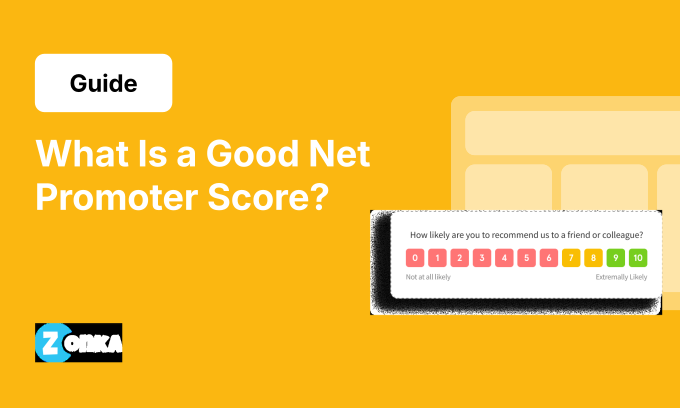
The Net Promoter System was created in 2003 by Fred Reichheld at Bain & Company as a framework for measuring customer loyalty. The methodology classifies customers into three groups based on a single question ("How likely are you to recommend us?"): Promoters (9–10), Passives (7–8), and Detractors (0–6). Your NPS is calculated by subtracting the percentage of Detractors from the percentage of Promoters.
Research from Bain & Company has consistently shown that companies with strong closed-loop NPS programs outperform competitors. One often-cited example: Bain's analysis of Dell found that Detractors cost the company $57 per customer while Promoters generated $328 in value, and converting just 2–8% of Detractors into Promoters could have added $167 million in annual revenue.
When connected to Salesforce, an NPS tool turns that framework from a measurement exercise into an operational system. You can trigger surveys automatically from CRM events (case closed, deal won, onboarding complete), sync scores and comments back to customer records in real time, build closed-loop workflows so Detractors get followed up inside Salesforce, and analyze loyalty trends across accounts and lifecycle stages without leaving the CRM.
The practical difference between NPS collected inside Salesforce and NPS collected in a standalone tool: when a sales rep opens a contact record, they already see the loyalty signal. No dashboard-hopping. No exports. The score lives where the relationship lives.
How to Choose the Right Salesforce NPS Tool
Not every NPS tool connects to Salesforce the same way. Some offer native AppExchange packages that write directly to CRM objects. Others rely on Zapier or middleware to pass data through. The gap between those two approaches determines whether your NPS program actually works inside Salesforce or just sends data in its general direction.
Here are 5 decision factors that matter most:
1. Integration depth: native vs. iPaaS. A native Salesforce integration writes NPS scores, comments, and metadata directly to Contacts, Accounts, Cases, Opportunities, or custom objects. An iPaaS integration (Zapier, Make) routes data through middleware, which introduces sync delays and mapping limitations. If Salesforce is your team's daily workspace, native wins. We've seen teams abandon iPaaS-based NPS setups within six months because the lag between survey response and CRM update made the data feel stale.
2. Trigger and automation fit. The best Salesforce NPS tools fire surveys automatically from CRM events: case closed, opportunity won or lost, onboarding milestone hit, renewal approaching. If your tool requires manual list uploads or batch sends instead of event-driven triggers, your feedback will always lag behind the moments that shape customer perception. Salesforce Flows support event-driven triggers natively, so your NPS tool should hook directly into that automation layer.
3. AI and analytics maturity. A score without context is just a number. Qualtrics' 2025 Consumer Trends research found that consumers are increasingly less likely to share direct feedback: 8 points less likely compared to 2021. When fewer customers are telling you what's wrong, your tool needs to extract more meaning from the responses you do get. Look for theme detection across open-text responses, sentiment analysis, urgency or churn-risk signals, and AI-generated summaries that tell your team what to fix.
4. Channel coverage. Your customers don't all respond to the same channel. Email NPS works for post-interaction surveys, but in-app NPS catches users at the moment of experience. SMS and WhatsApp reach customers who ignore email. The right tool matches the channels your customers actually use.
5. Pricing and scalability. Some tools charge per response, others per seat, and a few charge specifically for the Salesforce integration as an add-on. Check what's included before committing. A tool that looks affordable at 500 responses per month can become expensive at 5,000.
A quick decision shortcut: if your team needs NPS running inside Salesforce by next week with minimal setup, prioritize native tools with pre-built triggers. If you're building a long-term, multi-metric CX program across departments, prioritize integration depth and AI analytics over speed of setup.
12 Best Salesforce NPS Tools in 2026
Native Salesforce NPS Tools
These tools offer direct Salesforce connectors with object mapping, event-driven triggers, and real-time or near-real-time sync. They're the stronger choice for teams that treat Salesforce as their primary workspace.
(See our full compari son of NPS tools for alternatives beyond the Salesforce-specific list.)
1. Zonka Feedback: Best for AI-Powered NPS Intelligence & Analysis Inside Salesforce
Zonka Feedback is a Salesforce-native feedback and CX intelligence platform that combines NPS collection, AI analysis, and closed-loop automation in one system. Where most tools stop at syncing a score to a contact record, Zonka takes the open-text comment alongside that score, runs it through AI theme detection and sentiment analysis, and surfaces signals: which accounts are at churn risk, which product issues keep recurring, which support interactions drive Detractor spikes.
The Salesforce integration maps responses to standard and custom objects (Contacts, Accounts, Cases, Opportunities) with bi-directional sync. Surveys trigger from any Salesforce event: case closed, opportunity won or lost, onboarding milestones, renewal dates. Scores, comments, sentiment tags, and metadata write back to CRM records in real time.
What makes this particularly useful for CX and Success teams: the AI Feedback Intelligence layer doesn't just analyze individual responses. It clusters themes across hundreds of responses, identifies emerging patterns, flags urgency, and generates summaries that tell a CS manager "three of your top-ten accounts mentioned billing friction this month" without anyone digging through a spreadsheet.
Zonka Feedback Pros
- Deepest Salesforce integration in this category (multi-object, bi-directional, event-driven) for a 360-degree customer view
- AI goes beyond dashboards to surface churn risk and patterns
- No-code workflow setup for most use cases
- Works with Salesforce Flows and existing automation stacks
Zonka Feedback Cons
- Complex Salesforce mapping configurations require initial setup time
- Advanced AI features are available on higher-tier plans
Zonka Feedback Pricing
- Custom quote for Salesforce plan
- Contact the team for pricing
G2 Rating: 4.7/5
Best for: Mid-market SaaS, enterprise CX teams, and B2B companies that need NPS, CSAT, and CES unified with AI intelligence inside Salesforce. Especially strong for multi-department CX programs where Success, Support, and Sales all need to act on the same customer signals.
2. Survicate: Best for Email-Embedded NPS with Flexible Salesforce Sync
Survicate works well for teams that want to embed NPS questions directly inside emails, trigger surveys from Salesforce lists, and map responses to CRM fields without a heavy managed package. The first NPS question appears in the email body: the recipient clicks a score, the full survey opens, and the response writes back to the matching Contact, Lead, or Account in Salesforce.
The Salesforce integration connects via OAuth from each survey's settings. You choose the target object (standard or custom), map each survey question to a specific field, and responses sync on submission. It also supports creating new Leads or Contacts from survey contact forms, making it useful for lead enrichment alongside NPS tracking.
Where Survicate gets interesting is its AI Insights Hub, which categorizes open-text feedback into topics (pricing, support, UX), detects sentiment, and flags technical issues. It's not as deep as purpose-built CX analytics platforms, but it adds a useful intelligence layer on top of raw scores.
Survicate Pros
- Email-embedded NPS drives higher response rates than link-based surveys
- Field-level mapping to standard and custom Salesforce objects without heavy dev work
- AI Insights Hub adds topic categorization and sentiment beyond basic dashboards
- Supports sandbox and production environments for safe testing
Survicate Cons
- Limited to Salesforce CRM (Sales Cloud): no Service Cloud or Marketing Cloud support
- Anonymous responses can't sync to Salesforce (respondent identification required)
- Closed-loop workflows depend on Salesforce Flows, not built-in case management
Survicate Pricing
- From $56/month
- Free trial available
G2 Rating: 4.6/5 (198 reviews)
Best for: Digital-first SaaS and product teams that collect NPS through email and web channels and need responses to land in Salesforce Sales Cloud fields without complex managed packages.
3. SurveySparrow: Best for Conversational NPS Surveys via AppExchange
SurveySparrow's strength is its conversational, chat-like survey UI: the kind that feels more like a quick conversation than a traditional form. Combined with a native AppExchange package, it gives Salesforce teams a way to collect NPS through an engaging format while keeping responses synced to CRM records.
The integration supports mapping to Contacts, Accounts, Leads, and Opportunities. You can trigger surveys from Salesforce events, auto-create new Leads from submissions, and use Salesforce merge tags to personalize surveys. The package also installs a SurveySparrow report folder inside Salesforce so you can monitor responses alongside pipeline and service KPIs.
If your primary challenge is response rates and you suspect survey fatigue is the culprit, SurveySparrow's format is worth testing. The company claims its conversational format achieves up to 40% higher completion rates compared to traditional survey forms. The trade-off: it's lighter on deep analytics and enterprise-grade CX workflows compared to more mature platforms.
SurveySparrow Pros
- Conversational UI tends to improve survey completion rates
- Native AppExchange installation with built-in Salesforce reports
- Multi-channel distribution (SMS, email, web, embed)
- AI summaries for open-text responses reduce manual analysis
SurveySparrow Cons
- Limited depth for complex enterprise CX programs
- Analytics are thinner compared to platforms with dedicated AI intelligence layers
- Advanced Salesforce mapping may require alignment between object structures
SurveySparrow Pricing
- ~$19–$49/month (billed annually)
- Free trial available
G2 Rating: 4.4/5 (2,022 reviews)
Best for: SMB to mid-market teams that want higher survey completion rates through conversational UI, with native AppExchange installation and basic Salesforce reporting built in.
4. Typeform: Best for On-Brand NPS Forms with Salesforce Data Enrichment
Typeform isn't an NPS tool in the traditional sense. It's a form builder that happens to do NPS well: especially when you need beautifully designed, branded survey experiences that also push data into Salesforce. The combination of creative flexibility and CRM connectivity makes it popular with marketing and product teams who care deeply about the survey experience itself.
With the Typeform for Salesforce AppExchange app, form responses automatically create or update Leads, Contacts, Accounts, Opportunities, or Cases. You can map individual questions to specific fields, embed the first NPS question directly in an email for higher response rates, and use conditional logic to personalize follow-up questions based on the score.
The gap: Typeform doesn't offer NPS-specific analytics, trend tracking, or Detractor workflows natively. You'll need Salesforce Flows or Zapier to build closed-loop follow-ups. It's a great form builder that can do NPS. It's not a purpose-built NPS platform.
Typeform Pros
- Best-in-class survey design and user experience
- Strong for combining lead capture + NPS in a single form flow
- Native AppExchange integration with multi-object mapping
- Conditional logic creates personalized survey paths
Typeform Cons
- Not a dedicated NPS or CX platform: no built-in loyalty analytics
- Closed-loop workflows require external automation (Salesforce Flows, Zapier)
- Pricing scales with responses and features
- No AI-driven feedback intelligence
Typeform Pricing
- From $25/month
- Free trial available
G2 Rating: 4.5/5 (900+ reviews)
Best for: Marketing and product teams that prioritize survey design and brand experience, and need NPS responses to flow into Salesforce alongside lead capture data.
5. Sogolytics: Best for Enterprise Feedback with Bi-Directional Salesforce Sync
Sogolytics (formerly SoGoSurvey) is an enterprise feedback platform designed for organizations that treat surveys as a strategic data source, not a one-off pulse check. Its bi-directional Salesforce integration pulls contact data into surveys (for personalization and dynamic send lists) and pushes responses back into Salesforce objects for reporting and automation.
The platform supports multi-channel distribution, multilingual surveys, advanced logic and branching, and enterprise-level governance. For global CX programs collecting feedback across regions and languages with strict data handling requirements, Sogolytics offers configuration depth that simpler tools can't match.
The trade-off is complexity. Full Salesforce integration requires the Enterprise plan. Setup may involve professional services. For smaller teams, this level of infrastructure is overkill.
Sogolytics Pros
- True bi-directional sync (pull CRM data in, push survey data out)
- Enterprise-grade scale, security, and multilingual capabilities
- Strong logic and branching for complex survey workflows
- Supports standard and custom Salesforce objects
Sogolytics Cons
- Full Salesforce integration only on Enterprise tier (custom pricing)
- Setup complexity: may require professional services or admin support
- Lighter AI capabilities compared to modern CX-AI platforms
Sogolytics Pricing
- Custom pricing
- Free trial available
G2 Rating: 4.6/5 (85 reviews)
Best for: Large enterprises running global, multilingual CX and employee feedback programs that need bi-directional Salesforce data flow and enterprise-grade governance.
6. Delighted: Best for Simple NPS — But Sunsetting Soon
Delighted, built by Qualtrics, earned a loyal following for being the easiest NPS tool to set up: clean email and SMS surveys, minimal configuration, fast deployment. Its Salesforce integration synced NPS scores to Contact and Account records and supported basic workflow triggers through Flows.
The critical update: Delighted is sunsetting. Existing users will need to migrate to another platform. If you're currently on Delighted, start evaluating alternatives now: don't wait for the shutdown timeline to force a rushed decision. If you're evaluating Salesforce NPS tools for the first time, Delighted is no longer a viable long-term option.
For historical reference, Delighted's strengths were speed of setup, clean UI, and straightforward Salesforce field mapping. Its weaknesses were limited analytics, no multi-channel depth, and minimal closed-loop automation. Most of its use cases are now better served by tools like Zonka Feedback, Survicate, or SurveySparrow.
Delighted Pros
- Was the fastest, simplest NPS setup available
- Clean email and SMS distribution
- Easy Salesforce field mapping for basic programs
Delighted Cons
- Sunsetting: not a viable long-term choice
- Limited reporting and analytics (even before sunset)
- No true multi-channel distribution
- Minimal automation for closed-loop workflows
Pricing: Was ~$25–$100/month.
G2 Rating: 4.7/5 (60 reviews)
Best for: Legacy users only. Not recommended for new implementations. Teams currently on Delighted should begin migration planning now.
7. Alchemer: Best for Enterprise NPS with Compliance and Governance Controls
Alchemer (formerly SurveyGizmo) is the tool you reach for when your NPS program lives inside a regulated industry: finance, healthcare, insurance, government. Its Salesforce integration supports two-way sync, multi-object mapping, and workflow automation: but the real differentiator is the governance layer with field-level permissions, data routing controls, and audit-ready configurations that most feedback tools simply don't address.
The integration works as a push-pull system. You pull Salesforce record data into surveys for personalization and identity matching, then push NPS scores, comments, and metadata back into standard or custom objects. Surveys can be triggered from Salesforce Flows, Alchemer Workflow, or generated as links sent directly from Salesforce records.
For teams where data handling, permission controls, and compliance audit trails are non-negotiable, Alchemer fills a gap that most feedback tools don't address. For teams without those requirements, the setup complexity isn't worth the trade-off.
Alchemer Pros
- Strongest governance and compliance controls in this category
- True bi-directional Salesforce sync (push and pull)
- Multi-object mapping including custom objects
- Advanced logic and branching for complex survey workflows
Alchemer Cons
- Setup is more complex than lightweight tools: admin or technical support often needed
- Enterprise pricing (no published tiers)
- AI capabilities are moderate compared to purpose-built CX intelligence platforms
Alchemer Pricing
- Contact sales for custom pricing
G2 Rating: 4.4/5 (924 reviews)
Best for: Regulated industries (finance, healthcare, insurance) that need field-level governance, audit trails, and compliance controls alongside their Salesforce NPS program.
8. QuestionPro: Best for Multi-Metric CX Programs in Salesforce
QuestionPro has evolved from a free survey tool into a flexible feedback platform with solid Salesforce connectivity. Its CX Workflow feature lets you import Salesforce events, schedule NPS sends, trigger reminders, and exclude certain transactions from survey distribution: useful for teams that need precise control over who gets surveyed and when.
The Salesforce integration supports push-pull sync to Contacts, Leads, Accounts, and Cases. You can prefill survey fields with CRM data, map responses to custom objects, and use Salesforce lookups for respondent matching. An AppExchange app lets teams distribute surveys directly from Salesforce Lead records. QuestionPro also supports Salesforce Sandbox connections on Enterprise plans, which makes testing safer before production rollout.
QuestionPro fits organizations running structured, multi-metric CX programs (NPS + CSAT + CES) that need governance, multi-language support, and flexible workflow automation. It's heavier on configuration than simpler tools, but that configuration unlocks more precise feedback orchestration.
QuestionPro Pros
- Flexible survey logic and enterprise-grade governance (SOC 2, HIPAA options)
- CX Workflow feature gives precise control over survey timing and exclusions
- Deep Salesforce mapping for multi-object programs
- Supports partner, customer, and employee NPS in one platform
QuestionPro Cons
- More complex to set up compared to lightweight NPS tools
- Advanced workflows may require dedicated admin support
- AI analytics are improving but still lighter than top-tier CX intelligence platforms
QuestionPro Pricing
- Custom enterprise pricing
- Free trial available for core survey features
G2 Rating: 4.5/5
Best for: Enterprise CX and VoC teams running structured, multi-metric programs (NPS + CSAT + CES) with governance requirements, multi-language support, and precise survey distribution controls.
9. SurveyVista: Best for 100% Salesforce-Native NPS (Data Never Leaves Your Org)
SurveyVista is built entirely on the Salesforce platform: not connected to it, not synced with it, but running inside it. Every response, every score, every comment lives in your Salesforce org. No external servers. No third-party data transfers. For teams in regulated industries where data residency and security reviews are a real procurement hurdle, this is a meaningful differentiator.
The platform supports NPS, CSAT, and CES with 35+ question types, conditional logic, and response mapping to both standard and custom Salesforce objects. Surveys trigger from Salesforce Flows and can be distributed via email, SMS (through Twilio or similar providers), QR codes, and Experience Cloud pages. Detractor responses can automatically create follow-up tasks or cases, and pre-built dashboards track trends without requiring a BI tool.
SurveyVista also earns a 5-star rating on the Salesforce AppExchange, which is notable for a relatively newer entrant. Where it falls short compared to larger platforms: its AI analytics are less mature than dedicated CX intelligence tools, and its multi-channel reach outside Salesforce (in-app, WhatsApp, kiosks) is limited.
SurveyVista Pros
- 100% Salesforce-native: data never leaves your org (strongest compliance story in this list)
- Works across Sales Cloud, Service Cloud, Marketing Cloud, Experience Cloud, and Health Cloud
- No-code response mapping to standard and custom objects
- 5-star AppExchange rating with responsive support team
SurveyVista Cons
- Newer to market compared to established NPS platforms (300+ customers vs. thousands)
- AI analytics and sentiment capabilities are less advanced than purpose-built CX tools
- Multi-channel coverage outside Salesforce is limited (no native WhatsApp, in-app SDK, or kiosk mode)
SurveyVista Pricing
- Annual per Salesforce org
- Contact for quote
G2 Rating: 4.9/5
Best for: Security-first Salesforce teams in regulated industries (healthcare, finance, government) that need survey data to stay entirely within their Salesforce org with zero third-party data transfers.
10. GetFeedback: Best Salesforce-Native NPS Heritage — But Sunsetting Dec 2026
GetFeedback was purpose-built for Salesforce NPS and CX surveys. Founded in 2013 by former Salesforce executives Sean Whiteley and Kraig Swensrud, it became the go-to feedback tool for Salesforce-heavy teams: beautiful branded surveys, tight CRM mapping, and a workflow that felt native to the Salesforce ecosystem.
The critical update: GetFeedback Direct is closing down on December 31, 2026. SurveyMonkey (which acquired GetFeedback through its parent company Momentive) is migrating users to SurveyMonkey Enterprise. GetFeedback Digital (in-app and website micro-surveys) will continue, but the core NPS/CSAT/CES survey product is reaching end of life.
If you're currently on GetFeedback, start planning your migration now. The Dec 2026 deadline sounds far away, but migrating survey automations, Salesforce mappings, and historical data takes longer than most teams expect. If you're evaluating Salesforce NPS tools for the first time, GetFeedback is no longer a viable starting point.
GetFeedback Pros
- Was the gold standard for Salesforce-native NPS surveys
- Built by Salesforce insiders with deep CRM integration knowledge
- Clean survey UX with strong branding options
GetFeedback Cons
- GetFeedback Direct sunsetting Dec 31, 2026: not a long-term option
- Being merged into SurveyMonkey Enterprise (different product, different pricing)
- No active feature development on the GetFeedback Direct platform
Pricing: Legacy pricing varies. New customers directed to SurveyMonkey Enterprise.
G2 Rating: Not Applicable
Best for: Existing GetFeedback users only. If you're on the platform, use the remaining months to evaluate GetFeedback alternatives and plan migration. Not recommended for new implementations.
iPaaS / Middleware NPS Tools
These tools connect to Salesforce through Zapier, Tray, or Segment rather than a native connector. They work for lightweight NPS programs but introduce sync delays and limit the depth of CRM automation you can build.
11. Retently: Best for B2B SaaS and Ecommerce NPS with AI Insights
Retently is a focused NPS, CSAT, and CES platform built specifically for B2B SaaS companies and ecommerce brands. It's not trying to be a full CX suite. What it does well: automated survey campaigns timed to lifecycle moments (onboarding, renewal, post-purchase, support resolution), AI-powered theme clustering across open-text responses, and integrations with the tools these teams already use.
The Salesforce integration is available on Retently's Enterprise plan. It syncs contacts, triggers event-based NPS surveys from Salesforce actions, and exports scores and feedback back to Salesforce records. On lower-tier plans, teams connect through Zapier or the Retently API. The platform also integrates natively with HubSpot, Pipedrive, Intercom, Shopify, Gorgias, Klaviyo, and Zendesk: which makes it a strong fit for teams whose tech stack extends beyond just Salesforce.
Where Retently earns its reputation is customer support. G2 reviewers consistently highlight the responsiveness of the team, often describing it as the best support experience they've had with a SaaS tool. For smaller teams without dedicated CX ops resources, that kind of support makes the difference between a tool that gets implemented and one that gets abandoned.
Retently Pros
- Purpose-built for B2B SaaS and ecommerce NPS with lifecycle-based survey campaigns
- AI-powered theme clustering and sentiment analysis across surveys, reviews, and tickets
- Exceptional customer support consistently praised in G2 reviews
- 260+ integrations including Salesforce, HubSpot, Shopify, Intercom, and Zendesk
Retently Cons
- Native Salesforce integration only on Enterprise plan (lower plans require Zapier)
- No native mobile SDK for iOS/Android in-app surveys
- Basic plan limited to 10 campaigns, which can feel restrictive as programs scale
Retently Pricing
- Basic: from $25/month (1,000 surveys, 1 seat, self-service)
- Enterprise: custom pricing (includes native Salesforce integration)
- 7-day free trial available
G2 Rating: 4.9/5
Best for: B2B SaaS companies and ecommerce brands running lifecycle NPS programs (onboarding, renewal, post-purchase) that need AI-powered feedback analysis with strong integrations across their existing stack. Best on Enterprise plan for Salesforce-connected teams.
12. SatisMeter: Best for In-App NPS with Salesforce Sync (via Zapier)
SatisMeter is built for one thing: collecting NPS from active product users through lightweight in-app widgets. If you run a product-led SaaS company and need to capture loyalty signals at the moment of use: not via email three days later: SatisMeter handles that well.
The Salesforce connection is not native. You'll connect through Zapier, typically mapping each NPS response to a new Salesforce Case or updating a Contact field. Alternatively, SatisMeter can route data through Segment (the CDP) for teams that manage identity and analytics through a data pipeline. Either path works, but neither gives you the direct, real-time object mapping of a native AppExchange integration.
Where SatisMeter shines: install the SDK, it identifies users automatically, and in-app NPS widgets appear based on behavioral triggers. Response rates from in-context surveys tend to be significantly higher than from email-based NPS. Where it falls short: no multi-channel coverage, limited analytics, and no enterprise CX workflow depth.
SatisMeter Pros
- Fastest in-app NPS setup with automatic user identification
- Behavioral triggers collect feedback at the right moment
- Affordable for early-stage and PLG SaaS teams
- Clean, lightweight interface with minimal learning curve
SatisMeter Cons
- No native Salesforce integration (Zapier or Segment required)
- Limited analytics and no AI-driven feedback intelligence
- Email and SMS survey capabilities are basic
- Not suited for enterprise CX programs with multi-object Salesforce requirements
SatisMeter Pricing
- From $49/month
- Free trial available
G2 Rating: 4.7/5
Best for: Product-led SaaS companies that need in-app NPS triggered by user behavior, with scores synced to Salesforce through Zapier or a CDP like Segment.
3 Mistakes CX Teams Make When Adding NPS to Salesforce
After watching dozens of Salesforce NPS implementations, three patterns show up repeatedly: and they all lead to the same outcome. NPS data that gets collected but never acted on.
Mistake 1: Choosing a tool that doesn't write back to Salesforce objects. Some tools collect NPS in their own dashboard and offer a "Salesforce integration" that amounts to a Zapier connection pushing scores into a single custom field. That's not integration. When a CS manager opens an Account record and can't see the last three NPS responses, the survey comments, or the sentiment trend: that data might as well not exist. The fix: verify that your tool maps responses to the actual objects your team uses (Contacts, Cases, Accounts), not just a generic custom field.
Mistake 2: Running NPS as a quarterly batch instead of event-triggered surveys. Batch NPS gives you a snapshot. Event-triggered NPS gives you a signal. A score collected two days after a support case closes tells you something specific and actionable. A score collected in a quarterly blast tells you an average. Most Salesforce NPS tools support event-driven triggers from Flows or Process Builder. Tie surveys to the moments that actually shape customer perception: case resolution, onboarding completion, renewal milestones.
Research from the London School of Economics found that a 7-point NPS increase correlates with approximately 1% revenue growth. That increase doesn't come from collecting more scores. It comes from acting on the ones you have: faster Detractor follow-ups, smarter Promoter engagement, and closed-loop workflows that route the right signal to the right team.
Mistake 3: Collecting scores without building a Detractor workflow. We see this pattern constantly: team sets up NPS, responses come in, Detractors are visible in a dashboard, and nobody follows up. The survey becomes a monitoring exercise rather than a recovery mechanism. CustomerGauge research found that B2B brands see an 8.5% increase in retention when they close the loop with all customers. The fix is straightforward: set up a Salesforce Flow that creates a task or case when a Detractor responds. Assign it to the account owner or a CS manager. Track whether it gets resolved. A closed-loop workflow turns a negative score into a recovery opportunity. A score sitting in a dashboard turns into churn.
Wrapping Up
NPS inside Salesforce is no longer an optional add-on for CX teams: it's the mechanism that connects what happened in the CRM (a case, a deal, a renewal) with how the customer felt about it. The tools exist, the native integrations have matured, and the AI layer is now sophisticated enough to surface patterns that a dashboard alone would miss.
The real differentiator in 2026 isn't which tool you pick. It's whether your team builds the workflow to act on what the tool surfaces. A score is data. A signal that reaches the right person and triggers the right action: that's the program working. Once you've chosen a tool, our Salesforce NPS survey implementation guide covers the strategy and setup. And if you're evaluating CSAT and CES tools alongside NPS, the broader Salesforce survey tool comparison covers the full category.
Zonka Feedback was built for exactly this: collecting NPS across channels, syncing it into Salesforce, and turning responses into signals that every team can act on. Schedule a demo to see how it works inside your Salesforce environment.



.svg)