

.svg)
 Healthcare
 Finance
 Retail
 SaaS & Digital
 eCommerce
 Education
 Salesforce
  HubSpot
 Pipedrive
 Mailchimp
 Klaviyo
 Zendesk
  Intercom
 Freshdesk
 HelpScout
  Front
Front Jira
Jira Slack
Slack  MS Teams
 Zoom
Zoom Google Sheets
  Zapier
  Integrately
 Make
Make  Webhooks



 Sign In
 MS Teams


The best website feedback widgets include Zonka Feedback, Hotjar, Survicate, Qualtrics, and SurveySparrow, covering everything from free embeds with no credit card required to enterprise-grade targeting and CX automation. The right widget depends on your feedback goal, team size, and what you need beyond basic collection.
TL;DR
- A website feedback widget is a popup, slide-up, button, popover, or bottom bar embedded on a webpage to capture real-time visitor feedback without interrupting browsing
- Genuinely free options (permanent free tier, no credit card) include Hotjar Basic, Userback, and Survicate Free — each with response or feature caps
- For advanced targeting, CX metrics (NPS, CSAT, CES), and closed-loop workflows, paid platforms deliver more
- Widget type matters more than tool. Match the format to your feedback goal before picking a platform.
- Most widgets install via a single JS snippet. No developer needed after the initial setup.
Your website analytics tell you that visitors are leaving without converting. They won't tell you why. That drop-off might be a confusing navigation menu, a pricing objection, a form with one field too many, or a page that loaded slowly on mobile. Without feedback, you're guessing.
Website feedback widgets close that gap. They collect real-time input from users while they're on your site — through a popup that triggers on exit intent, a slide-up after a key action, or a feedback button that sits quietly on the edge of every page. No post-purchase survey. No email follow-up three days later. The feedback arrives in the moment, tied to the exact page and the exact experience that prompted it.
This guide covers the 12 best website feedback widget tools in 2026 (free and paid), including what each one actually does and how to choose based on your team's needs. If you're already running website surveys and want to add a widget layer on top, you'll find a clear path forward here. For a broader comparison of feedback platforms beyond widget-specific tools, the best website feedback tools guide covers the full stack.
What Is a Website Feedback Widget?
A website feedback widget is a lightweight element: a button, popup, slide-up, bottom bar, or popover, embedded on a webpage through a small JS snippet. When a visitor interacts with it, or meets a trigger condition you've set, a survey or feedback form appears. Responses are stored in the platform and surfaced to your team in real time.
A single line of code handles everything after installation: which pages show which widget, who sees it, when it fires, and how often.
Why Do Website Feedback Widgets Matter?
Most teams track behavior. Clicks, scrolls, session duration, heatmaps. That data tells you what users are doing. A visitor who hits your pricing page and leaves has done something measurable. What it can't tell you is whether they found the pricing too high, couldn't find what they were looking for, or got distracted by a broken link.
Feedback widgets capture the why. And that distinction changes what your team builds, fixes, and prioritizes.
The other thing they do: they catch problems users don't bother to report. Most frustrated visitors don't email support. They leave. A persistent feedback button on every page catches the user who found a bug, the one who couldn't figure out navigation, and the one who had a question your FAQ didn't answer — all unsolicited, all in context.
For teams already familiar with the types of feedback widgets and looking to expand coverage, the returns compound quickly. One widget on a checkout page can surface more useful data in a week than a monthly NPS survey delivers in a quarter.
What Features Should You Look For in a Website Feedback Widget?
Not every widget tool is built for the same job. These are the capabilities worth evaluating before you commit to a platform:
- Widget type variety: Does it support buttons, popups, slide-ups, popovers, and bottom bars? The format you use depends on your feedback goal, and flexibility matters as your program evolves.
- Targeting rules: Can you show different widgets on different pages, to different user segments, or only on specific devices? Broad-blast surveys get ignored. Targeted ones don't.
- Trigger options: Time delay, scroll percentage, exit intent, and click events are the standard triggers. The more control you have, the more precise your feedback timing.
- CX metric support: If you're measuring NPS, CSAT, or CES, confirm the tool supports those question types natively, not through workarounds.
- Display frequency control: Show once, show until submitted, show every visit. Without frequency caps, you'll over-survey users and tank response quality.
- Analytics depth: Basic response dashboards work for simple feedback. Sentiment analysis, theme clustering, and trend tracking require a different tier of tool.
- Integrations: Slack for alerts, Zendesk for ticket creation, HubSpot for CRM sync. How feedback reaches your team matters as much as how it's collected.
- Ease of installation: One JS snippet for the whole site is the standard. Anything that requires per-page implementation creates a developer dependency for every change.
How Do You Choose the Right Website Feedback Widget for Your Team?
Choosing comes down to three things: what you need to measure, how much targeting complexity your use case requires, and what budget you're working with.
| If you need… | Look for… |
| A free, no-setup widget for basic feedback | Hotjar Basic, Survicate Free |
| NPS, CSAT, and CES with targeting rules | Zonka Feedback, Survicate, SurveySensum |
| UX feedback combined with behavioral analytics | Hotjar paid, Medallia |
| Bug reporting with annotated screenshots | Marker.io, Userback |
| Enterprise VoC across multiple digital channels | Qualtrics, Medallia |
| Conversational, high-completion survey forms | Typeform, SurveySparrow |
The free tier question is worth addressing directly. Free tools are genuinely useful for single-page sites, low-traffic environments, or teams that want a basic "did you find what you were looking for?" button with no analytical requirements. Once you need targeting by user segment, CX metric tracking, or any kind of loop-closure workflow, you've outgrown what free plans offer.
Hotjar's free Ask plan caps at 20 responses per month. Survicate's free tier stops at 25. Those numbers are fine for testing. Not for running a continuous feedback program.
How We Evaluated These Tools
We assessed these 12 tools on four criteria:
- Widget type variety — Does the tool offer a range of widget formats (button, popup, slide-up, popover, bottom bar), or is it limited to one or two types?
- Targeting and trigger depth — Can you control who sees the widget, when it appears, and under what conditions? Rule-based targeting is what separates a useful feedback program from a random survey blast.
- Free tier quality — For tools with a free plan, how usable is it in practice? We noted response caps, feature restrictions, and whether "free" means permanent access or just a time-limited trial.
- Website feedback as the primary use case — Some tools on this SERP are general-purpose survey platforms with a widget as an add-on. We weighted tools where website feedback collection is the core product, not a secondary feature.
A few additional notes:
- G2 ratings reflect scores as of early 2026.
- Zonka Feedback is listed first and is the platform behind this blog. We've disclosed this here and applied the same evaluation criteria to Zonka as to every other tool on the list — including the cons.
- Pricing was verified from official pricing pages in April 2026. Plans change; always confirm directly with the vendor before purchasing.
Best Website Feedback Widgets in 2026: At a Glance
| Tool | Best For | Widget Types | Free Tier | Paid From | G2 |
| Zonka Feedback | Multi-channel feedback + CX automation | Popup, slide-up, feedback button, bottom bar, popover | 14-day trial on request | Custom | 4.7 |
| Hotjar | UX feedback + behavioral analytics | Feedback button, on-page survey | Yes (20 responses/mo) | $39/mo (Observe) | 4.3 |
| Survicate | SaaS and product team feedback | Popup, slide-in, embed | Yes (25 responses/mo) | $56/mo (annual) | 4.6 |
| Qualtrics | Enterprise experience management | Popup, embed, triggered intercepts | No | Contact sales | 4.4 |
| SurveyMonkey | Structured surveys + team collaboration | Popup, embed | Limited | $39/mo (Advantage Annual) | 4.4 |
| Typeform | Conversational, high-completion forms | Embed, popup | Yes (limited) | $29/mo (Basic, annual) | 4.5 |
| SurveySparrow | Recurring conversational feedback | Popup, inline embed, side panel | No | $19/mo (Basic, annual) | 4.4 |
| Wootric (InMoment) | NPS, CSAT, and CES tracking | Website + in-app widgets | No | Contact sales | 4.7 |
| SurveySensum | CX metrics with AI text analytics and fast support SLA | Website and app survey widgets, targeted CX surveys | 1-month trial | $3,600/yr | 4.6 |
| Marker.io | Bug reporting + dev teams | Screenshot + annotation widget | No | $39/mo | 4.8 |
| Medallia | Large-scale enterprise CX programs | Web intercepts, digital surveys | No | Contact sales | 4.5 |
| Userback | Visual feedback + free tier access | Screenshot + metadata widget | Yes (1 project) | Custom | 4.7 |
| Feedbackify | Simple free feedback button, no response cap | Feedback button, on-page form | Yes (unlimited) | $19/mo | 4.5 |
| Crowdsignal | Free polls and embedded survey widgets | Polls, quizzes, embedded survey widgets | Yes (2,500/mo) | $15/mo | 4.2 |
The Best Website Feedback Widgets, Reviewed
1. Zonka Feedback: Best for Multi-Channel Feedback and CX Automation
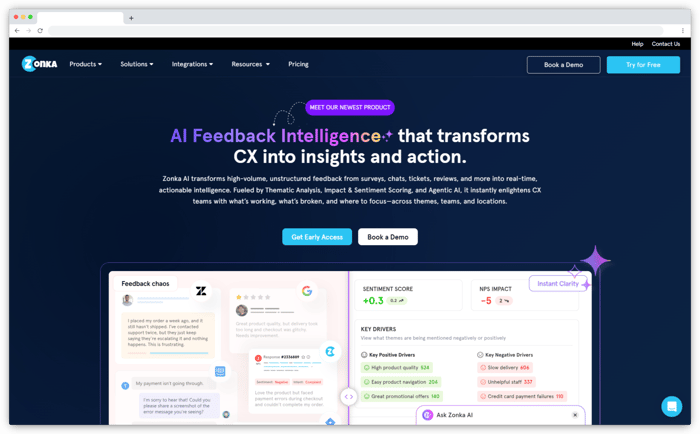
Zonka Feedback gives you five website widget types: popup, slide-up, feedback button, bottom bar, and popover, deployable from a single JS snippet installed once per workspace. Each widget runs independently based on targeting, trigger, and display rules you configure from the dashboard, with no redeployment required when new surveys are added. What separates Zonka from most tools in this category is the loop-closure layer: AI-powered theme analysis, sentiment scoring, automated routing, and NPS, CSAT, and CES tracking sit behind the widget collection layer.
Best For: Teams running NPS, CSAT, or CES programs who need targeting, analytics, and closed-loop automation in one platform.
Use Case: Collecting real-time website feedback through popups, slide-ups, feedback buttons, bottom bars, and popovers, with automated routing to Slack, Zendesk, or HubSpot based on response score.
Key Strength: Five widget types with workspace-scoped JS installation, combined with AI-powered theme analysis, sentiment scoring, and full NPS, CSAT, and CES support in one platform.
AI / Automation: Yes. AI-driven sentiment analysis and theme clustering on open-text responses, automated detractor routing, Zendesk ticket creation from low scores, and Slack alerts.
G2 Rating: 4.7 / 5
Top Features
- Five widget types configurable per survey through Appearance, Targeting, Behavior, and Segment panels
- Targeting by page URL, device type, user segment, and custom variables (plan tier, signup date, country)
- Trigger options: page load, time delay, scroll percentage, exit intent, click events
- NPS, CSAT, and CES question types native, with 30+ languages and multilingual survey support
- Post-ticket CSAT via Intercom integration: a slide-up fires on next session with ticket ID and agent name attached as hidden variables
- Zonka's feedback button sits persistently on any page and captures unsolicited feedback at any point in the user session
- Integrations with Salesforce, HubSpot, Zendesk, Freshdesk, Slack, Jira, and 1,000+ apps via Zapier
Zonka Feedback Pros
- One JS snippet per workspace. All new surveys go live without touching the code.
- Closed-loop workflows: detractor responses auto-route to CS via Slack or create Zendesk tickets
- 14-day trial with full feature access gives a fair evaluation window
Zonka Feedback Cons
- No self-serve free plan. Trial requires a demo booking.
- Mobile SDK uses a separate token architecture from the web JS Client, adding setup steps for mobile
Zonka Feedback Pricing
- Custom pricing
- 14-day free trial available on request
2. Hotjar: Best for UX Feedback Combined with Behavioral Analytics
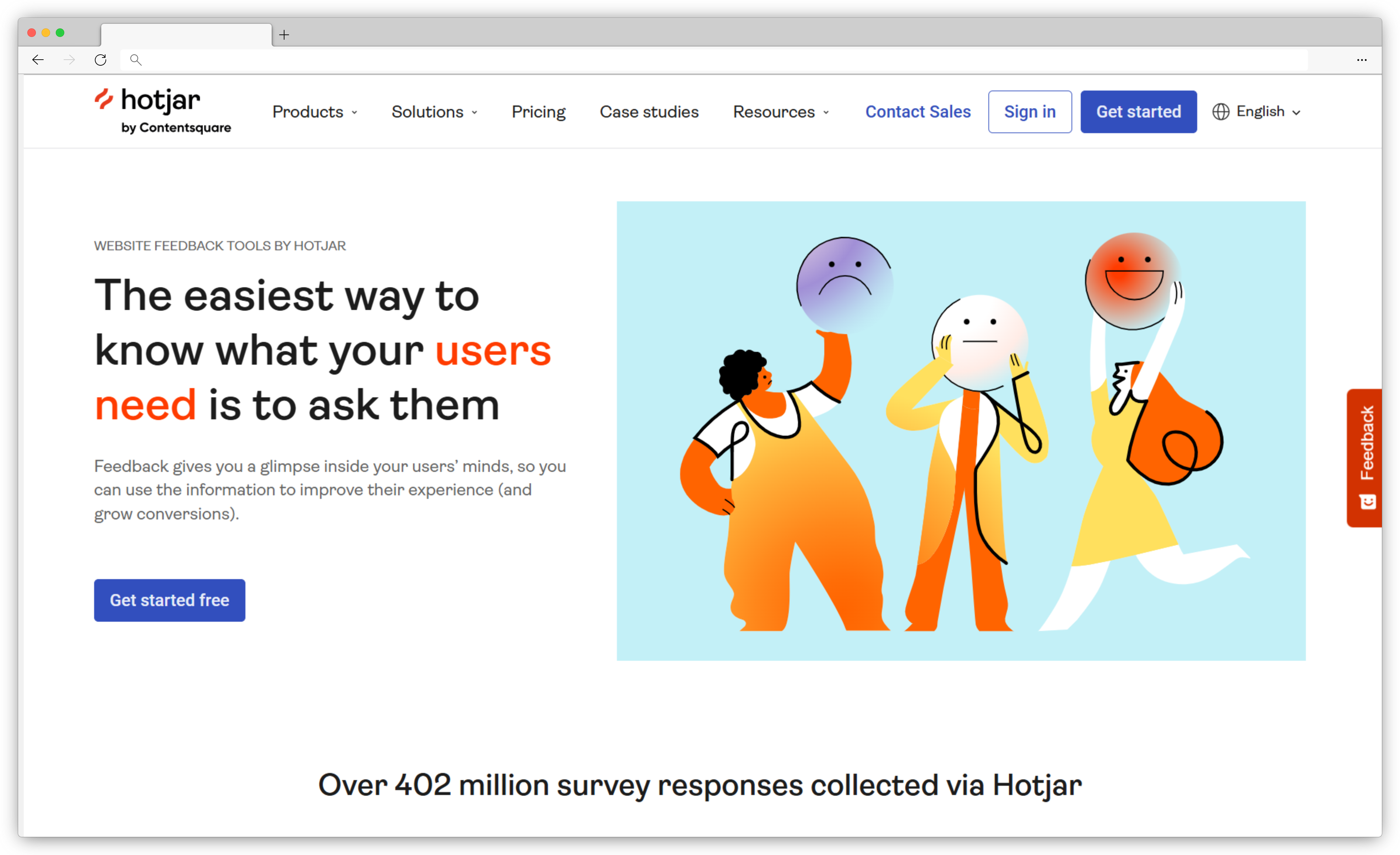
Hotjar (now part of Contentsquare following the July 2025 acquisition) is the only tool on this list that pairs feedback widgets with session recordings and heatmaps in a single platform. Its Ask product handles survey and feedback collection. Observe handles behavioral data. The two modules are priced separately. A team running both pays for two subscriptions, but the combination answers questions that neither tool could alone. Knowing users drop off at step 3 of checkout (Observe) and then reading "the discount code field was confusing" (Ask) produces a diagnosis, not just a signal.
Best For: UX and product teams who need to understand both what users do and why, and are willing to run two modules side by side.
Use Case: Capturing user insights through on-site feedback widgets, surveys, heatmaps, and session recordings to improve UX, spot pain points, and optimize conversion funnels.
Key Strength: Combines visual behavioral data like heatmaps and session recordings with feedback tools that reveal both what users do and why they do it, giving teams a fuller picture of user experience.
AI / Automation: Limited compared with AI-first platforms; mainly offers workflow automations and integration-based insights rather than AI-driven theme extraction.
G2 Rating: 4.3 / 5
Top Features
- Feedback button widget with optional screenshot attachment. On-page surveys trigger by scroll, time, or exit intent.
- Ask Basic includes 20 responses/month and 3 active widgets at no cost
- Heatmaps and session recordings available in Observe (Observe Basic includes 35 daily sessions on the free plan)
- Drag-and-drop survey creation. NPS and rating scale question types supported.
- Both Observe and Ask have free Basic plans with permanent access
Hotjar Pros
- Behavioral plus feedback data in one platform is a combination no other free tool offers
- Easy install. Most teams are live within an hour.
- Free plans on both modules let you evaluate before spending anything
Hotjar Cons
- Observe and Ask are priced separately. The combined paid cost climbs quickly.
- Ask Basic's 20-response cap limits utility for anything beyond initial testing
- Advanced targeting and filtering require the Plus tier or above
Hotjar Pricing
- Free plan available
- Ask Plus from $59/mo. Observe Plus from $39/mo (annual).
3. Survicate: Best for SaaS and Product Team Feedback at Scale
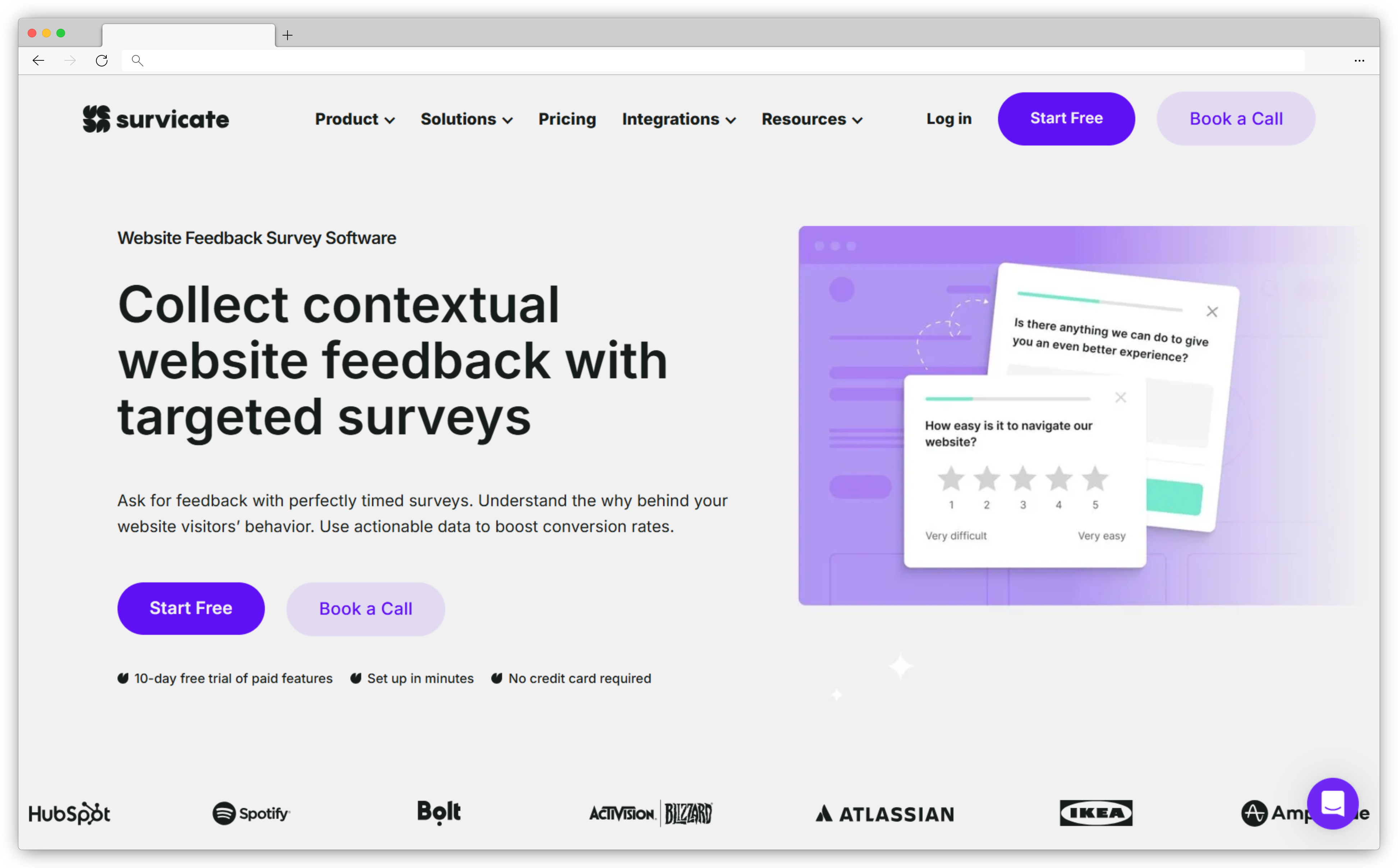
Survicate is built for feedback programs that run continuously, not one-off campaigns. Its website widgets support popup, slide-in, and embedded formats, with targeting based on page visits, user behavior, and lifecycle stage. The free plan is a real starting point, offering 25 responses per month and one active survey, though 25 responses runs out on any meaningful traffic. Where Survicate earns its place in this list is the HubSpot and Intercom integrations, which are among the tightest in the survey category at this price point.
Best For: SaaS product and marketing teams running NPS and CSAT programs with HubSpot or Intercom in their stack.
Use Case: Collecting contextual feedback through website widgets, in-app surveys, and email surveys to measure product experience, onboarding effectiveness, and customer satisfaction.
Key Strength: Strong targeting and segmentation capabilities that allow teams to trigger surveys based on user behavior, page visits, or lifecycle stage, making feedback highly relevant.
AI / Automation: Yes. Provides AI-powered insights that help summarize responses, detect patterns, and automate reporting across teams, along with integrations for workflow automation.
G2 Rating: 4.6 / 5
Top Features
- Popup, slide-in, and embedded widget formats with configurable triggers per survey
- Free plan: 25 responses/month, 1 active survey, basic CRM integrations
- Behavior-based targeting: page visits, user segment, lifecycle stage
- 125+ survey templates. NPS, CSAT, CES natively supported.
- HubSpot, Intercom, Salesforce integrations with two-way sync
Survicate Pros
- Targeting logic is strong for SaaS use cases, with segmentation by plan type, usage, or behavior
- Free plan lets you test before committing
- Support response times under 2 minutes on chat, consistently reported by users
Survicate Cons
- Targeting bugs are pdfs documented: surveys can occasionally fire to wrong user segments
- 25-response free cap is more a proof-of-concept than a usable program
- Reporting lacks depth for cohort-level analysis
Survicate Pricing
- Free plan available (25 responses/mo)
- Paid from $56/mo (annual) or $89/mo (Starter, monthly)
4. Qualtrics: Best for Enterprise Experience Management
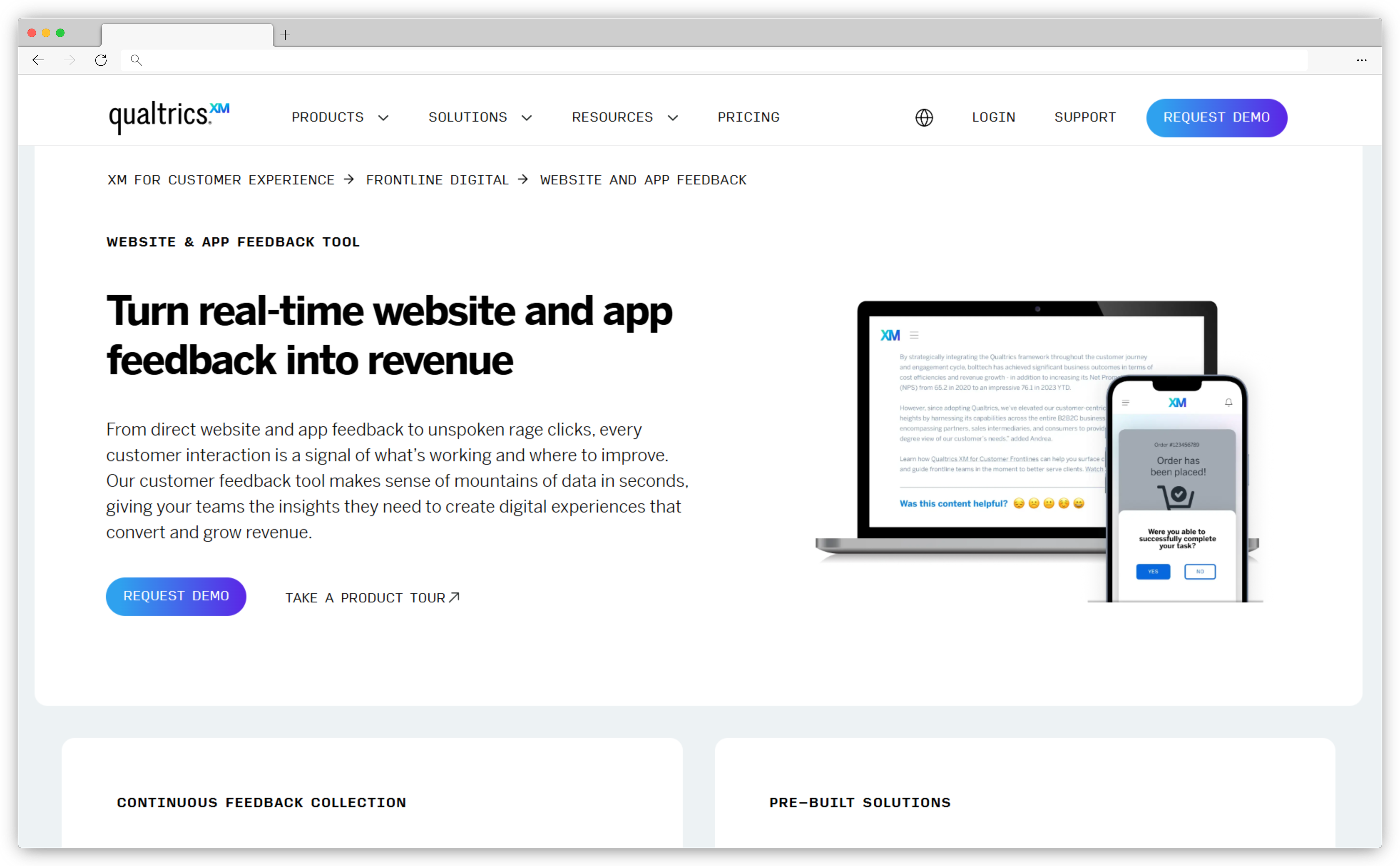
Qualtrics is the enterprise standard for experience management: survey research, employee listening, and digital feedback under one platform. Its website widgets cover popups, embedded surveys, and behavior-triggered intercepts. The platform's strength isn't the widget layer. It's what happens downstream: predictive analytics, AI-assisted summaries, and integration with Qualtrics' broader XM ecosystem. Teams running simple NPS surveys will find it overkill. The learning curve is real, and the pricing reflects it.
Best For: Enterprise CX and research teams running multi-channel feedback programs at scale, where analytical depth justifies the cost and complexity.
Use Case: Collecting and analyzing comprehensive feedback across websites, digital channels, and enterprise touchpoints; designing advanced surveys and experience measurement programs.
Key Strength: Enterprise-grade experience management platform with powerful analytics, customizable survey logic, integrated dashboards, and support for multi-channel feedback consolidation.
AI / Automation: Yes. Offers AI-powered insights including automated summaries, intelligent action triggers, conversational feedback capabilities, and automated workflows.
G2 Rating: 4.4 / 5
Top Features
- Triggered website intercepts configurable by URL, user behavior, or custom logic
- Embedded and popup formats with extensive branching and display logic
- Predictive analytics and AI-powered automated summaries
- Integrates with Salesforce, Marketo, ServiceNow, and major enterprise platforms
Qualtrics Pros
- Industry-leading analytics and research capabilities
- Pre-built templates cover diverse enterprise feedback programs
- Scales across very large organizations without performance degradation
Qualtrics Cons
- Starts at $1,500/user/year, cost-prohibitive for most small and mid-market teams
- Steep learning curve. Dedicated admin time required.
- Widget setup requires more configuration than simpler tools
Qualtrics Pricing
- Contact their sales team for pricing information
- Free plan not available
5. SurveyMonkey: Best for Structured Surveys with Team Collaboration
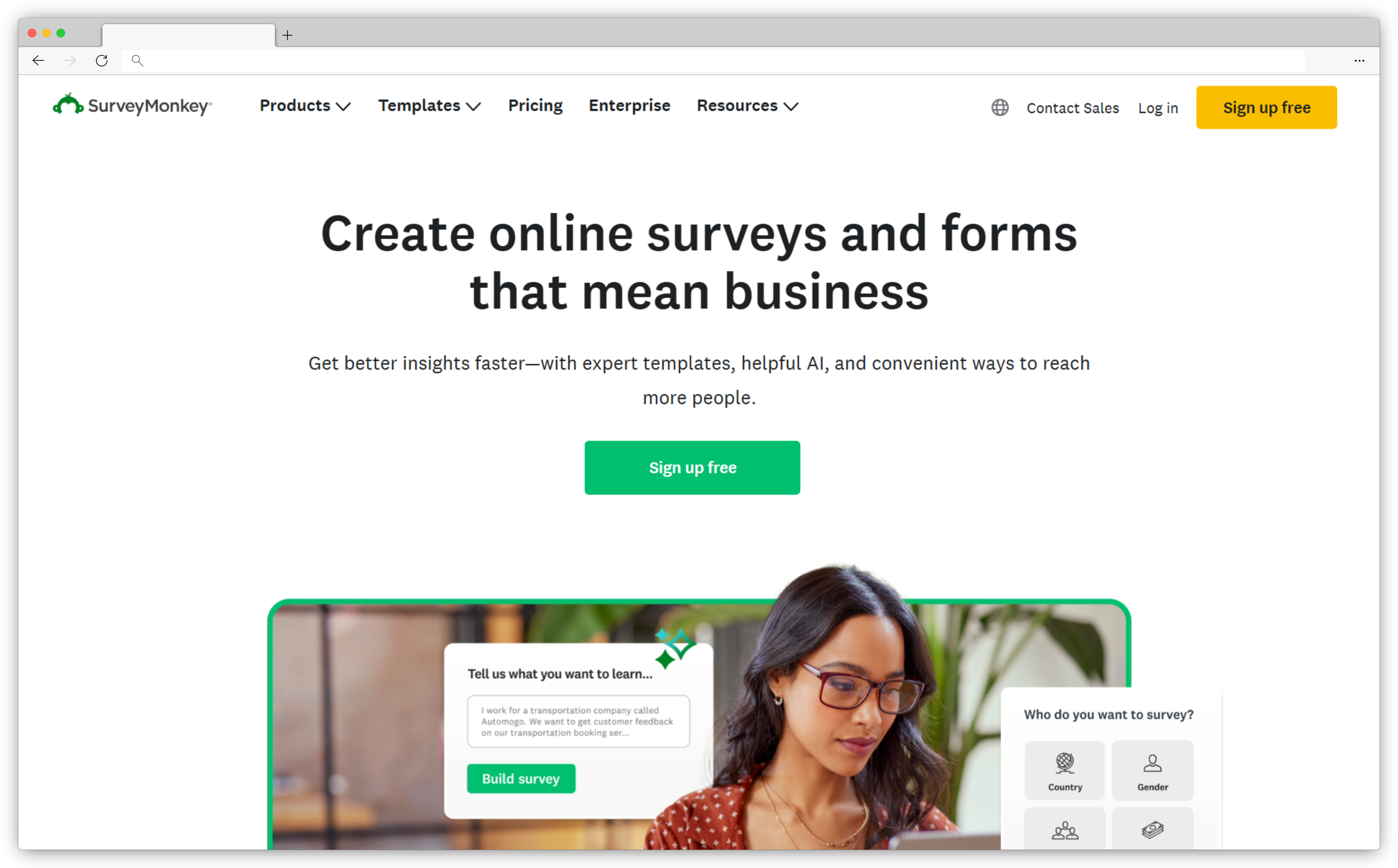
SurveyMonkey is the most widely recognized survey platform in the category, which cuts both ways. Its familiarity reduces onboarding friction, and the template library speeds up survey creation. Website widgets support popup and embedded formats. The strongest argument for SurveyMonkey is the collaboration layer: shared response inboxes, joint analysis, and multi-user survey management are more mature here than in most tools at this price point.
Best For: Teams already in the SurveyMonkey ecosystem who need basic website embed capabilities alongside existing survey programs.
Use Case: Creating and deploying customizable surveys or embedded forms to collect user feedback, customer satisfaction scores, market research insights, and website experience data at scale.
Key Strength: Strong survey builder with intuitive design, a large library of templates, robust analytics, segmentation, and reporting features, making it a trusted choice for both beginners and experienced researchers.
AI / Automation: Yes. Includes AI-assisted features such as automated insights, intelligent survey suggestions, and workflow automation.
G2 Rating: 4.4 / 5
Top Features
- Popup and embedded website widget formats with straightforward embed code generation
- 200+ survey templates across feedback, research, and satisfaction use cases
- Skip logic, display logic, and branching available on paid plans
- Team collaboration: shared survey access, response filtering, joint analysis
SurveyMonkey Pros
- Lowest barrier to entry in the category. Most teams already know the interface.
- Large template library covers diverse feedback scenarios out of the box
- Solid analytics with filtering, crosstab, and trend views
SurveyMonkey Cons
- Response limits on lower-tier plans hit quickly for high-traffic sites
- Advanced targeting options are limited compared to Survicate or Zonka
- $0.15 per-response overage fee adds up if you consistently exceed plan limits
SurveyMonkey Pricing
- From $39/mo (Advantage Annual)
- Team plans from $30/user/mo (3-user minimum, annual)
6. Typeform: Best for Conversational, High-Completion Feedback Forms
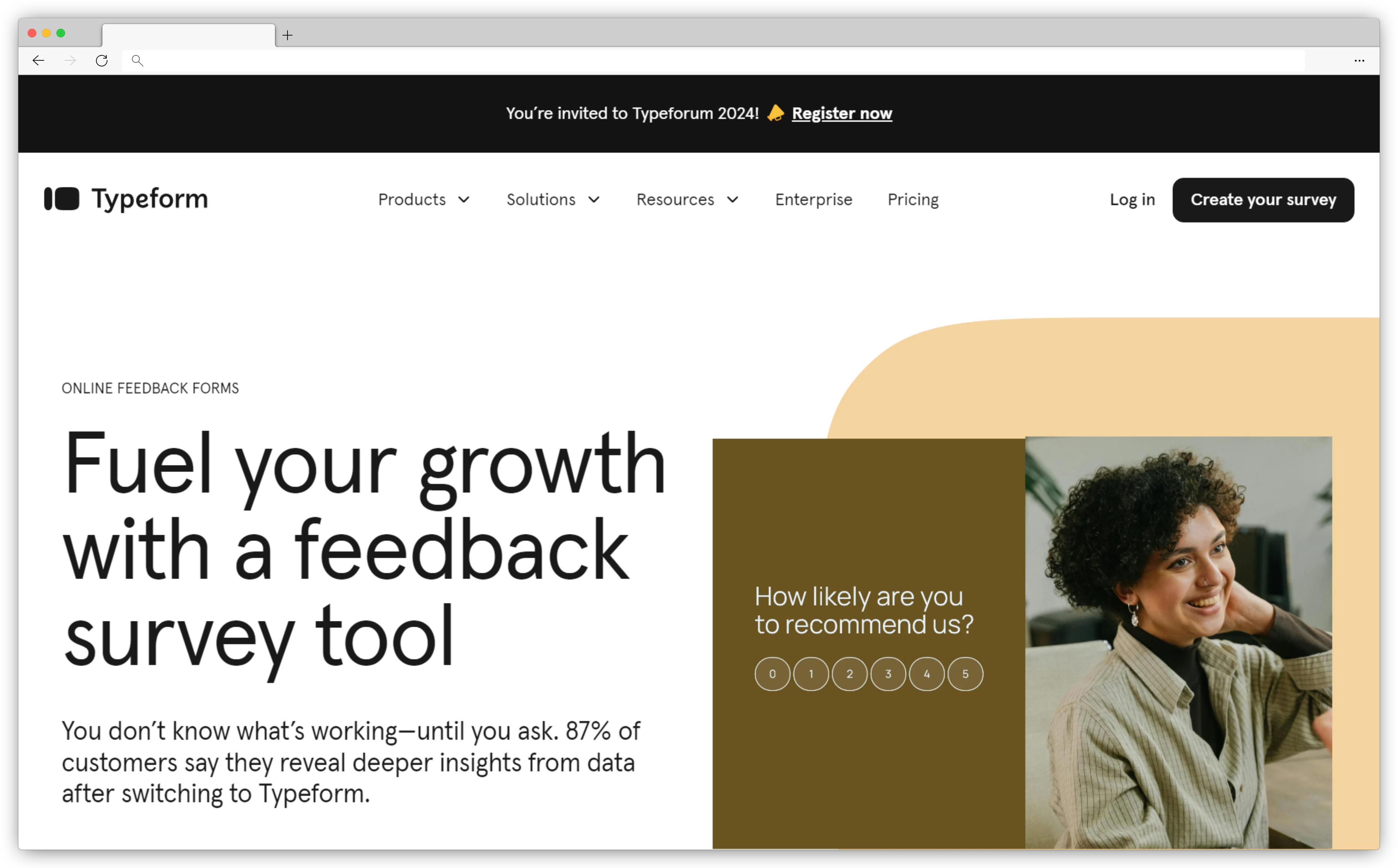
Typeform takes a different approach from every other tool on this list: one question at a time, in a conversational flow. Completion rates are higher than traditional multi-question forms, which matters when you're collecting qualitative feedback and need full open-ended responses rather than partial answers. Website widgets support embedded and popup formats. Conditional logic lets you branch based on previous answers.
Best For: Product and UX teams collecting qualitative open-ended feedback where completion rate matters more than analytical depth.
Use Case: Collecting user feedback, customer satisfaction responses, lead information, and general insights through visually appealing and conversational surveys embedded on websites.
Key Strength: Intuitive and interactive design with a one-question-at-a-time experience that increases engagement and completion rates; strong template library and integration support for CRM and marketing tools.
AI / Automation: Yes. Offers AI-assisted analysis and insights, enabling teams to summarize open-ended responses and spot trends without heavy manual work.
G2 Rating: 4.5 / 5
Top Features
- One-question-at-a-time conversational interface with documented higher completion rates
- Conditional logic for personalized response paths
- Embedded and popup widget formats with extensive design and branding customization
- AI-assisted response analysis on paid plans and a large template library
Typeform Pros
- Completion rates noticeably higher than multi-question formats for qualitative feedback
- Visually polished. Easy to align with brand design.
- Strong integration support across CRM and marketing tools
Typeform Cons
- Not purpose-built for NPS/CSAT/CES tracking, better suited for qualitative research
- Pricing scales quickly at high response volumes
- Targeting options are basic compared to Survicate or Zonka
Typeform Pricing
- Free basic plan available
- Paid from $29/mo (Basic, annual)
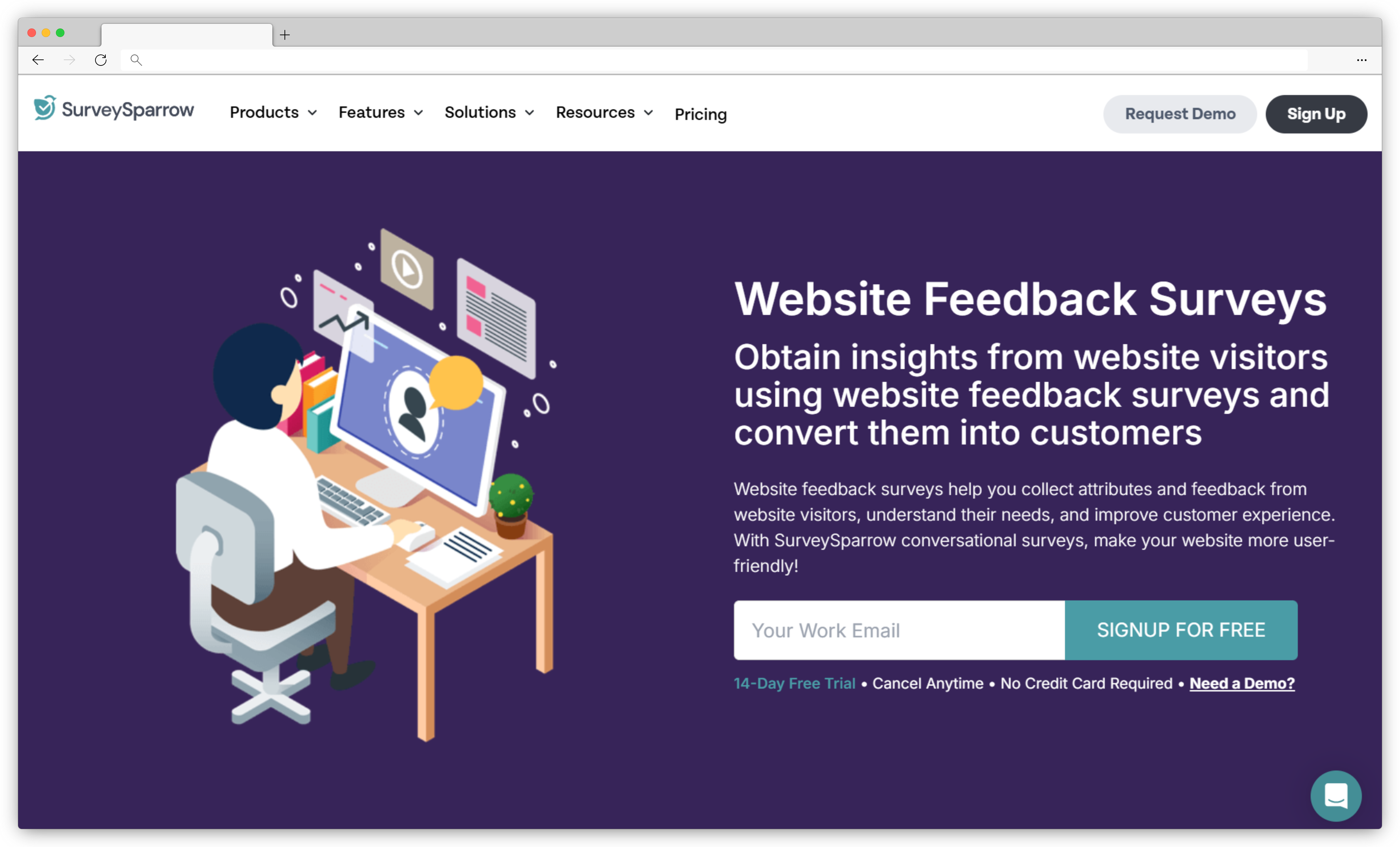
7. SurveySparrow: Best for Recurring Conversational Feedback Programs
SurveySparrow combines a conversational survey format with recurring scheduling, useful for teams running weekly or monthly feedback loops without manually triggering each wave. Website widgets support popup, inline embed, and side panel formats. Trigger options include page views, scroll depth, and exit intent. The AI features summarize open-ended responses automatically, reducing manual review time on high-volume programs.
Best For: Teams running recurring NPS or CSAT programs who want a conversational format and minimal manual scheduling.
Use Case: Running website feedback surveys, recurring NPS and CSAT programs, and user experience surveys using chat-like, engaging formats that improve response rates.
Key Strength: Conversational survey design combined with recurring feedback capabilities, making it well suited for ongoing experience measurement rather than one-off surveys.
AI / Automation: Yes. Includes AI-driven text analysis, automated insights, and workflow automations that help teams identify trends and close the feedback loop faster.
G2 Rating: 4.4 / 5
Top Features
- Chat-like conversational survey format across all widget types
- Popup, inline embed, and side panel formats with trigger options per widget
- Recurring survey scheduling for ongoing NPS and CSAT programs
- AI-assisted text analysis and automated response summaries
- Web widget implements via a single code snippet. Dashboard updates go live without redeployment.
SurveySparrow Pros
- Conversational format paired with recurring scheduling is a practical combination
- AI response summaries reduce manual analysis for high-volume programs
- Mobile-friendly design across all widget formats
SurveySparrow Cons
- No free plan. Basic plan starts at $19/mo (annual), limited to 2,500 responses/month.
- Advanced widget configurations (session tracking, conditional display) may need developer support
- Reporting dashboard lacks depth compared to enterprise tools
SurveySparrow Pricing
- From $19/mo (Basic, annual billing)
- Free plan not available
8. Wootric (InMoment): Best for Tracking NPS, CSAT, and CES Over Time
Wootric, now part of InMoment, is purpose-built for CX metric tracking across websites and apps. Its widget layer is intentionally simple. The focus is on reliable NPS, CSAT, and CES collection at key journey touchpoints, not broad qualitative research. Event-based triggers fire surveys precisely (post-purchase, post-support, post-onboarding), and real-time dashboards surface score trends by channel, segment, and time period.
Best For: CX and product teams focused on ongoing NPS, CSAT, and CES measurement across multiple digital touchpoints.
Use Case: Collecting website and in-app feedback to track customer sentiment at key touchpoints and monitor experience trends over time.
Key Strength: Strong focus on CX metrics combined with simple deployment and real-time dashboards that make it easy to monitor customer sentiment and take action quickly.
AI / Automation: Limited compared to AI-first platforms; primarily supports automated survey triggers, integrations, and reporting workflows rather than advanced AI-driven analysis.
G2 Rating: 4.7 / 5
Top Features
- NPS, CSAT, and CES widget formats with minimal configuration for standard deployments
- Event-based triggers tied to specific user actions
- Real-time dashboards with score trend tracking and segmentation
- Multi-channel: website, in-app, email, and SMS in one platform
Wootric Pros
- CX metric tracking is clean, reliable, and easy to interpret without analytical training
- Event-based triggers are precise, firing when the relevant interaction happens
- Scales across website, mobile app, and email without separate tools
Wootric Cons
- Limited customization for teams needing complex survey logic
- No free plan. Pricing requires a sales conversation.
- AI analysis capabilities are lighter compared to Zonka or Qualtrics
Wootric Pricing
- Contact their sales team for pricing information
- Free plan not available
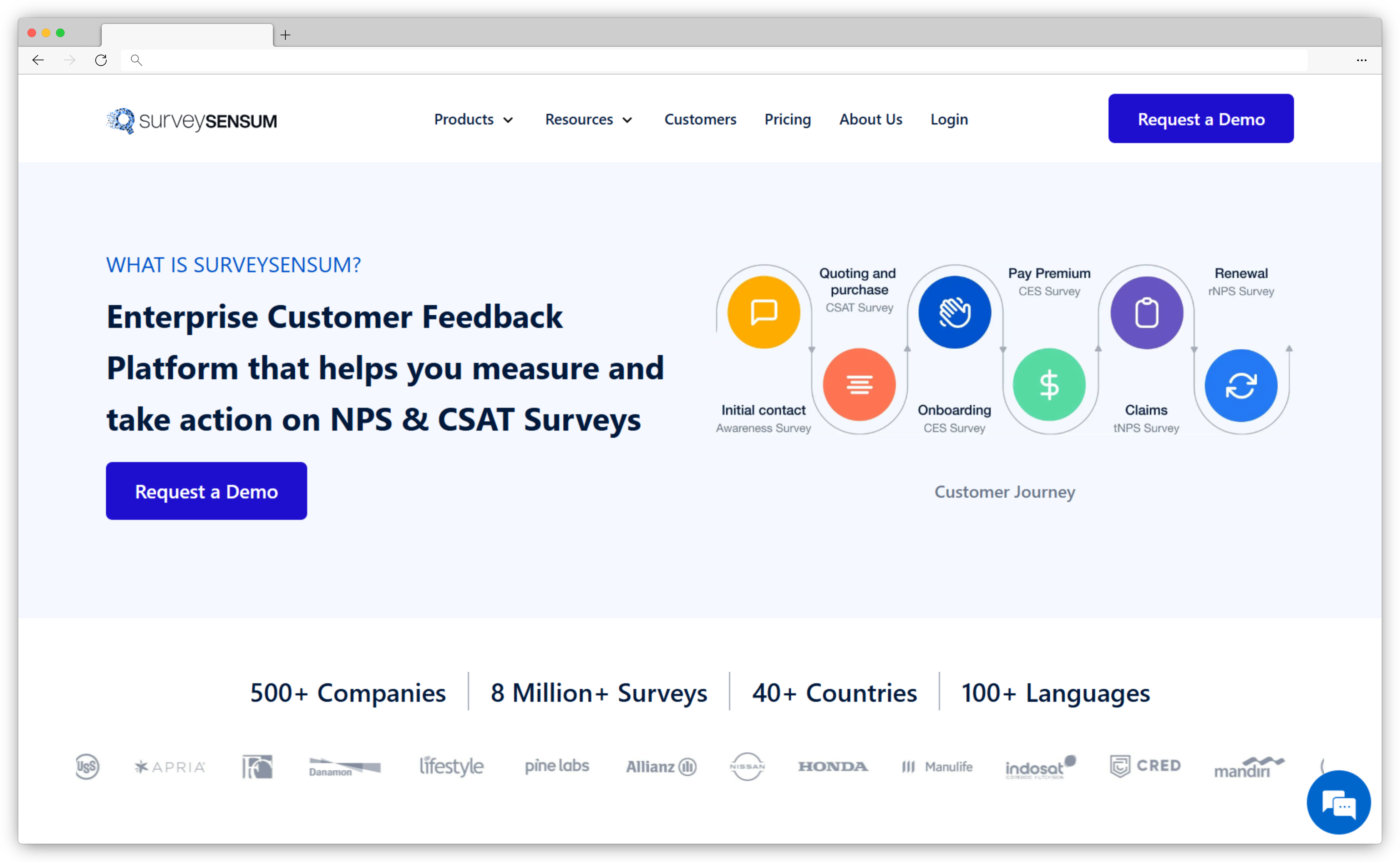
9. SurveySensum: Best for CX Metrics with AI Text Analytics
SurveySensum is an enterprise-grade CX feedback platform built around NPS, CSAT, and CES measurement across websites, apps, and digital touchpoints. Its website widgets deploy based on user actions — page visits, scroll depth, navigation events — so feedback fires at the right moment rather than on a blanket timer. The AI text analytics layer surfaces themes and sentiment from open-text responses automatically, and a real-time alert system flags score drops before they escalate. What SurveySensum is particularly known for among users is its support SLA: a 1-hour response guarantee that's rare in this category.
Best For: CX, product, and support teams looking for a structured yet easy-to-use platform to manage customer feedback and experience programs.
Use Case: Collecting website and digital feedback to measure NPS, CSAT, and CES, identify experience gaps, and prioritise improvements across customer journeys.
Key Strength: Clear focus on turning feedback into action through intuitive dashboards, prioritisation insights, closed-loop workflows, and a 1-hour customer support SLA.
AI / Automation: Moderate. Supports automated survey distribution, alerts, and reporting, with AI-driven text analytics for theme extraction and sentiment scoring.
G2 Rating: 4.6 / 5
Top Features
- Branded NPS, CSAT, and CES survey widgets deployable on websites and apps
- Action-based triggers: page visits, scroll depth, and navigation events for timely feedback collection
- AI-driven text analytics to extract key themes and sentiment from open-text responses
- Real-time feedback insights with advanced filtering and trend-tracking capabilities
- Target specific user groups or behaviours to collect context-specific feedback
SurveySensum Pros
- Simplified widget setup — surveys go live in minutes with no complex configuration
- AI text analytics reduce manual review time on high open-text response volumes
- 1-hour customer support SLA guarantee is one of the strongest in the category
SurveySensum Cons
- Annual pricing ($3,600/yr) is a higher upfront commitment than monthly-billed alternatives
- Initial setup for enterprise integrations may require additional technical resources
SurveySensum Pricing
- Paid plans start at $3,600/year
- 1-month free trial available
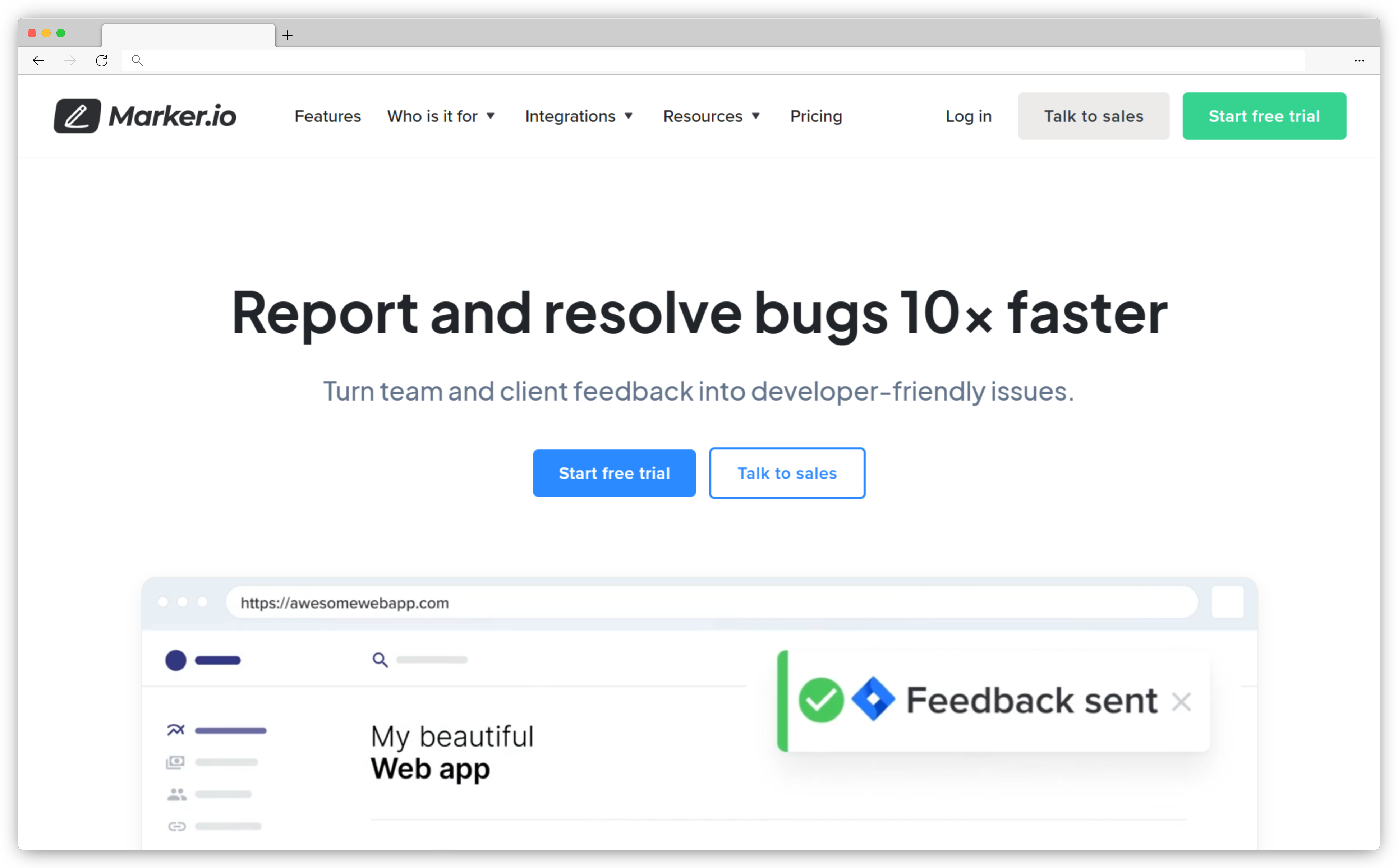
10. Marker.io: Best for Bug Reporting and Visual Feedback
Marker.io doesn't collect satisfaction scores or CX metrics. It does one thing: lets users annotate screenshots of website issues and submit them directly to your project management tools. A user clicks the widget, draws on the problem area, adds context, and submits. Marker.io automatically attaches the URL, browser version, screen resolution, and console logs. The report arrives in Jira, Trello, Asana, or ClickUp fully contextualized, with nothing missing.
Best For: Product, QA, and development teams who need structured visual bug reports from real users, delivered directly to their project management workflow.
Use Case: Collecting annotated screenshots and contextual bug reports from users or testers to streamline issue tracking and resolution.
Key Strength: Visual feedback with automatic technical context and strong integrations with tools like Jira, Trello, GitHub, and ClickUp.
AI / Automation: Limited. Focuses on automation through integrations and workflow routing rather than AI-driven analysis.
G2 Rating: 4.8 / 5
Top Features
- Screenshot annotation directly on live pages. No separate screenshot tool required.
- Automatic technical metadata: URL, browser, OS, screen size, console logs
- Direct integrations with Jira, Trello, ClickUp, Asana, GitHub, and Linear
- Customizable feedback form templates per project or environment
Marker.io Pros
- Bug reports arrive in dev tools fully contextualized, with no back-and-forth for clarification
- Non-disruptive widget design doesn't interrupt the browsing experience
- Works across local, staging, and live environments
Marker.io Cons
- No survey or satisfaction metric capability. It's a single-purpose tool.
- No free plan. Starts at $39/mo.
- Multilingual support is limited
Marker.io Pricing
- Paid plans start at $39/month
- Free plan not available
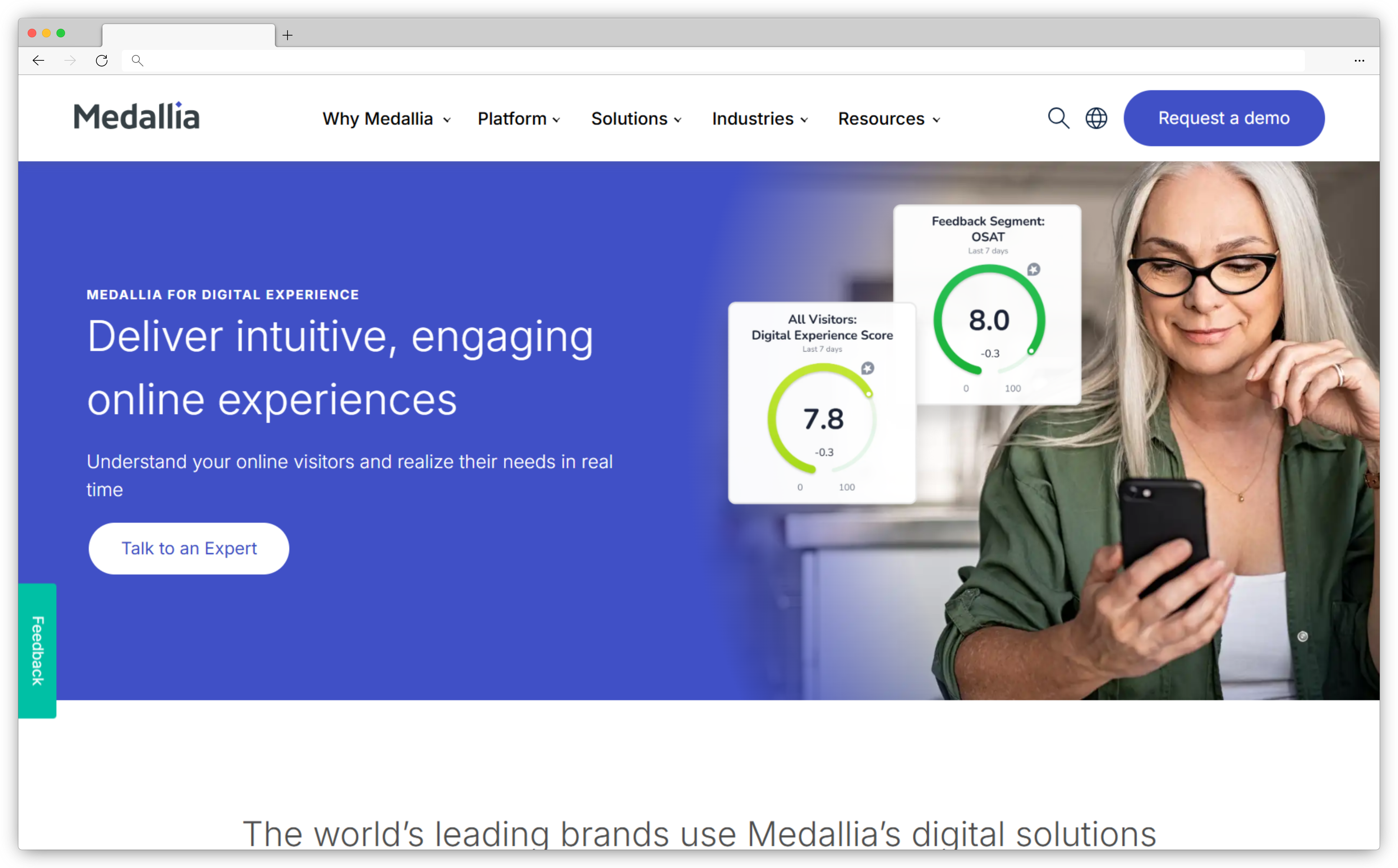
11. Medallia: Best for Large-Scale Enterprise CX Programs
Medallia is built for organizations running feedback programs across dozens of channels simultaneously: website, app, kiosk, social, speech analytics. Its website widget layer covers digital intercepts and embedded surveys with enterprise-grade targeting. The analytical depth is significant: AI text analysis, heatmap and click analysis, video feedback, and cross-channel benchmarking against public review ratings. The cost and setup complexity match the capability level.
Best For: Enterprise CX and VoC teams running feedback programs across multiple channels, locations, or business units.
Use Case: Collecting and analyzing website and digital feedback as part of broader CX, VoC, and experience management programs.
Key Strength: Robust enterprise capabilities, advanced analytics, and the ability to unify feedback across large, complex organizations.
AI / Automation: Yes. Offers AI-powered text analytics, sentiment analysis, and automated insights to help enterprises identify trends and prioritize actions at scale.
G2 Rating: 4.5 / 5
Top Features
- Enterprise web intercepts configurable by URL, user behavior, and custom attributes
- Cross-channel feedback: website, app, social, speech, and reviews unified
- AI text analysis, sentiment scoring, and theme detection at scale
- Heatmap and click analysis built into the platform
Medallia Pros
- Handles very large response volumes without performance issues
- Cross-channel feedback unification is the strongest in the category
- Enterprise-grade compliance, security, and data residency options
Medallia Cons
- Expensive and complex to implement, not practical without a dedicated CX team
- Setup typically requires a consulting engagement
- Interface is difficult for non-technical users without training
Medallia Pricing
- Contact their sales team for pricing information
- Free plan not available
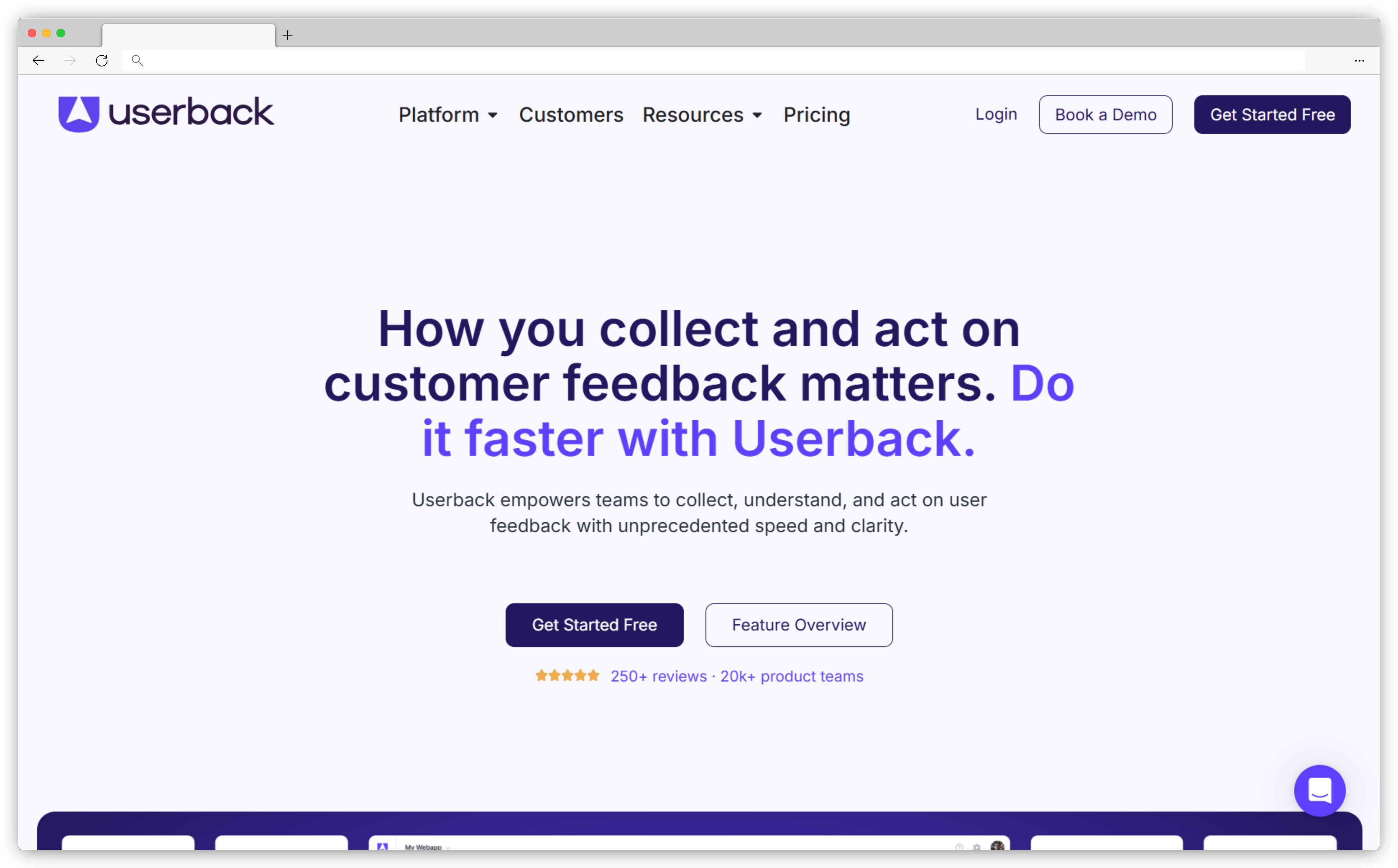
12. Userback: Best for Visual Feedback with a Genuine Free Tier
Userback sits at the intersection of Marker.io's visual feedback approach and a real free tier. The free plan supports one project with annotated screenshot collection, the most accessible entry point for visual feedback on this list. Unlike Marker.io, it also supports text feedback alongside screenshots, and real-time collaboration with team members and clients. The metadata it captures automatically (URL, browser, OS, screen resolution) makes reports self-explanatory without extra steps from the user.
Best For: Design and product teams that need free, visual bug reporting on a single site, with collaboration features for client review.
Use Case: Collecting annotated screenshots, bug reports, and user suggestions directly from websites to improve usability and fix issues faster.
Key Strength: Visual feedback with screenshots, annotations, and automatic technical metadata that makes issues easy to understand and act on.
AI / Automation: Limited. Focuses on workflow automation through integrations with tools like Jira, Trello, and Asana rather than advanced AI-driven analysis.
G2 Rating: 4.7 / 5
Top Features
- Annotated screenshot widget with automatic technical metadata capture
- Real-time collaboration: team members and clients can respond within the platform
- Integrates with Jira, Trello, Asana, GitHub, and Slack
- Free plan: one project, core visual feedback features, no credit card required
Userback Pros
- The only visual feedback tool in the main list with a genuine free plan
- Screenshot annotations are clear enough that developers can act without follow-up
- Supports feedback on live websites, staging environments, and prototypes
Userback Cons
- Advanced analytics for broader feedback insights are limited
- Annotation precision is less fine-grained than Marker.io for complex UI components
- Free plan restricts to one project. Multi-site teams need a paid plan.
Userback Pricing
- Free plan available (1 project)
- Paid plans on request
Top Free Feedback Widgets to Collect Customer Feedback
While many of the tools above offer free tiers, the options below are built for teams that need a lightweight, low-cost solution to get started. Crowdsignal offers a permanent free plan with no credit card required. Feedbackify offers a 15-day free trial before its paid plan kicks in at $19/mo — included here for its simplicity and no-response-cap model.
Zonka Feedback doesn't offer a self-serve free plan, but a 14-day free trial is available on request with full access to all widget types, advanced targeting, CX metrics, and loop-closure workflows — no feature restrictions. Book a demo to get started.
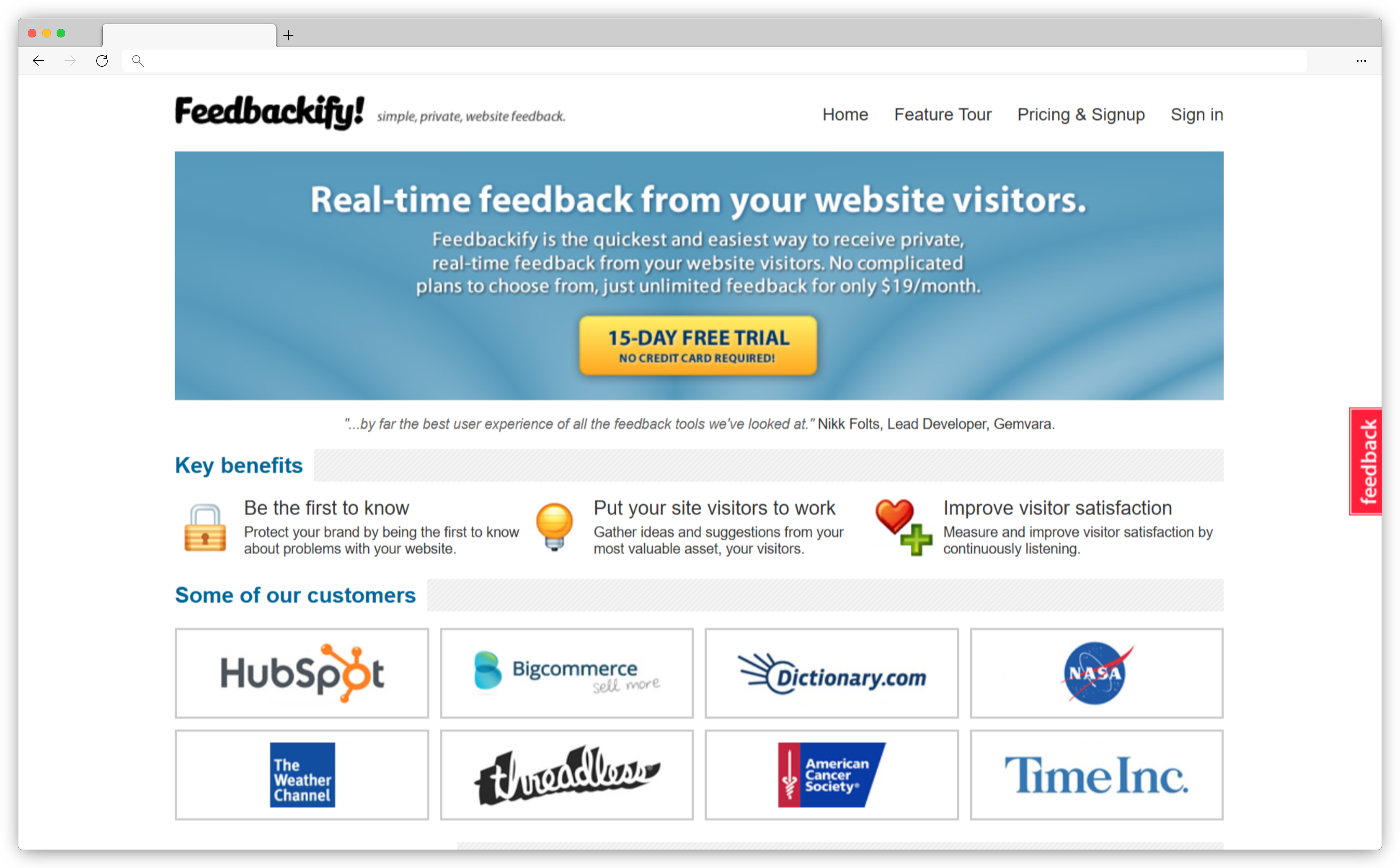
13. Feedbackify: Best for Simple, Low-Cost Feedback Button Widgets
Feedbackify is a lightweight website feedback widget tool built around one thing: a customizable feedback button that lets visitors submit ratings and comments directly from any page. Its drag-and-drop form builder requires no coding, and a 15-day free trial lets you test it without a credit card before committing to a paid plan. What you trade for that simplicity is analytics depth; the dashboard shows you what was submitted but won't cluster themes, detect sentiment, or flag trends. For teams that just need a "give us feedback" button live on their site today, that trade-off is perfectly reasonable.
Best For: Small businesses and teams that need a simple, no-frills free feedback widget with no response limits.
Use Case: Collecting on-page website feedback, usability suggestions, and issue reports directly from visitors during their browsing experience.
Key Strength: Quick setup with a drag-and-drop builder, anonymous feedback collection, and a 15-day trial to test before committing — no credit card required.
AI / Automation: No. Feedbackify focuses on manual feedback collection and basic reporting rather than AI-driven analysis or advanced automation.
G2 Rating: 4.5 / 5
Top Features
- Drag-and-drop form builder — create and customise a feedback button form without any coding
- Paid plans from $19/mo with no response cap — visitors can submit as many times as they want
- Supports anonymous feedback, increasing response rates from visitors who wouldn't identify themselves
- Feedback collected via an embedded button or text link; no redirect to an external page
- Centralised dashboard to view, filter, and manage all submitted responses in one place
Feedbackify Pros
- 15-day free trial with no credit card required — enough runway to test before committing
- Intuitive drag-and-drop editor makes setup fast for non-technical teams
- Anonymous feedback option captures candid responses that named forms often miss
Feedbackify Cons
- Analytics are basic — no sentiment analysis, theme detection, or trend tracking
- No targeting rules: the widget shows to all visitors on all pages with no conditions
- No multilingual support, limiting use for global or multi-region sites
Feedbackify Pricing
- 15-day free trial available (no credit card required)
- Paid plans from $19/month
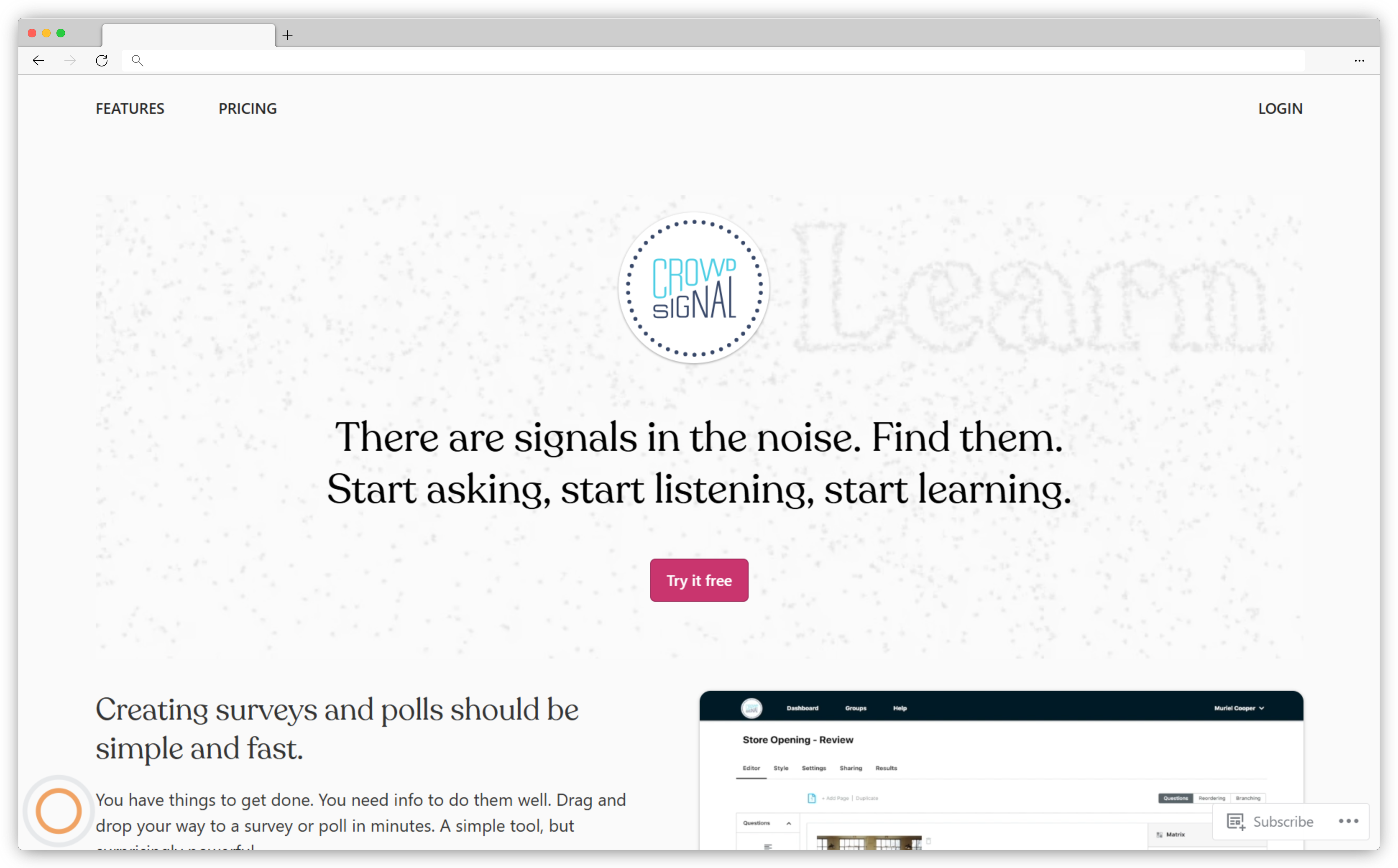
14. Crowdsignal: Best Free Widget for Website Polls and Quick Pulse Checks
Crowdsignal is a versatile polling and survey tool from Automattic (the company behind WordPress) that lets you embed feedback widgets, polls, and quizzes directly on web pages or share them via email without users needing to leave their inbox. Its free plan covers up to 2,500 responses per month — enough for most content sites and blogs — and setup takes minutes. It's not built for CX metric tracking or advanced feedback programs; it's built for quick, low-friction pulse checks from readers and visitors.
Best For: Content creators, bloggers, and small businesses who want quick poll or survey widgets embedded on web pages with minimal setup.
Use Case: Collecting quick website feedback through polls, ratings, and short surveys embedded on web pages or shared via email.
Key Strength: Easy-to-use polling widgets with a generous free tier (2,500 responses/month) and the ability to share surveys via email without redirecting users to another page.
AI / Automation: No. Crowdsignal focuses on basic feedback collection and reporting rather than AI-driven insights or advanced automation.
G2 Rating: 4.2 / 5
Top Features
- Embed polls, surveys, and quizzes directly on any web page with a simple code snippet
- Free plan includes up to 2,500 responses per month with no credit card required
- Share polls via email — respondents can answer directly from their inbox without visiting your site
- Interactive quizzes alongside standard surveys for higher engagement on content-heavy pages
- Connect with existing tools for data sharing and analysis via native integrations
Crowdsignal Pros
- 2,500 free responses per month is one of the most generous free tiers in this category
- Backed by Automattic — reliable infrastructure with a long product history
- Email-shareable polls remove friction for audiences who prefer not to visit a website
Crowdsignal Cons
- No advanced targeting — widgets show to all visitors with no segment or page-level conditions
- Analytics are basic on the free plan; detailed reports require a paid upgrade
- Limited widget customisation for branding on the free tier
Crowdsignal Pricing
- Free plan available (2,500 responses/month)
- Paid plans from $15/month
How to Add a Website Feedback Widget to Your Website
Most platforms on this list install through a single JS snippet. Here's how it works with Zonka Feedback. The process is representative of what most tools require.
Step 1: Sign up for Zonka Feedback and log in to your account.
Step 2: Click on 'Add Survey' and select from survey templates that align with your survey goals, or use AI to create your survey.
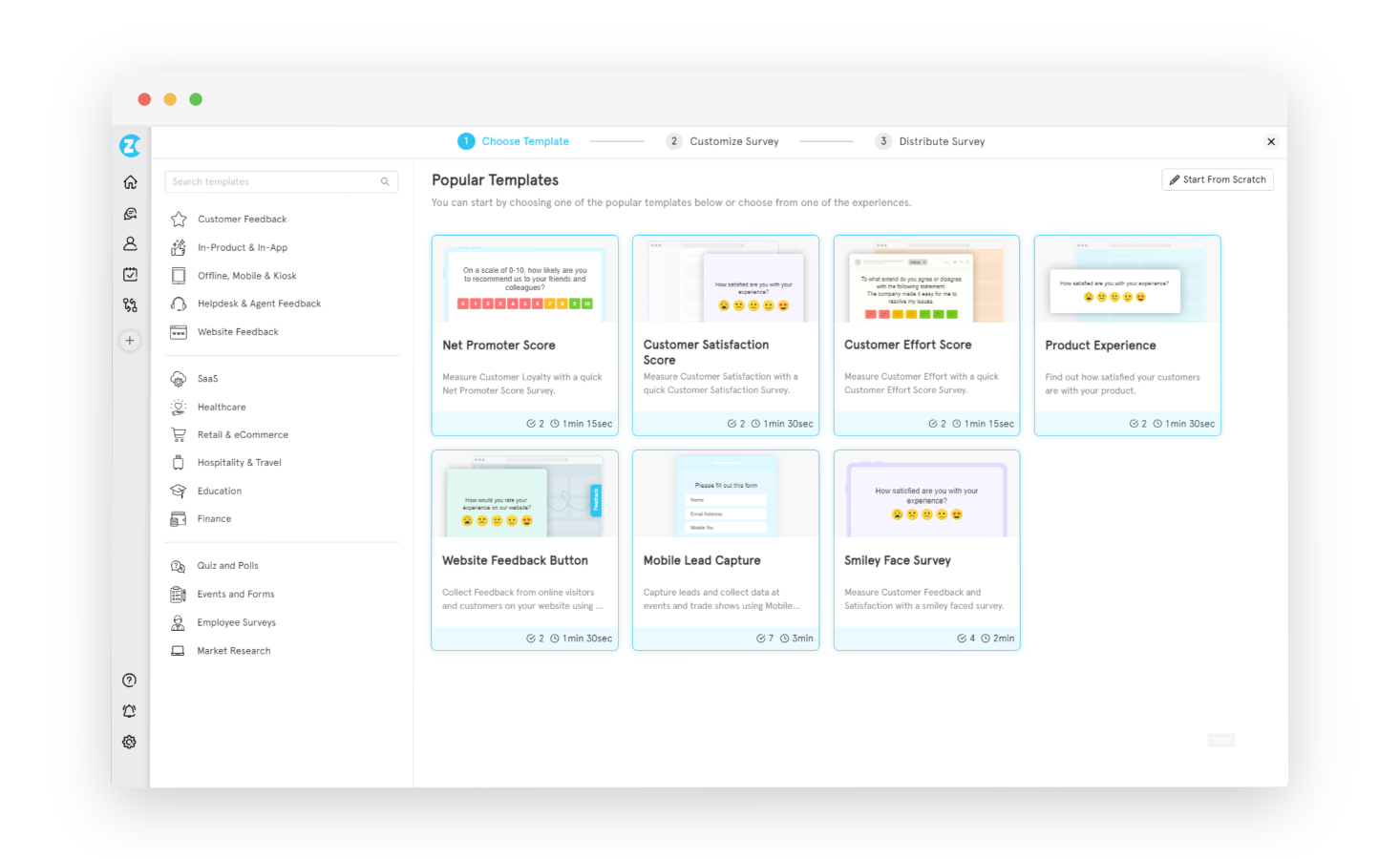
Step 3: Select 'Website and Web Apps' as your survey distribution method. This routes the survey to the widget configuration flow.
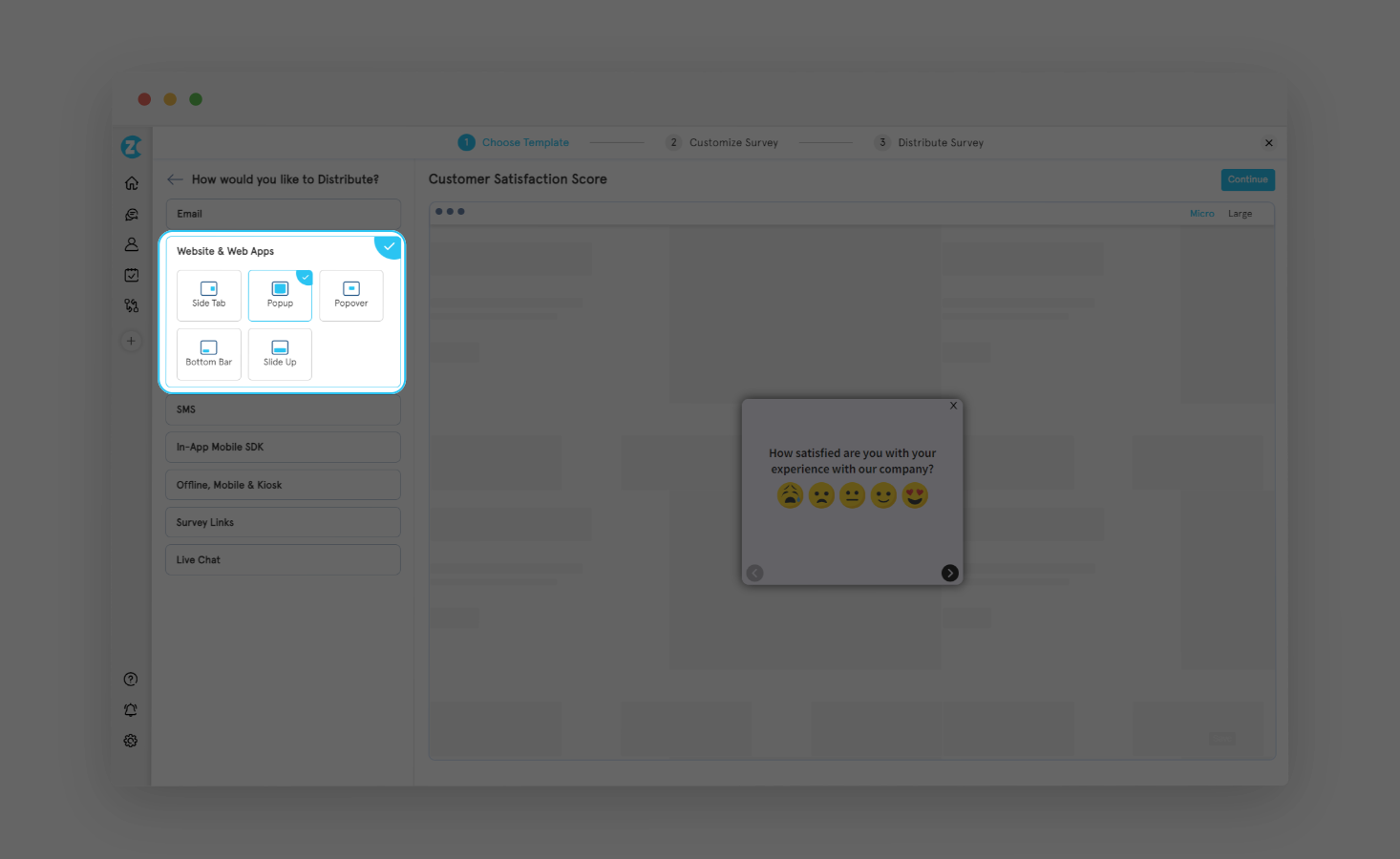
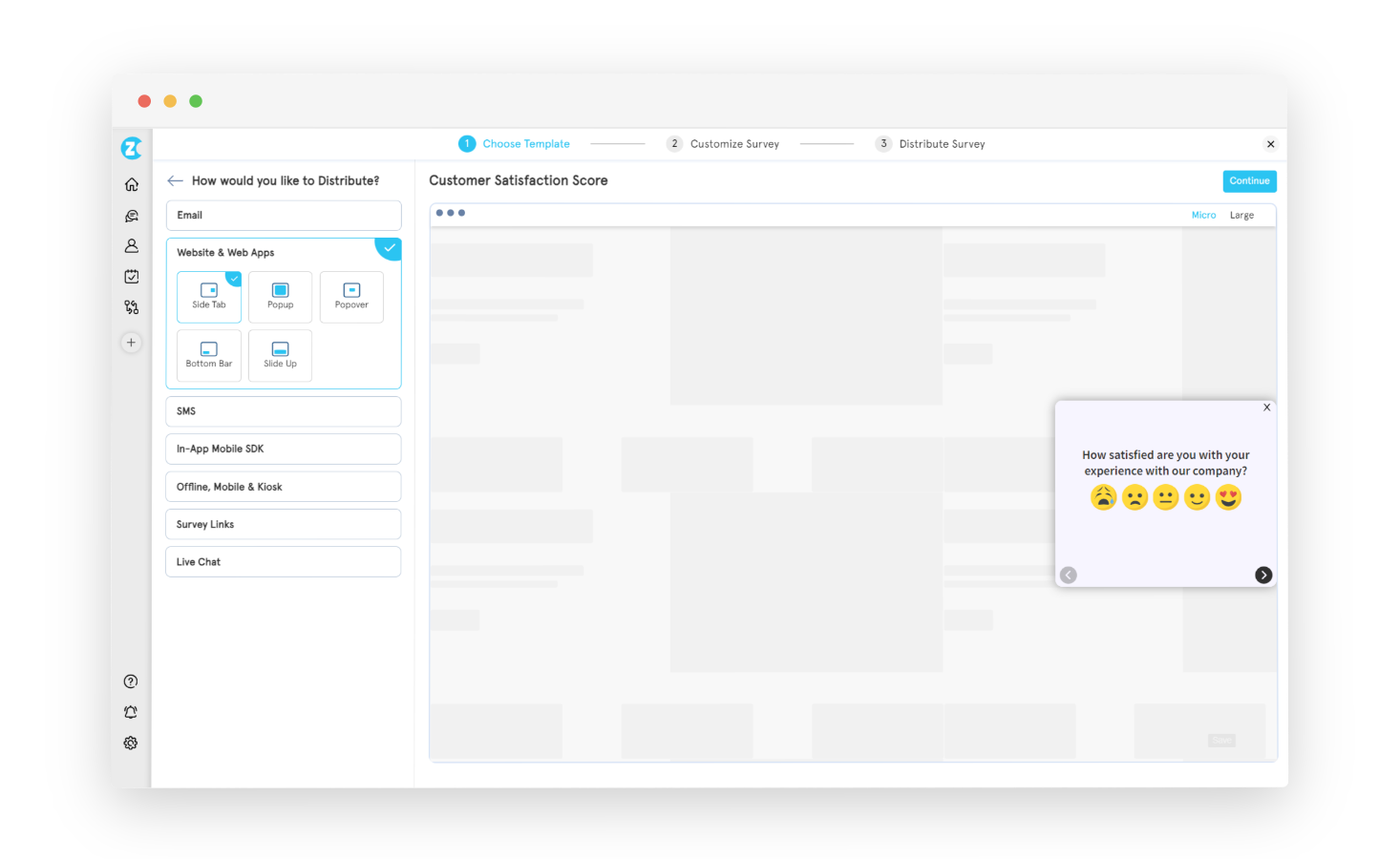
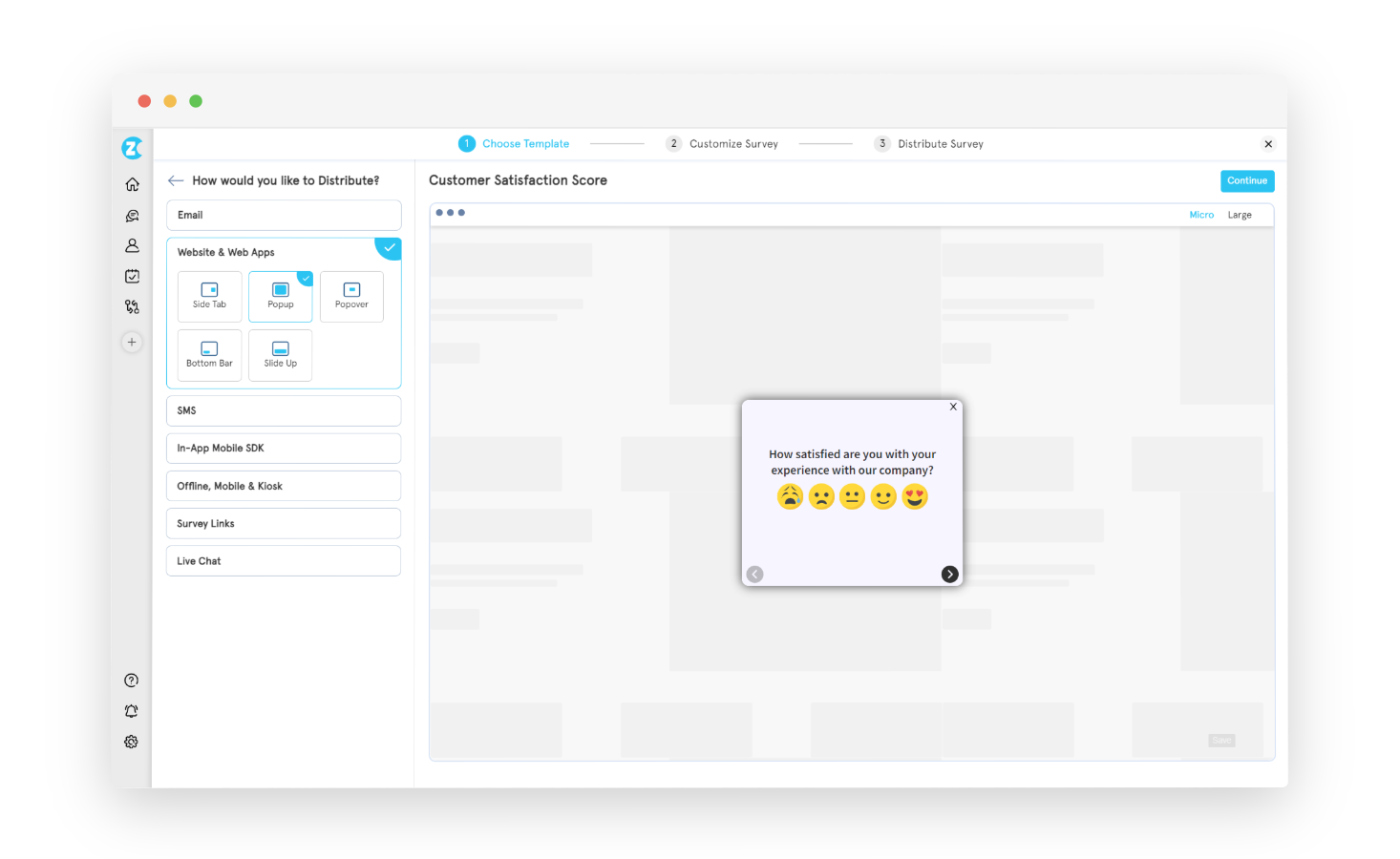
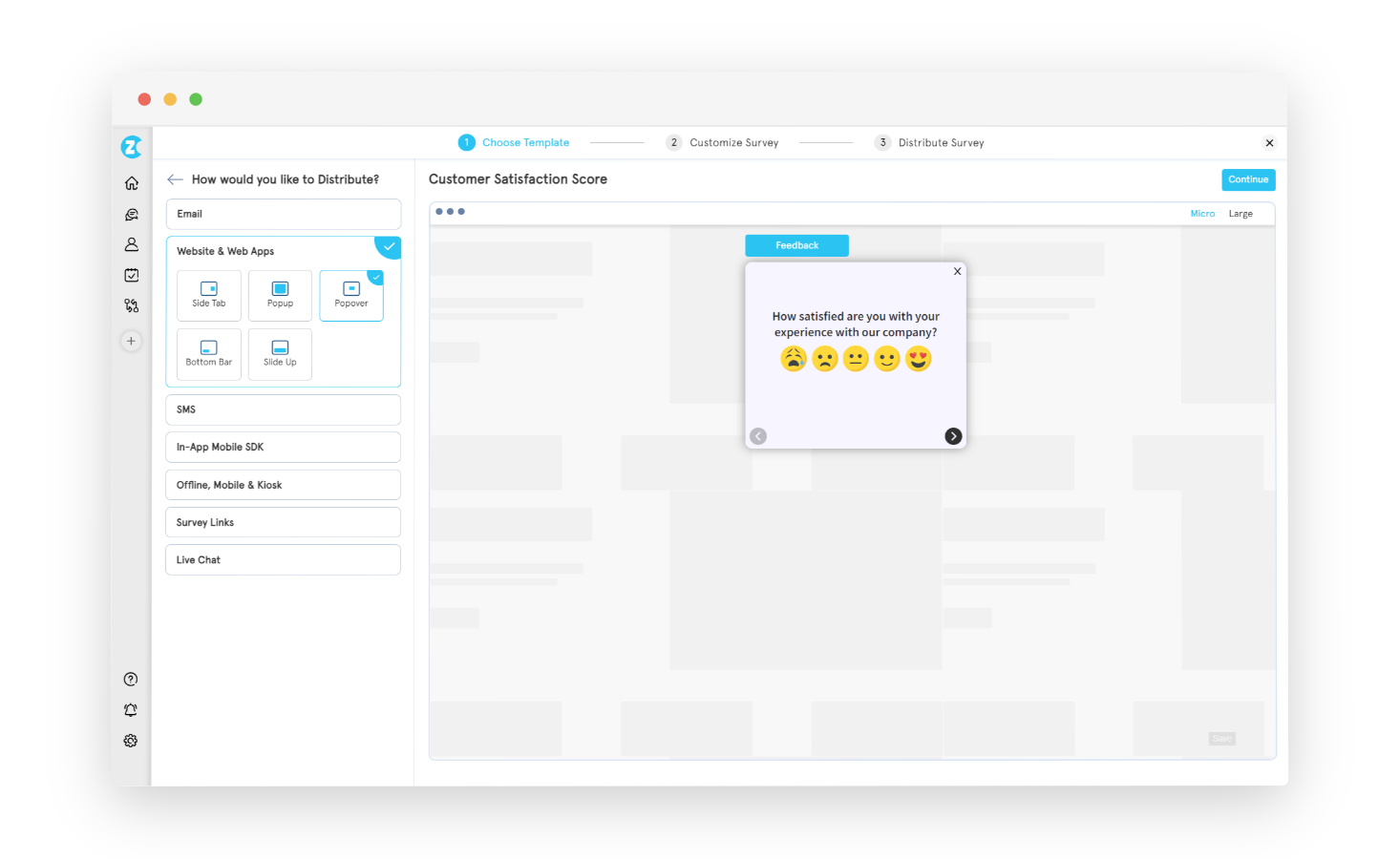
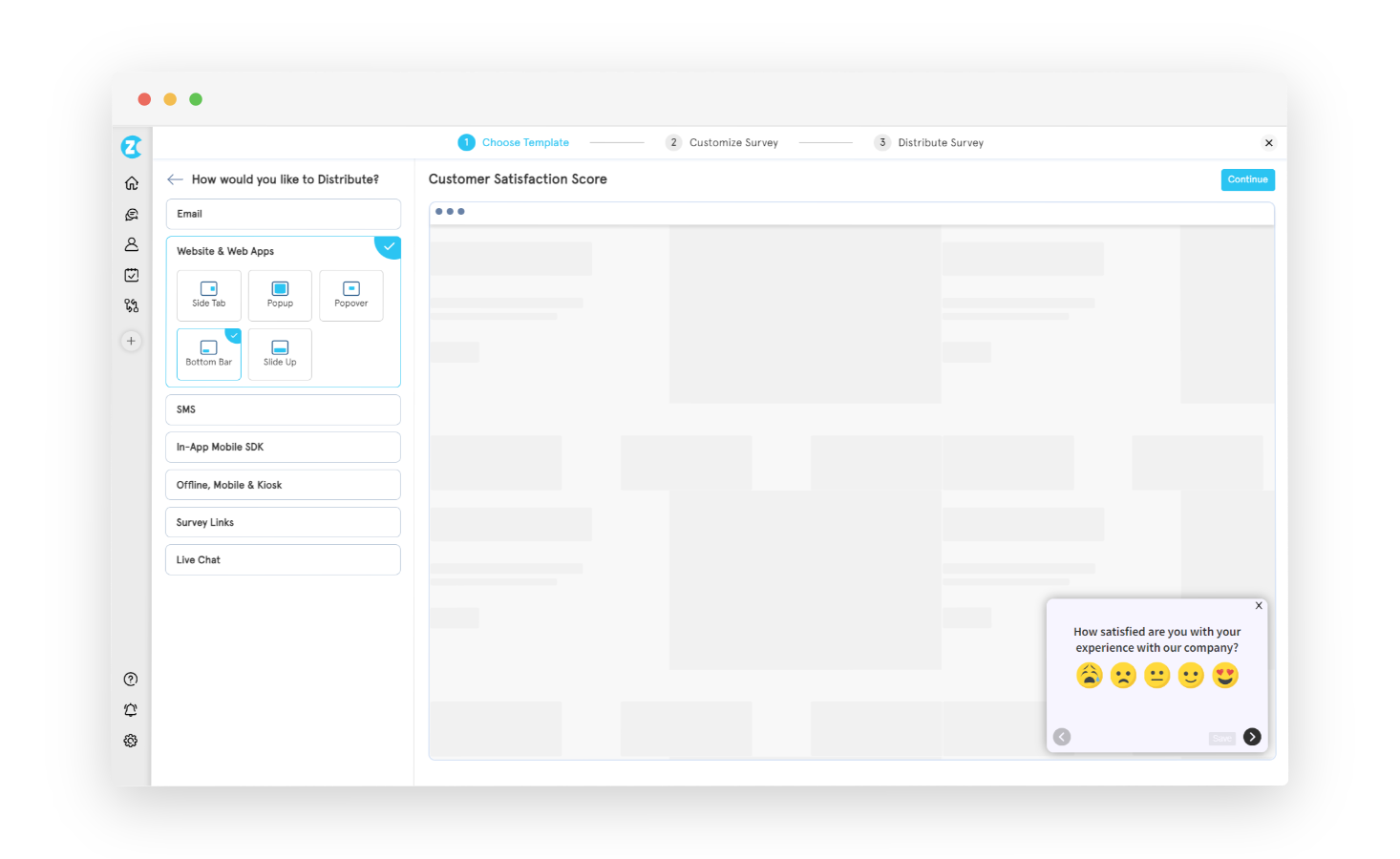
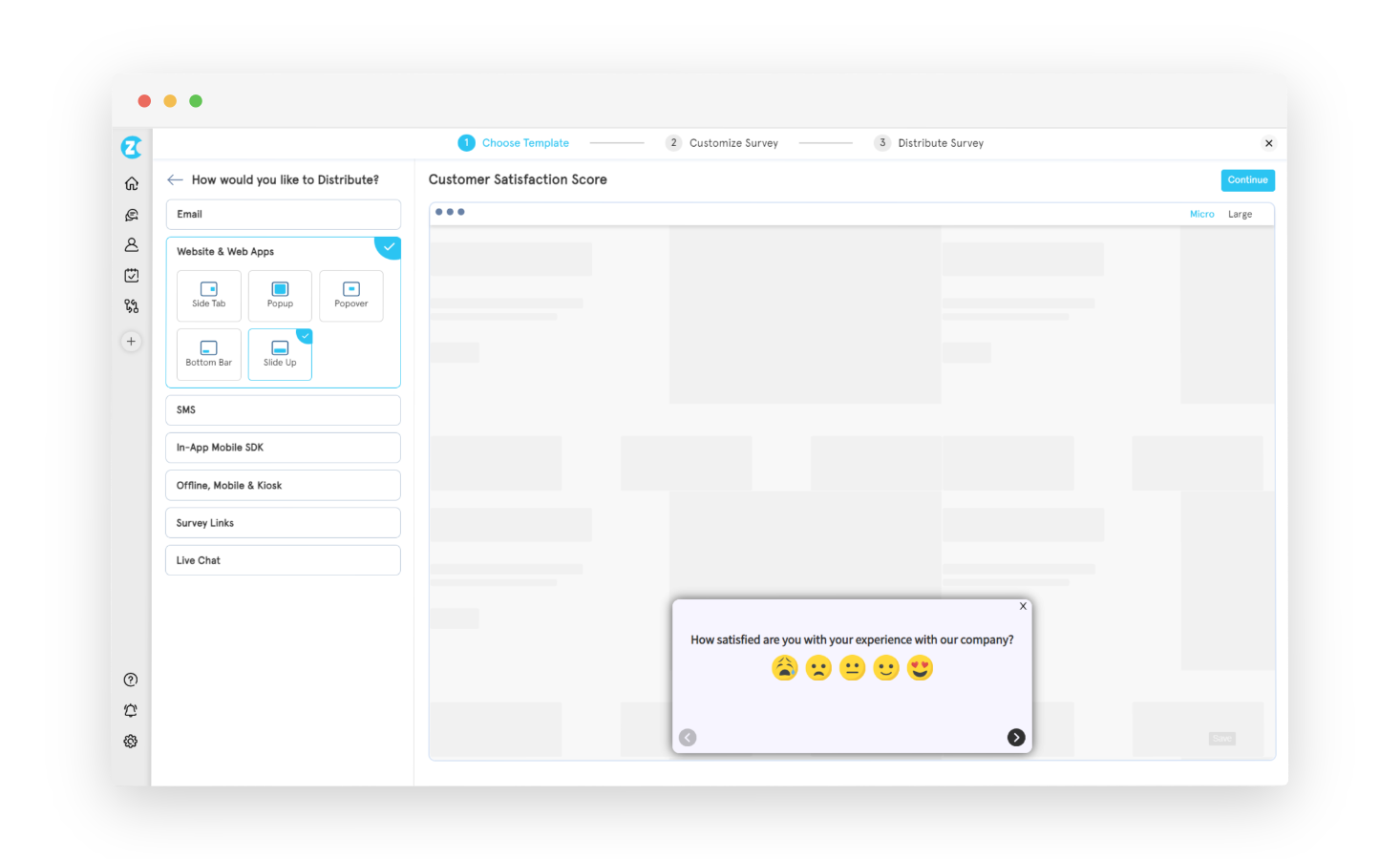
Step 4: Choose your widget type and click on 'Continue'.
-
Side Tab (Feedback Button): Fixed to the left or right of the page, always visible, user-initiated
-
Popup: Center-screen, system-triggered on load, scroll, time, or exit intent
-
Popover: Opens when a specific button or link is clicked, user-initiated, anchored to the trigger element
-
Bottom Bar: Fixed bar at the page foot, persistent and low-friction
-
Slide Up: Rises from the bottom, triggered like a popup but takes up less screen space
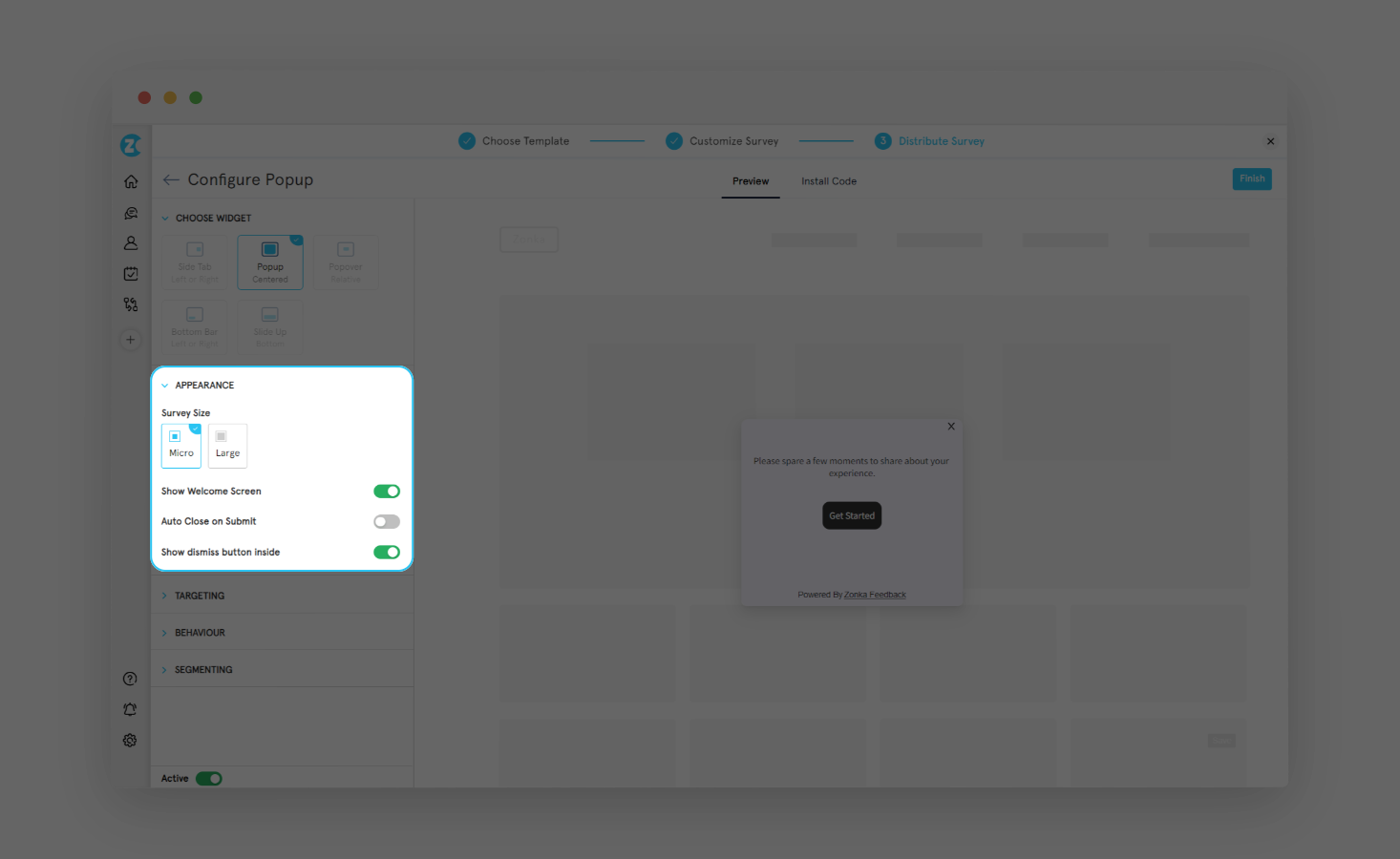
Step 5: Configure your feedback widget by adjusting the available settings in the editor, then click 'Done'.
-
Appearance: Size, position, welcome screen, dismiss button, auto-close behavior
-
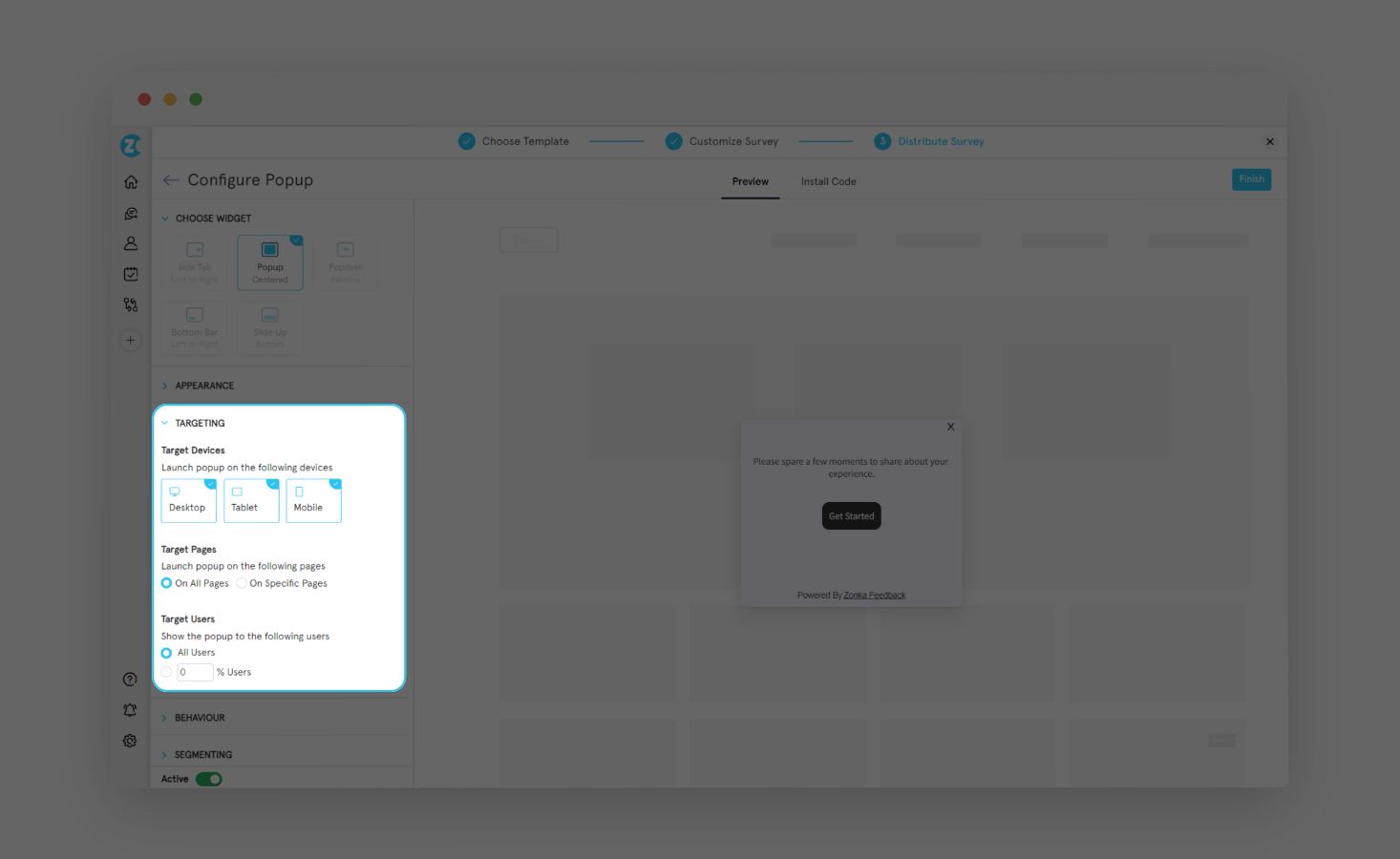
Targeting: Which pages show the widget, which devices, which user segments
-
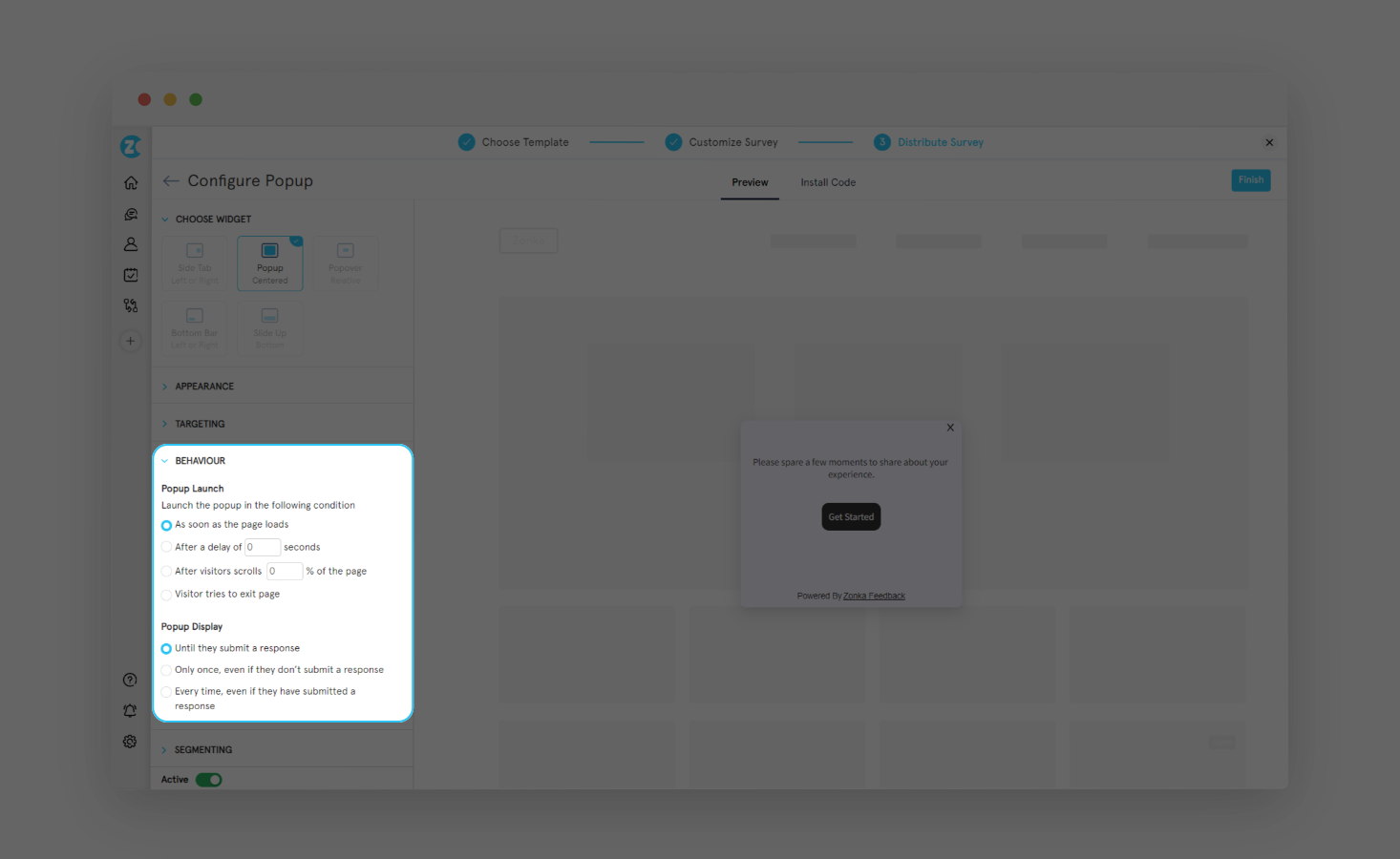
Behavior: Controls when the widget fires (immediately on load, after a time delay, after a scroll percentage, on exit intent) and how often (once per user, until submitted, every visit). This is the panel that makes the difference between a survey that hits the right moment and one that gets dismissed on sight.
-
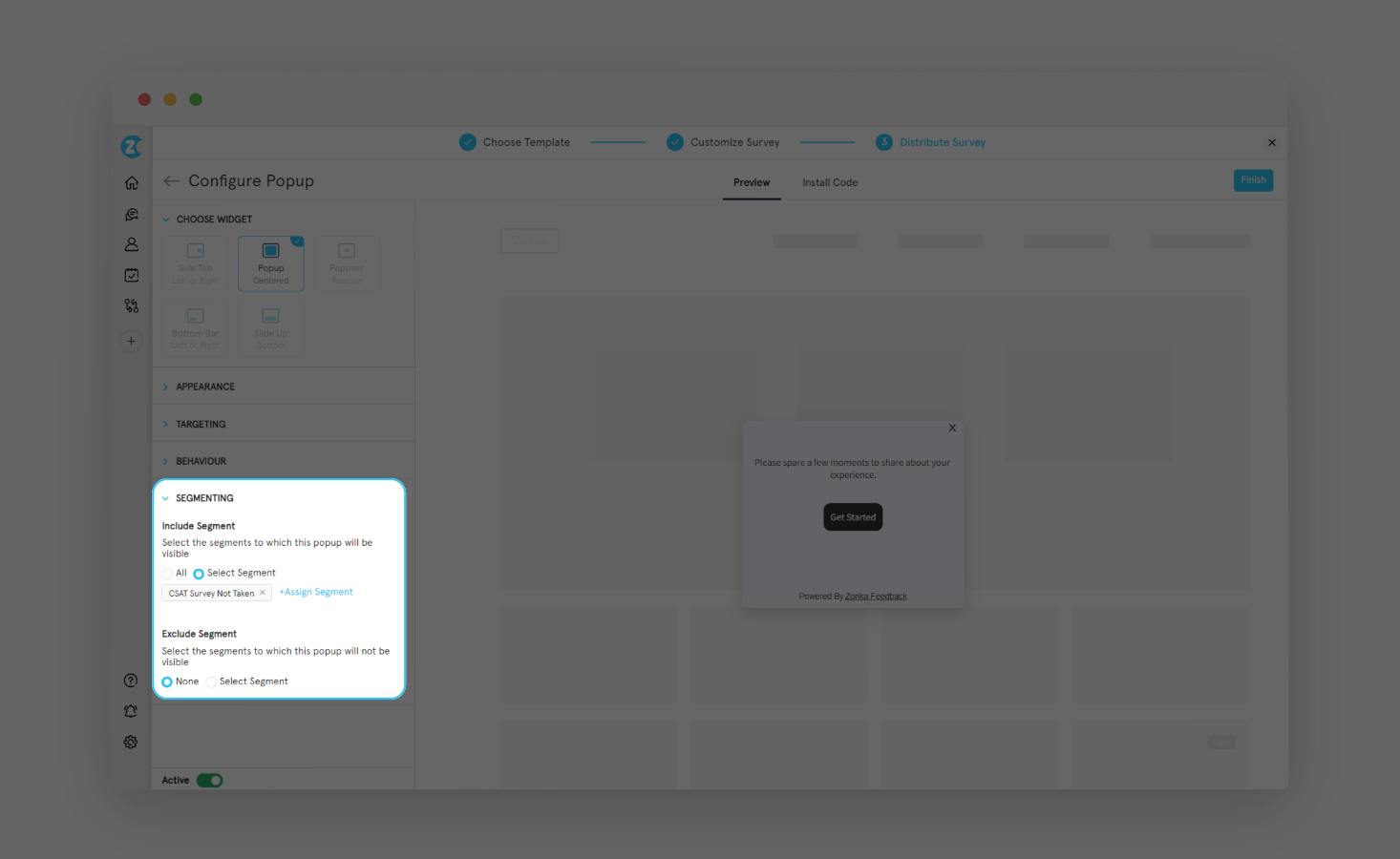
Segment: Define user groups for survey visibility and exclusions
Once the JS snippet is installed on your site, every widget you configure in the dashboard goes live automatically. No redeployment. No developer involvement. New surveys in the same workspace appear without touching the code.
Which Website Feedback Widget Is Right for Your Team?
For SaaS and product teams: Zonka Feedback, Survicate, and SurveySensum cover the range from full CX programs to targeted NPS and CSAT collection. If HubSpot or Intercom is in your stack, Survicate's integrations are worth the evaluation. Teams currently migrating off Delighted (which shuts down June 30, 2026) will find a full comparison of alternatives in Zonka's Delighted sunsetting guide.
For UX research and usability testing: Hotjar's behavioral plus feedback combination is the most efficient way to answer both the "what" and the "why." Marker.io and Userback handle bug reporting if that's the primary need.
For enterprise CX programs: Qualtrics and Medallia are the category leaders. The cost and setup complexity are real. Factor both into the evaluation timeline.
The honest summary: free tiers are worth starting with if your volume is low and your needs are basic. They become liabilities the moment you need targeting, metric tracking, or integration with your existing stack. Zonka Feedback offers a 14-day trial with full feature access (widgets, targeting, analytics, and loop-closure workflows) — before you commit to anything.

.svg)

.svg)