

.svg)
 Healthcare
 Finance
 Retail
 SaaS & Digital
 eCommerce
 Education
 Salesforce
  HubSpot
 Pipedrive
 Mailchimp
 Klaviyo
 Zendesk
  Intercom
 Freshdesk
 HelpScout
  Front
Front Jira
Jira Slack
Slack  MS Teams
 Zoom
Zoom Google Sheets
  Zapier
  Integrately
 Make
Make  Webhooks



 Sign In
 MS Teams


TL;DR
- Mid-market CX teams leave Medallia primarily because of three things: implementation timelines that run 6–12 months, enterprise pricing that doesn't flex for lean programs, and a platform architecture built for global conglomerates — not 50-person CX teams.
- The best Medallia alternatives in 2026 deliver AI-powered thematic analysis, omnichannel feedback collection, and closed-loop workflows without requiring a systems integrator to stand them up.
- Our top picks for mid-market CX teams: Zonka Feedback (fastest time-to-value with Gen AI and pre-built signal classification), SurveySensum (guided CX + AI text analytics), Survicate (product-led, in-app speed), GetFeedback (Salesforce-native), and Qualtrics (if you need Medallia-scale analytics and can self-serve).
- For enterprise-grade alternatives that match Medallia's depth: InMoment, Forsta, and CustomerGauge (B2B account-level NPS) are worth evaluating depending on your use case.
- If your primary need is AI analysis of unstructured feedback without rebuilding your survey stack, Thematic is an underrated option.
Medallia is one of the most powerful enterprise CX platforms on the market. It's also one of the hardest to deploy — most implementations take 6 to 12 months, involve dedicated professional services teams, and land at price points that start well into six figures annually.
For large enterprises running global CX programs with dedicated implementation teams and long budget cycles, that model works. But for mid-market CX teams that need to get a feedback program live in weeks — not the next fiscal year — it's a real problem.
The good news: you don't have to choose between Medallia-grade intelligence and a timeline that actually works for your team. A new generation of CX platforms combines AI feedback analysis, omnichannel collection, and closed-loop workflows at mid-market price points and implementation timelines measured in days, not quarters.
We've evaluated 9 Medallia alternatives that mid-market and growth-stage CX teams should actually consider — not just tools that appear in every "alternatives" listicle, but platforms where the implementation model, price point, and feature depth actually match what teams looking to leave Medallia need.
Quick Answer: Best Medallia Alternatives for Mid-Market CX Teams
Not every Medallia alternative serves the same buyer profile. Use the list below to match the right tool to your team's situation before reading the full profiles.
- Fastest time to value (Gen AI + omnichannel): Zonka Feedback
- Best for guided AI-led VoC programs: SurveySensum
- Best for product-led and in-app feedback: Survicate
- Best for Salesforce-native CX teams: GetFeedback
- Best for enterprise XM with self-service research: Qualtrics
- Best for B2B account-level NPS: CustomerGauge
- Best for managed enterprise CX with AI: InMoment
- Best AI text analytics overlay: Thematic
- Best for global CX + research programs: Forsta
What is Medallia?
Medallia is the enterprise-standard for CX management at global scale — trusted by Fortune 500 companies in financial services, retail, and telecom. Understanding what it does well, and where it creates friction, is the fastest way to know which alternative actually fits your program.
Medallia is an enterprise experience management platform built to capture feedback across digital, voice, and in-person channels and analyze it at the scale large enterprises operate. Founded in 2001, it primarily serves Fortune 500 companies in financial services, retail, telecom, and hospitality. Its platform spans customer experience, employee experience, contact center analytics, and market research — connected through a single customer experience cloud.
The result is genuine analytical depth, but also genuine organizational weight. Medallia is built to replace a CX team's entire analytics infrastructure, which means it requires significant IT involvement, professional services support, and budget authority that most mid-market teams simply don't have.
Why Mid-Market Teams Look for Medallia Alternatives?
The reasons teams leave Medallia are consistent across organization sizes: the platform is architected for global conglomerates, and the implementation model reflects that. Here's what drives the search for alternatives.
- Implementation takes too long. Typical Medallia deployments run 6–12 months before a team sees meaningful data. For teams that need insights this quarter, that timeline is a dealbreaker.
- Pricing isn't structured for lean programs. Medallia's enterprise pricing model doesn't accommodate teams running NPS programs at 5,000–50,000 responses per year — the contract structures are built around much larger scale.
- You're paying for capabilities you won't use. Employee experience modules, contact center analytics, digital experience orchestration — Medallia packages everything. Mid-market CX teams often only need two or three of those layers.
- It requires specialists to operate. Most Medallia customers maintain a team of platform administrators or rely on ongoing consulting support. Lean CX teams can't operate a platform that needs a system integrator to change a dashboard.
- The AI architecture is showing its age. Medallia's analytics layer is capable but built on an older NLP foundation. Teams evaluating modern platforms find that Gen AI-native tools offer intent extraction and phrase-level sentiment that keyword-based NLP doesn't reach.
What to Look for in a Medallia Alternative?
Not every Medallia alternative is interchangeable. Five criteria separate the tools that actually replace Medallia from those that just look similar on a features checklist.
- Implementation speed: How long before your team has real data? Look for platforms that promise days or weeks, not months — and verify that claim against G2 reviews, not just marketing copy.
- AI feedback analysis: Thematic analysis, sentiment scoring, and entity mapping. Does the platform tell you WHY scores changed, not just that they changed?
- Omnichannel collection: Email, SMS, in-app, web widget, WhatsApp, offline — whichever channels your customers actually use.
- Closed-loop workflows: Alerts, case routing, and follow-up automation. Collecting feedback without acting on it is just data hoarding.
- Right-sized pricing: Can the platform actually be purchased by a mid-market CX team, or does it require finance committee sign-off?
Medallia Alternatives at a Glance
A quick reference across all 9 tools — time to live, AI depth, and G2 rating. Use this to shortlist before diving into the full profiles below.
| Medallia Alternative | Best For | Time to Live | AI Strength | G2 Rating |
| Zonka Feedback | Mid-market CX teams needing Gen AI + omnichannel + fast deployment | Days | Gen AI — thematic analysis, entity mapping, impact scores, intent extraction, pre-built AI signal classification | 4.7 / 5 |
| SurveySensum | Cost-conscious teams wanting AI VoC + guided CX support | Days–Weeks | AI text analytics with themes, sentiment, ticketing | 4.6 / 5 |
| Survicate | Product-led SaaS teams running in-app and web intercepts | Minutes–Hours | Basic analytics, strong targeting; no deep AI analysis | 4.6 / 5 |
| GetFeedback | Salesforce-native CX teams | Days (if on Salesforce) | Limited; primarily CRM-mapped reporting | 4.5 / 5 |
| Qualtrics | Enterprise teams needing Medallia-scale analytics + self-service research | Weeks–Months | NLP-based Text iQ; deep survey logic and research capabilities | 4.3 / 5 |
| CustomerGauge | B2B enterprises managing account-level NPS and revenue attribution | Weeks | Account-level VoC analytics, revenue attribution | 4.6 / 5 |
| InMoment | Enterprise teams that want managed CX deployment | Months (managed service) | Early AI adoption; NLP-based analytics | 4.1 / 5 |
| Thematic | Teams that need AI text analytics layered on existing survey data | Days–Weeks | Deep AI theme extraction and open-text classification | 4.8 / 5 |
| Forsta | Global enterprises blending CX, EX, and market research | Months | Advanced modeling, storytelling, end-to-end EX/CX/MR | 4.2 / 5 |
9 Best Medallia Alternatives for Mid-Market CX Teams
Each tool below serves a distinct buyer profile. Let us look at some of the best Medallia competitor for varied use case.
1. Zonka Feedback — Best for Mid-Market Teams That Need Enterprise AI Without the Enterprise Timeline
The knock against most Medallia alternatives is that they force a choice: you either get the analytical depth (and a six-month implementation) or you get the speed (and shallow reporting). Zonka Feedback is built to close that gap.
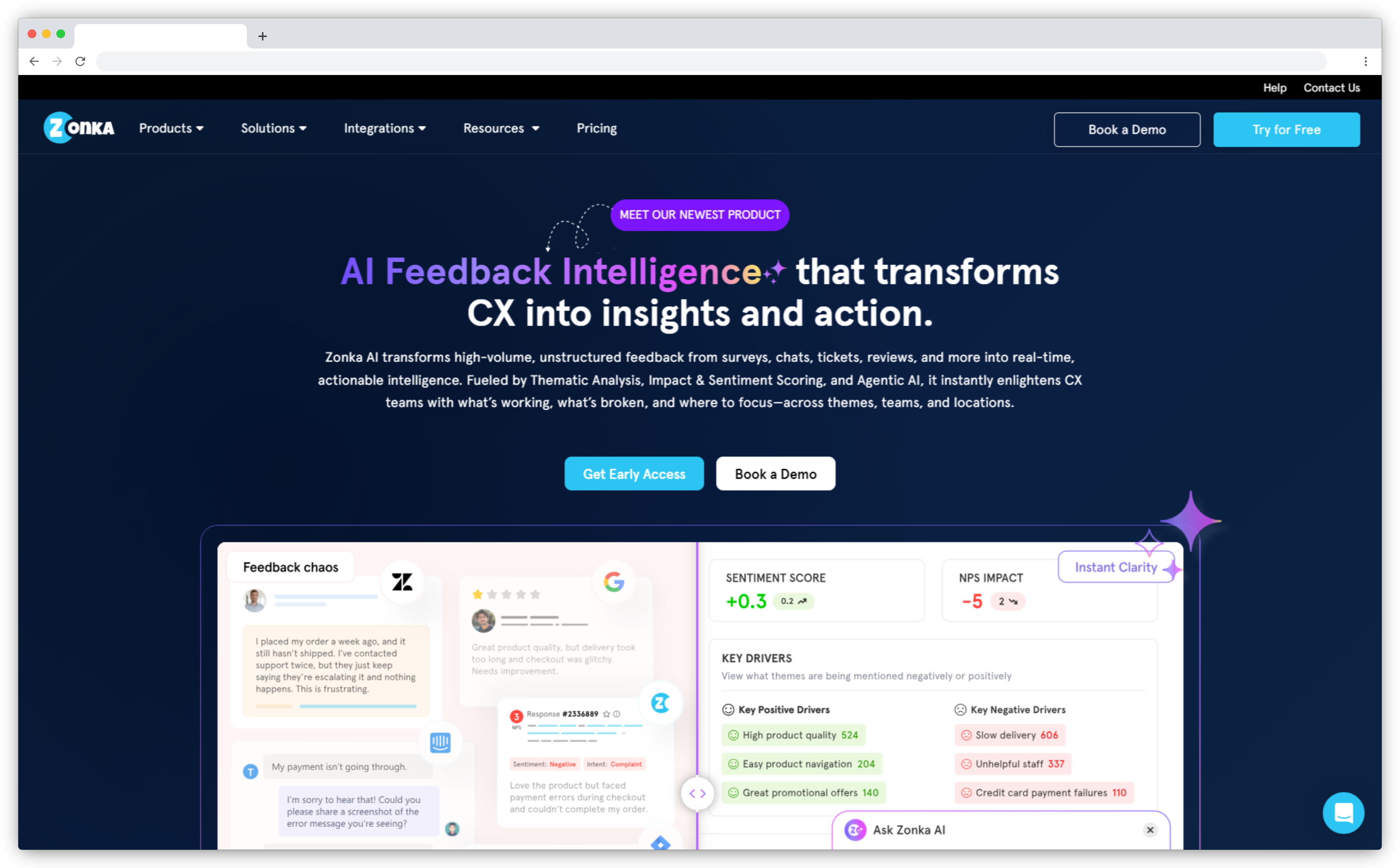
Zonka's AI Feedback Intelligence layer automatically classifies incoming feedback — from surveys, support tickets, reviews, and in-app responses — into themes, maps those themes to specific business entities (locations, agents, product features, departments), and scores them for sentiment and business impact. The difference from older NLP-based systems is what it surfaces: not just "this response is negative" but "agent training is the theme driving dissatisfaction in your New York location, and it's been trending up for three weeks." That's the kind of output that changes what a CX team does on Monday morning.
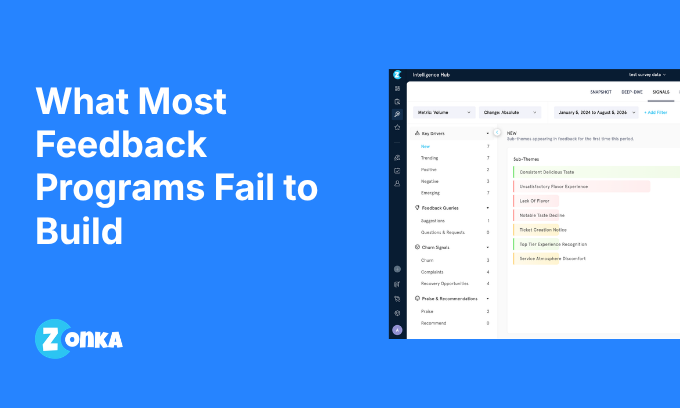
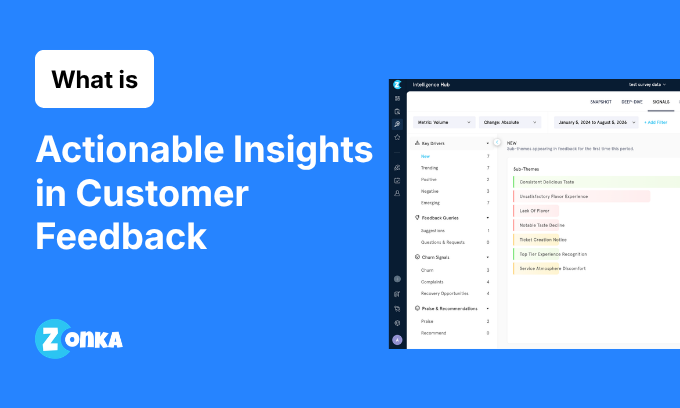
But theme detection is only half the problem. The other half is knowing what to do with 400 detected themes when your team has bandwidth for five actions this sprint. That's where Zonka's AI Signals view changes the equation. Instead of handing you a flat list of themes and leaving the interpretation to you, AI Signals auto-classifies every detected sub-theme into five pre-built operational signal buckets — Key Drivers (New, Trending, Positive, Negative, Emerging), Churn Signals (Churn, Complaints, Recovery Opportunities), Feedback Queries (Suggestions, Questions & Requests), Praise & Recommendations, and Mixed Signals (where words contradict the score). The classification is pre-built. No taxonomy setup, no custom model training, no professional services engagement. You see your themes already sorted into "what's driving satisfaction," "what's driving churn," and "what needs a response" — from day one.
That's a fundamentally different proposition from Medallia's Athena AI. Athena is powerful, but it's powerful the way a custom analytics build is powerful: it requires months of implementation, data pipeline configuration, and taxonomy calibration before it starts delivering the operational signal routing that Zonka ships out of the box. For a mid-market CX team that doesn't have a dedicated analytics engineering squad, that distinction is the difference between getting actionable insights this month and getting a project plan for next quarter.
Deployment is fully self-service. No consulting engagement required. Most teams complete initial setup — customer satisfaction survey templates, channel configuration, CRM integration, and dashboard setup — in a few days. The platform covers email, SMS, WhatsApp, web widget, in-app, offline/kiosk, and QR code collection out of the box. With built-in CX automation, you can measure customer satisfaction and trigger alerts, route cases, and create data-driven workflows in the same platform.
How Zonka Feedback Compares to Medallia
- Speed: Zonka is live in days via self-service setup; Medallia deployments typically run 6–12 months with a dedicated PS team.
- AI architecture: Zonka uses Gen AI for intent extraction and phrase-level sentiment; Medallia is built on an older NLP foundation that surfaces keywords rather than meaning.
- Pre-built signal classification vs. custom analytics builds: Zonka's AI Signals view delivers pre-classified operational intelligence — churn signals, key drivers, feedback queries — from day one, with zero configuration. Medallia's Athena engine can surface similar patterns, but only after months of taxonomy setup, data pipeline integration, and model calibration with professional services. For mid-market teams, that's the difference between insight on demand and insight on a roadmap.
- Pricing: Zonka is accessible for mid-market programs; Medallia's enterprise contracts are structured for multi-million dollar CX budgets.
Key Features
- AI Feedback Intelligence: Transform qualitative and quantitative data into insights using sentiment analysis, predictive analytics, and emotion detection.
- AI Signals: Pre-built signal classification that auto-sorts every detected sub-theme into five operational buckets — Key Drivers, Churn Signals, Feedback Queries, Praise & Recommendations, and Mixed Signals — so teams get action-ready intelligence without building custom taxonomies or training models.
- Unified Intelligence Hub: Centralize customer experience data across channels, teams, and locations, and visualize trends that impact satisfaction and retention.
- CX Automation & Case Management: Automate routing, alerts, task assignments, and case closures to speed up resolution.
- Survey Management at Scale: Create NPS, CSAT, CES, and custom surveys with 100+ templates, advanced logic, and multilingual support.
- Impact & Trend Analysis: Identify top churn drivers, friction points, and satisfaction gaps across customer segments and touchpoints.
- Reputation & Review Management: Track online brand sentiment, consolidate feedback from reviews, and align actions with CX performance goals.
- Advanced Analytics & Reporting: Customizable dashboards, drill-downs, and exports for data-driven decisions.
- Enterprise Security & Compliance: GDPR- and SOC 2-compliant with encryption and role-based access for multi-location enterprises.
Zonka Feedback Pros
- Enterprise-grade customer feedback tool combining Gen AI analytics, pre-built signal classification, and closed-loop automation
- Real-time feedback collection across multiple channels with seamless CRM integration
- Intuitive interface that reduces setup time compared to other Medallia competitors
- Powerful CX automation workflows to close the feedback loop efficiently
- Deep customization options with custom pricing, branding, and AI model tuning
- Exceptional customer support with onboarding assistance and dedicated success managers
Zonka Feedback Cons
- Voice feedback analysis not yet available
- Limited employee experience specialization compared to dedicated EX platforms
Zonka Feedback Pricing
- Custom pricing available based on business requirements
- Free trial for paid features available for 14 days
2. SurveySensum — Best for Teams That Want AI-Driven VoC With Guided CX Support
SurveySensum positions itself differently from most tools on this list: it bundles optional CX expert guidance alongside the software. For teams that have the budget to hire Medallia but don't have an internal CX architect to design the program, that combination of software and methodology support is genuinely useful.
Powered by AI-driven analytics, SurveySensum combines customer feedback tools, text and sentiment analysis, and predictive analytics to help teams capture, interpret, and respond to customer insights faster. Its built-in ticketing system ensures every piece of feedback triggers a follow-up, enabling organizations to close the feedback loop faster and improve customer experience management across the entire customer lifecycle.
How SurveySensum compares to Medallia
- Speed: SurveySensum is live in days to weeks; its guided setup means even teams without dedicated CX ops can start collecting data quickly.
- Guidance model: SurveySensum's consultants help you run the platform yourself; Medallia requires consultants to run it for you — a fundamentally different model for self-sufficient teams.
- Pricing: Significantly more affordable than Medallia, with CX consulting included rather than billed separately.
Key Features
- AI-Powered Text Analytics: Transform unstructured feedback into meaningful data using sentiment analysis, keyword clustering, and intent detection.
- Real-Time Ticketing & Automation: Automatically trigger workflows to resolve customer issues quickly and track resolution timelines.
- Comprehensive CX Metrics: Measure CSAT, NPS, and CES to monitor experience across the entire customer lifecycle.
- Advanced Analytics & Reporting: Generate insights from dashboards with filters, trend reports, and customer segment breakdowns.
- Integrated Feedback Collection: Capture feedback through email, web, in-app, and chat — no interaction goes unnoticed.
- AI Recommendations: Machine learning identifies churn signals, friction points, and upsell opportunities.
- Custom Dashboards & Alerts: Real-time insight into survey responses, with automatic escalation for urgent cases.
SurveySensum Pros
- Combines advanced analytics capabilities with a simple, user-friendly interface
- Affordable alternative to Medallia with guided onboarding and CX consultation included
- Robust automation for closing the feedback loop without technical overhead
- Strong customer support and fast implementation timelines
SurveySensum Cons
- Limited offline feedback functionality compared to larger CX suites
- Some advanced features like predictive analysis available only on premium tiers
SurveySensum Pricing
- Free trial available with up to 25 responses and unlimited surveys
- Custom pricing for enterprise and CX automation plans
3. Survicate — Best for Product and Growth Teams Running In-App Feedback
Survicate is the fastest tool on this list to get running. Install the JavaScript snippet or the mobile SDK, connect your user data, and you can be running a targeted in-app survey within the hour. For product teams that need fast feedback loops — post-onboarding NPS, feature adoption CSAT, churn-risk signals — that speed is hard to beat.
The platform covers website widget surveys, in-app surveys, email surveys, and link surveys, with strong audience targeting based on user attributes, behavior triggers, and segment rules. Templates for NPS, CSAT, CES, and PMF are pre-built. Where Survicate stops short is analytics depth: the reporting shows response distributions and basic trend lines, but it doesn't do the deep thematic analysis or impact scoring that a full CX platform provides.

How Survicate compares to Medallia
- Scope: Survicate is a survey collection tool; Medallia is a full experience management platform — they're not the same category, but for product feedback Survicate is far faster and lighter.
- Speed: Live in minutes to hours; Medallia comparisons here are almost irrelevant given the different implementation models.
- Pricing: Significantly lower entry price — accessible for product-led teams on startup or growth-stage budgets.
Key Features
- In-App & Web Feedback Widgets: Capture contextual feedback directly within your product or website through pop-ups, slide-ins, and microsurveys.
- AI-Powered Sentiment & Text Analytics: Analyze open-text responses with sentiment analysis, keyword clustering, and emotion detection.
- Behavior-Based Survey Triggers: Launch targeted surveys based on user actions, page views, or feature usage at the most relevant moments.
- Comprehensive CX Metrics: Measure NPS, CSAT, and CES in real time to monitor satisfaction across the customer lifecycle.
- Real-Time Dashboards & Alerts: Access automated alerts that help teams respond faster to emerging issues.
- Seamless Integrations: Connect with HubSpot, Intercom, Salesforce, Slack, and Google Analytics to unify customer experience data.
- Customizable Survey Templates: Create branded, multilingual surveys with advanced logic — no coding required.
Survicate Pros
- Best-in-class speed for in-app and web feedback setup — live in minutes
- Intuitive interface with strong behavioral targeting and segmentation
- Strong AI sentiment analysis and trend reporting for product teams
- Integrates seamlessly with marketing and CRM tools
Survicate Cons
- Limited advanced analytics compared to enterprise CX suites
- No built-in ticketing or workflow automation features
Survicate Pricing
- Business plans from $79/month; Enterprise custom pricing available
- Free trial available
4. GetFeedback — Best for Salesforce-Native CX Teams That Need Fast Setup
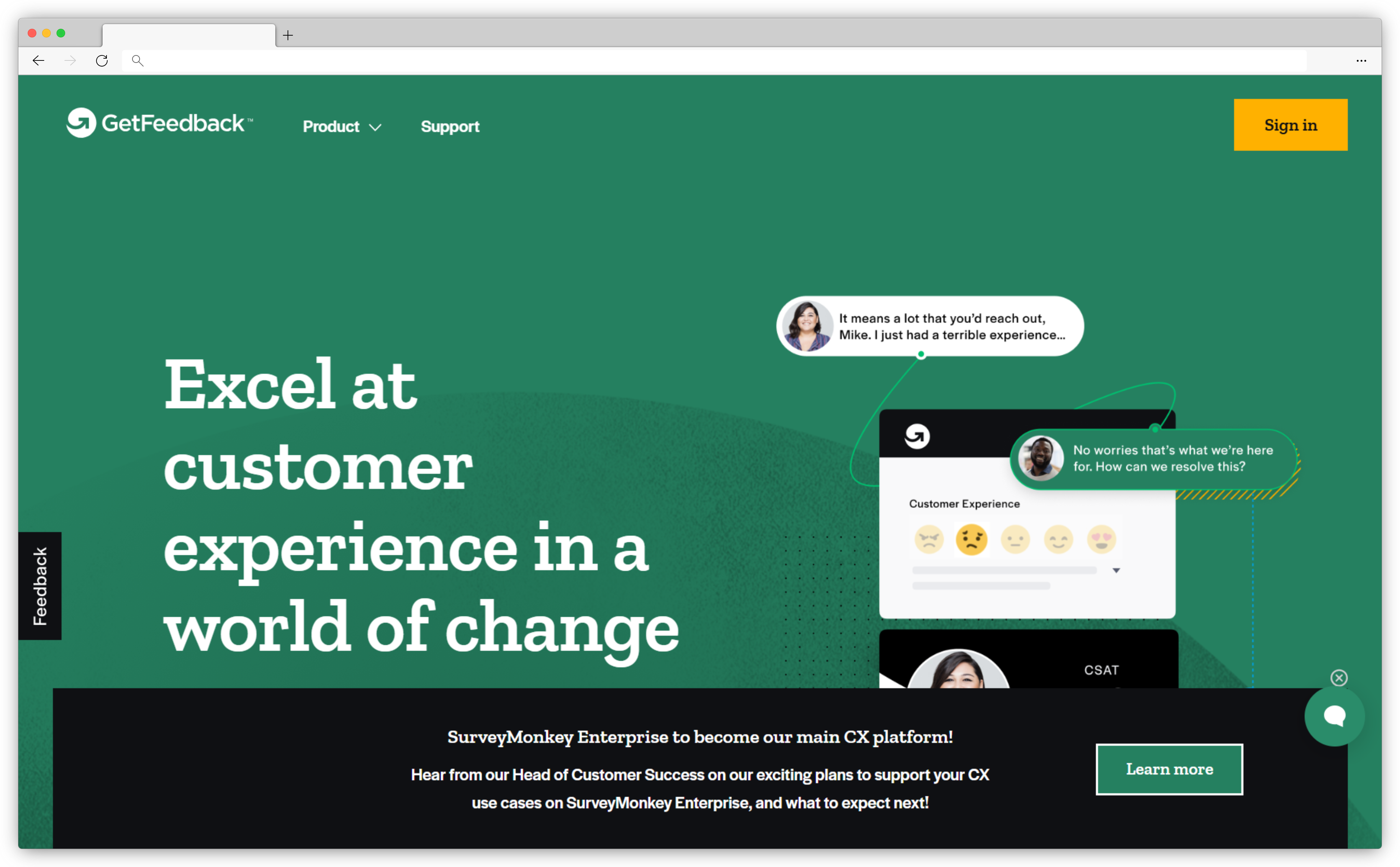
GetFeedback was originally built as the deepest Salesforce-native feedback tool on the market — custom object mapping, merge fields in survey questions, bidirectional sync, and image capture all came standard. It was the fastest route to a Salesforce-integrated feedback program, and for Salesforce-heavy teams it still is.
Since its acquisition by SurveyMonkey, the situation is more complicated. GetFeedback is being migrated to SurveyMonkey's unified platform, and some advanced Salesforce integration capabilities have been removed or limited in the process. The digital channels product (non-Salesforce web/in-app surveys) is also being discontinued. Worth verifying exactly which capabilities are live before committing. A closed-loop feedback program that can close the feedback loop via Salesforce workflows remains the core use case where it leads.
How GetFeedback compares to Medallia
- Scope: GetFeedback is a Salesforce feedback layer; Medallia is an enterprise CX platform — for Salesforce-centric teams, GetFeedback provides CRM-connected VoC that Medallia doesn't prioritize.
- Speed: Live in days if your team is on Salesforce; the CRM integration is the easy part, not the hard part — opposite of Medallia.
- Acquisition risk: Post-SurveyMonkey acquisition, feature changes are ongoing — less predictable roadmap than standalone platforms.
Key Features
- Salesforce Native Integration: Bidirectional sync with automatic data export and synchronization — custom object mapping, merge fields in survey body, image capture.
- Mobile-Optimized Feedback Collection: Responsive, branded surveys that adapt across devices for higher engagement.
- Real-Time Alerts & Dashboards: Real-time insights into customer sentiment with automated alerts to close the feedback loop.
- CX Metrics & Benchmarking: Track NPS, CES, and CSAT scores to measure satisfaction and identify opportunities for improvement.
- Advanced Analytics & Segmentation: Filter survey responses by location, segment, or product to identify patterns in customer behavior.
- Automated Workflows: Intelligent triggers that assign tasks and follow-ups based on customer feedback, routed through Salesforce.
- Multi-Channel Distribution: Gather feedback across email, web, chat, and SMS.
GetFeedback Pros
- Deepest Salesforce-native integration for CRM-first CX teams
- Fast deployment when Salesforce is already in the tech stack
- Intuitive dashboards with strong CRM-mapped reporting
- Mobile-first design for higher survey engagement rates
GetFeedback Cons
- Post-SurveyMonkey acquisition, some advanced Salesforce features have been removed or changed
- Digital channels product being discontinued — limited utility outside Salesforce workflows
- Limited standalone analytics compared to full enterprise CX suites
GetFeedback Pricing
- No public pricing available; custom pricing offered based on business requirements
- Free trial available upon request
5. Qualtrics — Best for Enterprises Needing Medallia-Scale Analytics With More Self-Service Research
Qualtrics is the most direct enterprise-to-enterprise Medallia alternative on this list. Its XM platform covers customer experience, employee experience, market research, and product feedback in a single system — same coverage as Medallia, different philosophy about who does the work. Qualtrics leans self-service for research and survey design; Medallia leans toward managed analytics programs.
Popular among voice of customer tools, Qualtrics combines advanced text analytics, predictive intelligence, and machine learning to help enterprises analyze the impact of product changes on customer satisfaction, perception, and sales — and identify customers at risk. That said, "self-service" is relative. Qualtrics still requires meaningful IT involvement for enterprise deployments, and its Text iQ analytics layer is frequently described by users as powerful but labor-intensive to configure and maintain.
How Qualtrics compares to Medallia
- Research depth: Qualtrics is stronger for self-service research programs — conjoint analysis, MaxDiff, academic survey logic; Medallia is stronger for operational CX at continuous scale.
- Implementation: Qualtrics enterprise deployments run weeks to months — faster than Medallia, but not the self-service speed mid-market teams need.
- Pricing: Qualtrics enterprise contracts typically land between $25,000 and $100,000+ per year — less than Medallia for most implementations, but still requires enterprise budget cycles.
Key Features
- Experience Management Suite (XM): Centralize customer experience data, employee engagement, and market research insights across departments in one platform.
- Text iQ & Speech iQ: Analyze open-ended text and voice data to extract key themes, sentiment analysis, and tone indicators.
- Predict iQ: Anticipates churn and satisfaction outcomes using AI-powered behavioral prediction.
- Stats iQ: Runs advanced statistical tests automatically, highlighting customer insights and significance levels.
- Feedback Collection & Survey Management: Build CSAT, CES, NPS, and research surveys with advanced survey logic, branching, and multilingual options.
- Real-Time Reporting Dashboards: Customizable dashboards for improving customer experience across multiple channels.
- Advanced Governance & Data Security: Role-based access, audit trails, and encryption for enterprise compliance.
- Integrations & Ecosystem: Connects with Salesforce, HubSpot, Zendesk, Adobe, and BI tools.
Qualtrics Pros
- Enterprise-grade platform with robust CX, EX, and market research capabilities in one suite
- Rich text and speech analytics for multi-source feedback collection
- Strong AI-powered insights for predicting trends and improving customer satisfaction
- Excellent for academic research and large-scale market research initiatives
- Extensive ecosystem of integrations and extensions
Qualtrics Cons
- Steep learning curve and complex setup for lean or mid-market teams
- High cost of ownership; many advanced features locked behind enterprise plans
- Text iQ analytics frequently described as "fiddly and manual" — requires configuration time
Qualtrics Pricing
- $25,000 – $100,000+ per year for enterprise; simple survey tier available free
- Custom pricing based on enterprise scope and modules
If you're exploring more options, check out our full guide to the top Qualtrics competitors and alternatives.
6. CustomerGauge — Best for B2B Enterprises Managing Account-Level NPS and Revenue Attribution
CustomerGauge solves a problem that Medallia doesn't prioritize: B2B account-level feedback. Most CX platforms, including Medallia, aggregate feedback by individual contact — which misses a fundamental reality of B2B relationships, where multiple stakeholders across an account have different experiences and the account's commercial health matters more than any single contact's score.
CustomerGauge's Account Experience methodology assigns NPS scores at the account level, lets you visualize which accounts are at risk, and connects feedback directly to account revenue through its Monetized NPS feature. For CS leaders trying to justify the ROI of their CX program to finance, that revenue attribution capability is genuinely distinctive. Gartner ranked CustomerGauge #1 for the B2B VoC use case in its Critical Capabilities report.
How CustomerGauge compares to Medallia
- B2B fit: CustomerGauge is purpose-built for B2B account structures; Medallia is built for enterprise B2C programs and adapts to B2B — a meaningful distinction for teams managing complex account hierarchies.
- Revenue attribution: CustomerGauge's Monetized NPS links feedback to ARR, churn risk, and upsell potential — Medallia's analytics are strong on operational CX metrics but not specifically designed around B2B account revenue.
- Implementation: CustomerGauge's structured setup is purpose-built for the B2B use case, which means less configuration overhead than Medallia for account-level programs.
Key Features
- Account Experience™ Methodology: Assign NPS at the account level, aggregating feedback across multiple stakeholders within a single customer organization.
- Account Hierarchy Visualization: Clear overview of all accounts — which are healthy, at risk of churn, and ready for upselling opportunities.
- Monetized NPS: Revenue attribution ties feedback scores to ARR, churn risk, and upsell potential for financial ROI visibility.
- Multi-Stakeholder Feedback Aggregation: Collect VoC data from direct and indirect sources across complex account structures.
- Closed-Loop Workflows: SMART goal setting, task assignments, and churn alert triggers for at-risk accounts.
- Upsell & Referral Identification: Surfaces accounts that are ready for upselling or referral program engagement.
- G2 & NPS Benchmarking: Industry-specific scoring and proactive outreach tools to contextualize program performance.
CustomerGauge Pros
- Purpose-built for B2B account-level NPS — the only platform on this list that does this natively
- Gartner #1 for B2B VoC use case in Critical Capabilities report
- Monetized NPS directly ties CX performance to ARR and churn risk
- Strong closed-loop workflows designed for complex multi-stakeholder accounts
- Highest G2 quality of support score (9.6/10) among alternatives on this list
CustomerGauge Cons
- Not suitable for B2C programs or transactional survey-first use cases
- Focused specifically on NPS and account intelligence — not a full multi-channel CX suite
- Limited pricing transparency; requires sales engagement for evaluation
CustomerGauge Pricing
- Custom pricing; contact sales for details
- Demo available on request
7. InMoment — Best for Enterprise Teams That Want Managed CX Deployment With AI Capabilities
Note: Press Ganey Forsta acquired InMoment in May 2025. Qualtrics subsequently announced a $6.75 billion agreement to acquire Press Ganey Forsta in October 2025, pending regulatory approval. Teams evaluating InMoment as an independent alternative should factor in roadmap uncertainty from this consolidation before committing to a multi-year contract.
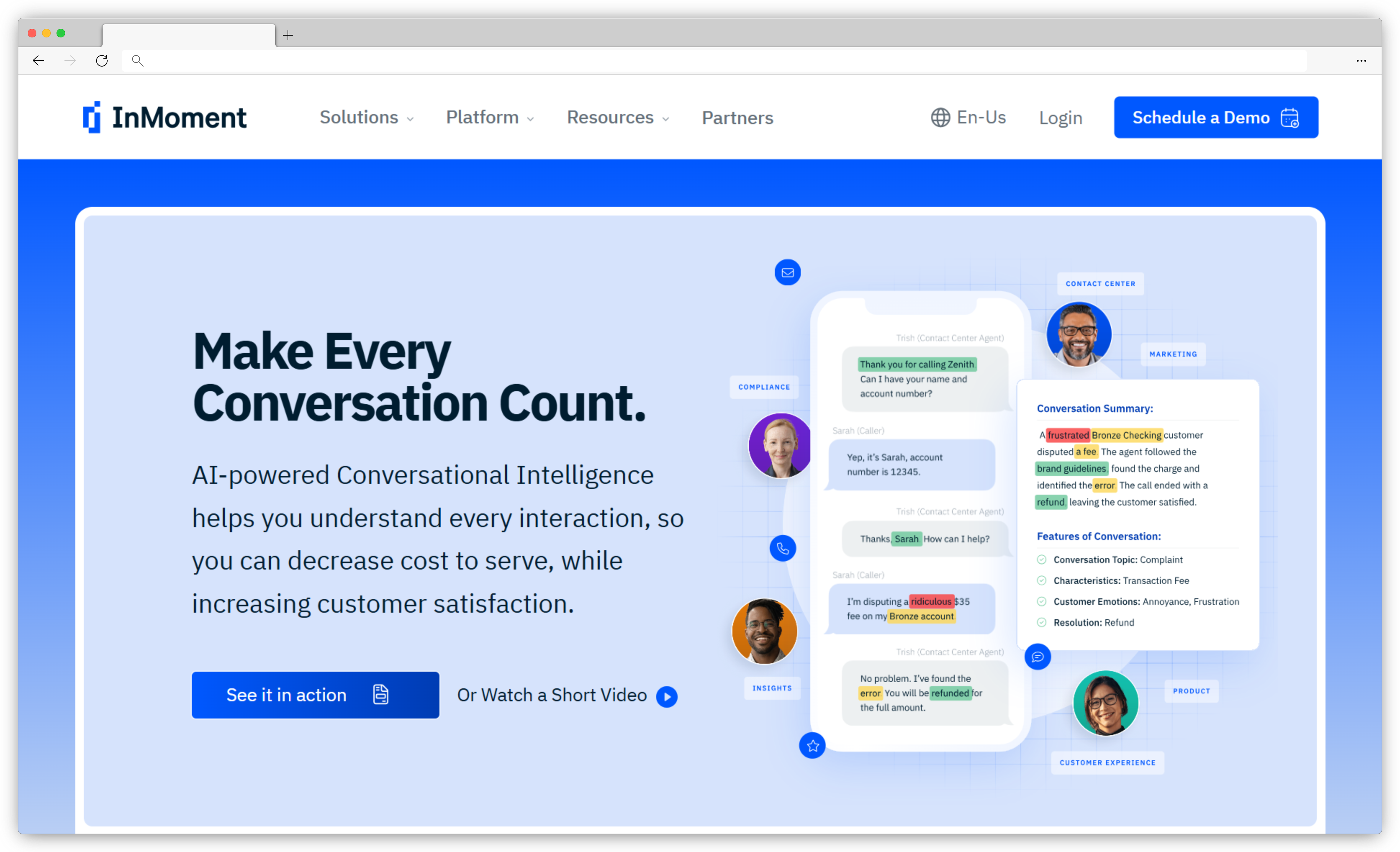
InMoment built its reputation as an early AI adopter in the enterprise CX market. Its XI (Experience Intelligence) platform combines customer, employee, and market data into unified intelligence across touchpoints. For enterprise teams that want a hands-off implementation experience — where a dedicated InMoment team stands up the platform and manages ongoing configuration — this managed service model is a genuine feature.
The limitation is the inverse of its strength: if you want to configure the platform yourself, change a dashboard without a consulting engagement, or iterate quickly on your survey design, InMoment's managed service model creates friction. G2 reviews consistently flag long onboarding, consulting dependency, and dashboard rigidity as recurring pain points.
How InMoment compares to Medallia
- Implementation: InMoment's managed service model produces similar deployment timelines to Medallia — months, not weeks. Right for enterprise teams that want consultants; wrong for teams trying to move faster.
- Flexibility: Less flexible than Medallia for self-service configuration — InMoment's implementation model is more rigid by design, which is a feature for some buyers and a constraint for others.
- AI: InMoment was an early AI adopter, but its analytics are NLP-based — worth evaluating current capabilities against Gen AI-native platforms before assuming parity.
Key Features
- Experience Improvement (XI) Platform: Centralize customer experience, employee, and market insights into a connected system.
- AI & Text Analytics Engine: NLP-based analysis of open-ends from surveys, chat logs, and social mentions to detect sentiment, emotion, and themes.
- Omnichannel Feedback Collection: Gather feedback from email, chat, social media, web, and in-app across the customer lifecycle.
- Integrated CX, EX & Market Clouds: Manage customer, employee, and market experience programs collaboratively.
- Predictive Intelligence: Identifies churn risk, satisfaction drivers, and revenue impact for strategic CX management.
- Action Planning & Workflow Automation: Intelligent alerts, team assignments, and follow-up tracking to close the feedback loop.
- Data Security & Compliance: Enterprise-grade governance and GDPR compliance for large-scale deployments.
InMoment Pros
- Enterprise-ready managed CX deployment — right for organizations that want consultants to handle the platform
- Strong early AI capabilities for text analytics and predictive analytics
- Excellent for integrating CX with financial and operational data
- Multi-cloud coverage across CX, EX, and market experience in one system
InMoment Cons
- Managed service model means implementation takes months — same timeline as Medallia
- Consulting dependency for ongoing configuration; limited self-service flexibility
- Pending acquisition by Qualtrics (via Press Ganey Forsta) adds roadmap uncertainty for 2026 planning
- G2 rating of 4.1/5 reflects user frustrations with dashboard rigidity and onboarding length
InMoment Pricing
- No public pricing available; custom enterprise pricing offered based on business requirements
- Free trial not available; demo available via sales
8. Thematic — Best for Teams That Need AI Text Analytics Layered on Existing Survey Data
Thematic is the most distinctive tool on this list because it doesn't try to replace your feedback collection platform — it sits on top of it. Connect your existing survey data from Qualtrics, SurveyMonkey, Medallia, or any tool with data export, and Thematic applies AI-driven theme extraction and sentiment classification to your open-text responses.
The core problem it solves is familiar to any CX analyst who has received a batch of 3,000 open-text survey responses: you know there are patterns in there, you know those patterns matter, but reading through them manually is a week's work. Thematic cuts that to hours by automatically identifying the themes appearing most frequently, tracking how those themes change over time, and flagging statistically significant shifts — including which themes are most negatively impacting your NPS or CSAT scores.
How Thematic compares to Medallia
- Scope: Thematic is an analytics layer, not a full CX management platform — it replaces the open-text analysis component of Medallia, not the collection and workflow layers.
- Speed: Days to connect and configure, assuming you already have survey data flowing — no professional services required.
- Right use case: Ideal for teams that have already invested in a collection platform but aren't satisfied with the analytical output on open-text — not for teams starting from scratch.
Key Features
- AI-Driven Theme Extraction: Automatically identifies and groups recurring topics from open-text responses across channels — no manual taxonomy setup required.
- Sentiment Scoring Per Theme: Scores sentiment at the theme and sub-theme level so mixed-emotion responses are properly classified.
- Multi-Source Data Connection: Connects to surveys, support tickets, reviews, and any data source with an export — Qualtrics, SurveyMonkey, Medallia, Zendesk, and more.
- Theme Impact Scoring: Quantifies which themes are most negatively or positively impacting your NPS, CSAT, or CES scores.
- Trend Tracking Over Time: Monitors how themes evolve wave over wave, flagging statistically significant shifts before they become crises.
- AI Story Assist: Generates plain-language narrative summaries of theme clusters for executive reporting.
- Intuitive Theme Management Dashboard: Adjust, merge, and rename themes through a visual interface without coding.
Thematic Pros
- Best-in-class AI theme extraction for open-text responses — highest G2 rating on this list at 4.8/5
- Works with any existing data source — no need to switch collection tools
- Fast setup in days; connects data and starts surfacing insights immediately
- Excellent customer success team — high-touch support throughout onboarding
- Strong impact scoring ties themes directly to NPS/CSAT movement
Thematic Cons
- Analysis layer only — does not include feedback collection, closed-loop workflows, or case management
- Smaller review base (40+ G2 reviews) vs. larger platforms — less community validation
- Advanced theme customization may require initial setup time for complex taxonomies
Thematic Pricing
- Tiered plans available; see thematic.com for current pricing
- Demo available on request
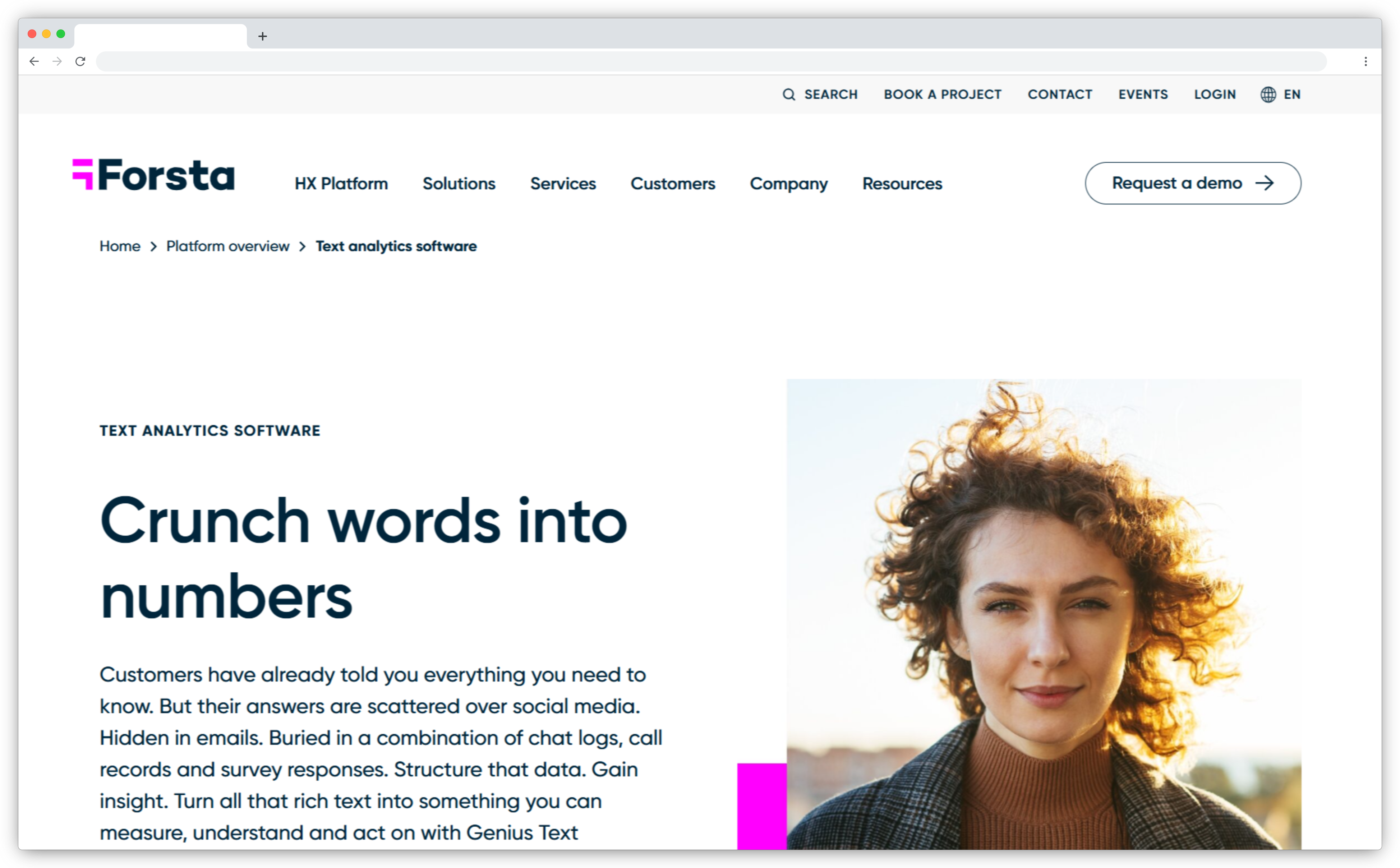
9. Forsta — Best for Global Enterprises Blending CX, EX, and Market Research
Note: Forsta (formed from the merger of Confirmit, FocusVision, and Dapresy) was acquired by Press Ganey in 2024, which was subsequently subject to a $6.75 billion acquisition agreement by Qualtrics in October 2025, pending regulatory approval. Teams evaluating Forsta as an independent platform should account for roadmap changes under new ownership.
Forsta is built for the global scale at which Medallia operates. It covers end-to-end CX, EX, and market research in a single platform with advanced modeling capabilities, multilingual survey support, and visual storytelling tools that produce executive-ready reports directly from raw data. As a flexible online survey tool that blends market research and experience management, it enables teams to understand what customers feel and why they behave the way they do across the entire customer lifecycle. For organizations running research programs across multiple markets — coordinating field research, customer panels, and NPS programs in parallel — Forsta's unified data model is a genuine operational advantage.
How Forsta compares to Medallia
- Research vs. CX focus: Forsta is stronger for complex market research — conjoint, MaxDiff, qualitative tools, and advanced visualization; Medallia is stronger for continuous operational CX at large enterprise scale.
- Implementation: Comparable to Medallia — months, not weeks; enterprise complexity at enterprise scale. Not a mid-market tool.
- Scope: Forsta unifies CX, EX, and market research in one platform; Medallia separates them into distinct modules and clouds.
Key Features
- Omnichannel Feedback Collection: Capture feedback across email, web, in-app, SMS, and offline channels including digital intercepts and mobile SDK.
- Qualitative Research Suite: Video interviews, focus groups, and discussions within Forsta's built-in tools — merging qualitative data with survey analytics.
- HX Analytics & AI Insights: NLP and machine learning to decode emotions, tone, and emerging trends across feedback and open-ended survey data.
- Data Visualization & Storytelling: Transform survey data and qualitative clips into dynamic visual reports and dashboards tailored to executives and CX leaders.
- Reusable Survey Assets & Libraries: Create, store, and replicate templates, question banks, and logic flows for enterprise-scale programs.
- Integrations & Data Flow: Connect to Salesforce, Power BI, Tableau, Snowflake, and SQL databases to automate feedback workflows.
- Global Deployment & Multilingual Support: Launch surveys in multiple languages, manage quotas by region, and monitor results across markets from one platform.
Forsta Pros
- End-to-end platform integrating CX, EX, and market research in a single system
- Strong focus on advanced analytics and executive-ready visual storytelling
- Deep text analytics and sentiment analysis for qualitative data
- Highly customizable and scalable for global enterprise environments
- Best-in-class data visualization through the Dapresy layer
Forsta Cons
- Steeper learning curve for non-technical users — comparable complexity to Medallia
- Pending Qualtrics acquisition adds roadmap uncertainty for 2026 and beyond
- Not a mid-market tool — pricing and implementation model suited for global enterprise programs
Forsta Pricing
- Custom pricing based on business needs and user volume
- Free trial not available; demo available via sales
How We Evaluated These Medallia Alternatives
This list isn't a generic "top tools" roundup. Every tool included was chosen because a team actually leaving Medallia for a mid-market CX program would realistically evaluate it.
This list is based on a combination of G2 and Capterra customer reviews, public product documentation, and Zonka Feedback's direct experience migrating teams from enterprise CX platforms. We evaluated each platform on five criteria: AI feedback analysis depth, omnichannel collection capability, implementation timeline, self-service configurability, and pricing accessibility for mid-market teams.
We excluded tools that don't serve the search intent here — employee experience platforms, contact center analytics tools, and market research-only platforms are covered in separate guides. Every platform listed here was chosen because a team leaving Medallia for a mid-market CX program would realistically evaluate it.
Our analysis drew from verified G2 and Capterra reviews to ensure each recommendation reflects real-world performance and user satisfaction.
Which Medallia Alternative Is Right for You?
The best alternative isn't the one with the longest feature list. It's the one your team can get live, run independently, and get meaningful data from — within a timeline that serves your program's goals.
If your team is leaving Medallia because you need CX intelligence faster and at a price your program can actually afford — Zonka Feedback is worth a serious look. It's the only alternative on this list that combines Gen AI feedback analysis, pre-built signal classification, omnichannel collection, and closed-loop automation with a self-service implementation model and mid-market pricing.
If your use case is specifically B2B account-level NPS, CustomerGauge is purpose-built for that problem in a way no general CX platform is. If you're on Salesforce and need CRM-native feedback collection, GetFeedback remains a practical fast-start option (verify current feature availability). If you're a global enterprise and need comparable depth to Medallia, InMoment or Forsta are the right conversations to have — just go in knowing that both involve comparable implementation complexity, and both now sit within the Qualtrics acquisition orbit.
Wrapping up
Choosing a Medallia alternative comes down to one honest question: what does your team actually need to operate, not just evaluate?
Most CX platform decisions go wrong at the demo stage — the tool that looks best in a 45-minute walkthrough isn't always the one a lean team can run six months in. Before you shortlist, know your answer to three things: who will own the platform day-to-day, what's your realistic go-live timeline, and which two or three capabilities actually drive your program's value. Everything else is just extra.
The tools on this list were chosen because they each answer a different version of that question honestly. The right one is whichever matches your actual operating reality and helps you take actionable decisions.

.png)
.svg)
.png)