

.svg)
 Healthcare
 Finance
 Retail
 SaaS & Digital
 eCommerce
 Education
 Salesforce
  HubSpot
 Pipedrive
 Mailchimp
 Klaviyo
 Zendesk
  Intercom
 Freshdesk
 HelpScout
  Front
Front Jira
Jira Slack
Slack  MS Teams
 Zoom
Zoom Google Sheets
  Zapier
  Integrately
 Make
Make  Webhooks



 Sign In
 MS Teams


The best online survey tools in 2026 include SurveyMonkey, Qualtrics, Zonka Feedback, Typeform, Porsline, and Google Forms: platforms that let you create, distribute, and analyze surveys across email, web, SMS, and in-app channels, from completely free to enterprise CX.
TL;DR
-
24 tools reviewed: AI-powered CX platforms, general-purpose survey makers, free tools, live polling tools, and specialized research platforms
-
Evaluated on: survey builder quality, distribution channels, free plan generosity, AI capabilities, analytics depth, integrations, and pricing
-
Includes a full comparison table, use-case decision framework, and 15 FAQs
-
Genuinely free picks (no hidden limits): Google Forms, SurveyMars, Tally
-
Best for AI-powered CX programs: Zonka Feedback. Best for enterprise research: Qualtrics. Best for conversational surveys: Typeform, Porsline
I've spent time researching and going through hundreds of user reviews across 40+ online survey platforms, and here's what I keep seeing: most teams don't pick the wrong survey tool because they didn't research enough. They pick the wrong one because they didn't ask the right question first.
Do you need to collect feedback, analyze it with AI, or both? Do you need a free plan that actually works long-term, or are you ready to invest in a proper CX platform? Are you running one-off research surveys or building an automated feedback program? The answers narrow the field from hundreds of customer feedback tools to a handful that are actually right for your situation.
This guide covers 24 of the best online survey tools in 2026: platforms I've evaluated based on survey builder quality, distribution breadth, free plan generosity, AI capabilities, and real-world usability. Each entry includes verified G2 ratings, honest pros and cons, current pricing, and a direct verdict on who should use it.
What Are Online Survey Tools?
Online survey tools are software platforms that let you build surveys, send them across digital channels, and analyze the responses you collect. Unlike basic form builders that simply capture data, survey tools are built for feedback programs, they handle distribution at scale across email, SMS, WhatsApp, web, and in-app channels, calculate metrics like net promoter score and CSAT automatically, and generate reports that teams can act on.
The distinction matters when you're choosing. A form builder is designed for data collection and workflow triggers. A survey tool is designed for feedback analysis and insight generation. Modern platforms increasingly blur this line, but the core question remains: are you trying to collect data, or understand it?
What Makes a Good Online Survey Tool in 2026?
After going through reviews and comparative research across 40+ platforms, the difference between a good survey tool and a great one comes down to six things:
Survey builder flexibility. A good drag-and-drop survey builder handles 15+ question types (NPS, CSAT, matrix, ranking, file upload, image choice) along with skip logic and conditional branching. Pre-written questions and industry-specific templates help teams get to a first survey in minutes.
Distribution channels. The best tools don't restrict you to a survey link. Email, SMS, WhatsApp, web widgets, in-app deployment, and offline/kiosk mode all matter. Survey respondents complete surveys where they already are, not where you send them, broader channel coverage means higher response rates.
Free plan quality. Free plans vary wildly. Some give you unlimited surveys and responses; others cap you at 25 viewable responses before requiring an upgrade. Knowing the actual limits, not just whether a free plan exists, is what matters before committing.
AI and analytics capabilities. In 2026, AI features span survey creation (generate surveys from a prompt), open-ended analysis (auto-tag themes and sentiment from text responses), and reporting (surface insights without manual work). Basic charts and filters are table stakes; the differentiator is how much analytical work the AI handles automatically.
Integrations. Survey data only drives action when it flows to tools your team already uses, including CRMs like Salesforce and HubSpot, helpdesks like Zendesk and Intercom, and project tools like Jira. Automated workflows that route detractor responses to your CS team are what separate a survey tool from a feedback intelligence platform.
Data quality and compliance. For regulated industries or large-scale research, GDPR, HIPAA, ISO 27001, and SOC 2 compliance matter. Targeting controls, showing specific surveys to specific user segments, directly affect response quality and data relevance.
How to Choose the Right Online Survey Tool
The right tool depends on what you're actually trying to accomplish. Here's a practical decision framework:
| If you need… | Look for… | Best fit |
| NPS/CSAT/CES programs with AI analysis | Omnichannel distribution + AI text analytics | Zonka Feedback, Qualtrics |
| Completely free with no response limits | Genuinely unlimited free plan | Google Forms, SurveyMars, Tally |
| Conversational surveys with high completion | Chat-style interface | Typeform, SurveySparrow, Porsline |
| Market research or academic research | Advanced logic + panel access | QuestionPro, Alchemer |
| Enterprise CX with role-based reporting | SSO + advanced dashboards + workflows | Qualtrics, Zonka Feedback |
| Employee engagement or anonymous feedback | Anonymity controls + HR integrations | SoGoSurvey, Alchemer |
| Live event polling and audience interaction | Real-time response display | Mentimeter, Tally |
| Surveys + lead gen + contests in one tool | Multi-purpose campaign builder | Jotform, Woorise |
Teams running NPS, CSAT, or CES programs at scale need automation, AI analysis, and CRM integration: capabilities that general survey makers don't include. Teams running occasional research surveys need flexible logic and export formats, not workflow automation. Start with the use case, not the feature list.
How I Evaluated These Online Survey Tools
I researched 40+ survey platforms for this guide by going through verified G2 and Capterra reviews, analyzing feature documentation, comparing free plan limits firsthand, and reviewing real-world use cases reported by users across CX, research, and product teams. Each tool was assessed on survey builder quality, distribution breadth, free plan honesty, AI and analytics depth, integration coverage, pricing transparency, and real-world usability based on what users consistently report across review platforms.
A disclosure worth making upfront: Zonka Feedback is the product behind this blog. It's placed at #3 based on where it genuinely competes on the criteria above, not because it's ours. The same standards apply to it as to every other tool here.
Comparison Table: 10Best Online Survey Tools at a Glance
| Tool | Best For | Free Plan | Starting Price | AI Features | G2 Rating |
| SurveyMonkey | Versatile business surveys | Yes (25 resp limit) | $39/mo | Yes | 4.4/5 |
| Qualtrics | Enterprise research & XM | Trial only | Contact sales | Yes | 4.4/5 |
| Zonka Feedback | AI-powered omnichannel CX | 14-day trial (on request) | Custom pricing | Yes | 4.7/5 |
| Sprig | Enterprise product & UX research with AI | Trial only | Custom | Yes | 4.3/5 |
| Typeform | Conversational high-completion surveys | Yes (10 resp/month) | $29/mo | Yes | 4.5/5 |
| Porsline | AI-assisted surveys with conversational & classic modes | Yes (100 responses/mo) | €23/mo | Yes | NA |
| Survicate | In-app and multi channel feedback | Yes (25 resp/month) | $56/mo | Yes | 4.6/5 |
| Google Forms | Completely free simple surveys | Yes (unlimited) | Free | No | 4.6/5 |
| SurveySparrow | Chat-style CX + employee surveys | Yes (3 surveys, 50 resp/mo) | $19/mo | Yes | 4.4/5 |
| Jotform | Form workflows with 10,000+ templates | Yes (100 sub/mo) | $34/mo | Yes | 4.7/5 |
| QuestionPro | Research with 50+ question types | Yes (200 resp/survey) | $85/mo | Yes | 4.5/5 |
| Alchemer | Enterprise VoC and CRM integration | No | $55/user/mo | Yes | 4.4/5 |
| SurveyMars | Completely free with AI | Yes (unlimited) | Free | Yes | 4.7/5 |
The 24 Best Online Survey Tools in 2026
Survey & CX Platforms
1. SurveyMonkey: Best for Versatile Business Surveys
G2 Rating: 4.4/5 (23,035 reviews)
SurveyMonkey is the most recognized name in survey software, and that reputation is largely earned. It's widely used across customer feedback programs, employee pulse surveys, and market research, and consistently handles all three without failing. The platform is built for breadth: 200+ templates, 15+ question types, solid analytics, and integrations that cover everything from Salesforce to Slack.
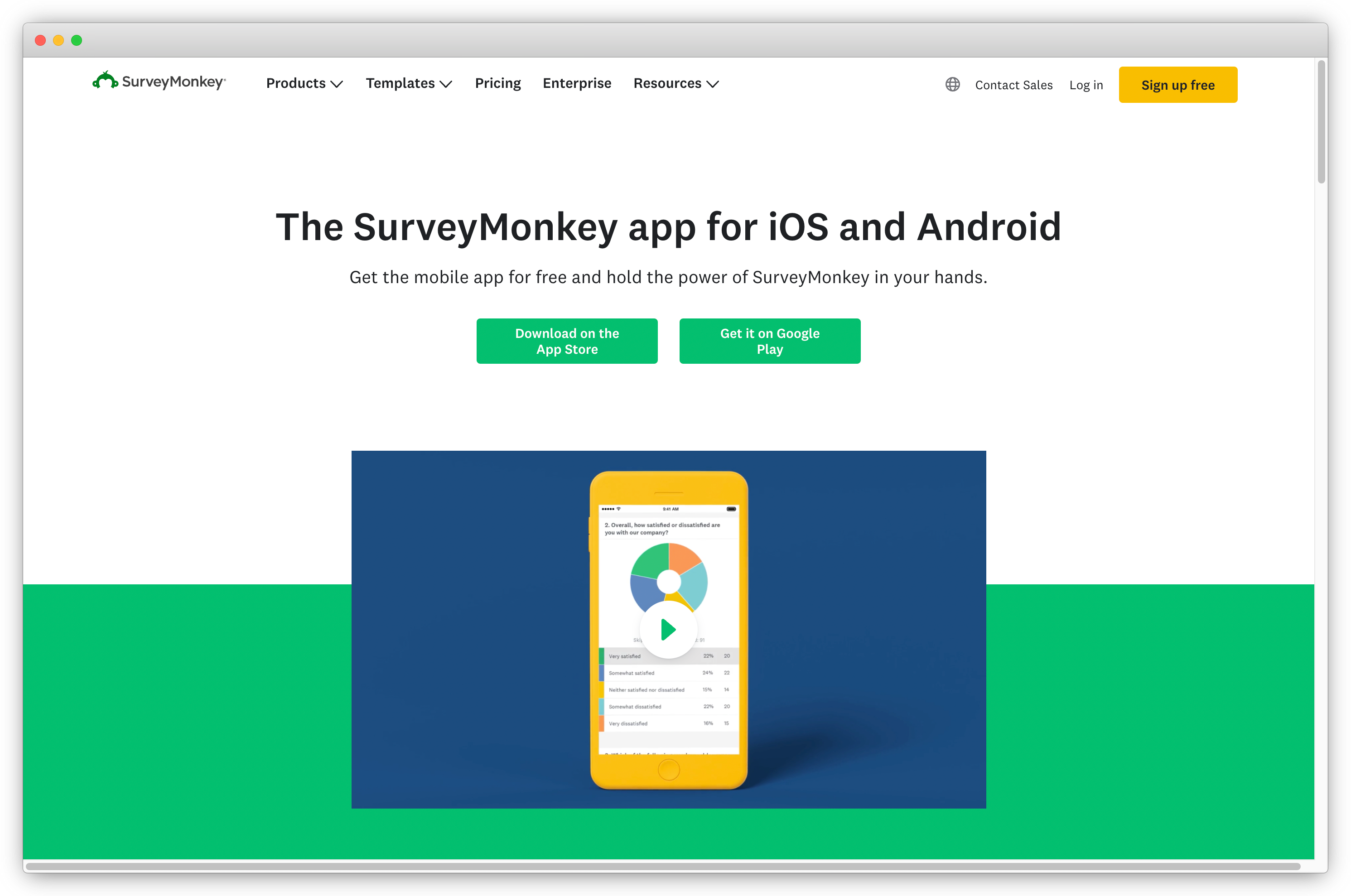
The survey builder quality is the standout. Branching and logic tools are intuitive for non-technical users, templates reduce time-to-first-survey significantly, and the distribution reliability is consistent, survey respondents complete SurveyMonkey surveys at high rates because the interface is clean and loads fast on any device.
The honest limitation is pricing. The free plan caps you at 10 questions per survey and 25 responses per survey; responses beyond that are deleted. Skip logic, custom branding, and data export all require paid plans starting at $39/month. For teams needing anything beyond occasional simple surveys, the free tier's limits arrive quickly.
Key Features
-
200+ survey templates covering customer, employee, and market research use cases
-
AI-powered survey creation and sentiment analysis on higher-tier plans
-
Distribution via email, web link, QR code, and social media
-
Advanced analytics with cross-tab reports and trend tracking
-
200+ native integrations including Salesforce, HubSpot, Slack, and Zendesk
Pros
-
Brand recognition improves survey completion rates among recipients
-
Strong template library covers nearly every common use case
-
Reliable data collection at scale with no technical issues
Cons
-
Free plan is among the most restrictive on this list: 25 responses per survey, no data export
-
AI features and advanced analytics locked to the $139/mo Premier plan
-
Customization options limited without upgrading
Pricing
-
Free (10 Q, 25 viewable responses). Advantage: $39/mo. Premier: $139/mo. Enterprise: contact sales.
"The most helpful aspect of SurveyMonkey is its ability to turn responses into clear insights through built-in analytics and reports. It allows users to easily track responses, analyze trends, and visualize data using charts and summaries.", Verified G2 reviewer
Best For: Mid-size teams that need a reliable, widely recognized platform for customer and employee surveys with broad template coverage and strong out-of-the-box analytics.
2. Qualtrics: Best for Enterprise Research and Experience Management
G2 Rating: 4.4/5 (2,276 reviews)
Qualtrics is the gold standard for enterprise research and experience management. It's widely deployed for complex conjoint studies at research agencies and multi-location CX programs at large enterprises, and handles both without showing strain. The depth of its logic engine, with 100+ question types and statistical tools most platforms don't offer, is unmatched.
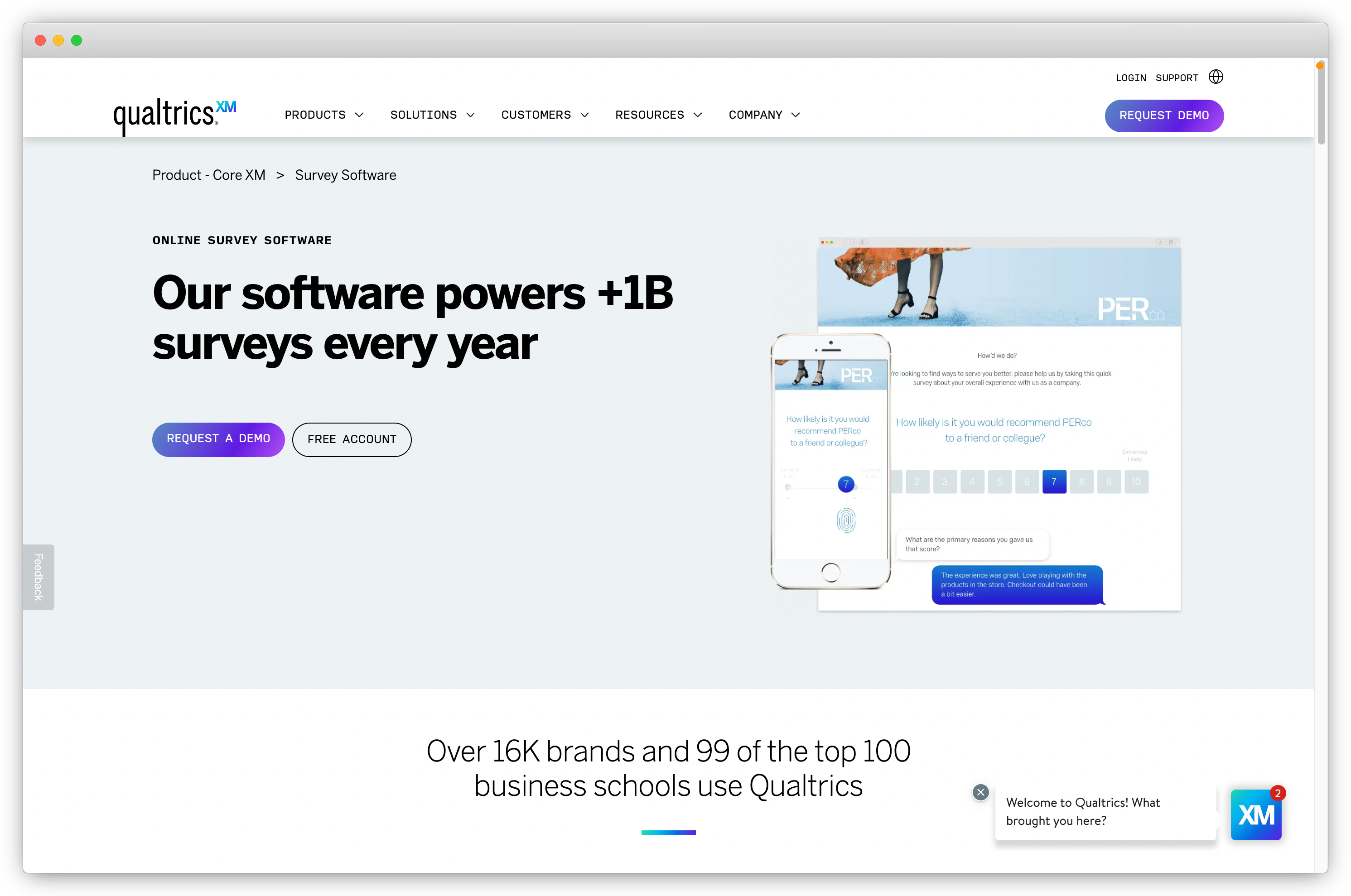
The XM positioning means Qualtrics goes beyond surveys. It connects customer, employee, brand, and product feedback into one platform, with predictive analytics and AI-powered text analysis that processes tens of thousands of open-ended responses automatically. For organizations running serious VoC programs, it's the most complete tool on this list.
The tradeoffs are real: pricing starts at $1,500/year for research features and scales significantly for enterprise XM. The interface has a steep learning curve, teams typically need training before getting full value. If you're running occasional surveys or have a small team, Qualtrics is significant overkill.
Key Features
-
100+ question types including MaxDiff, conjoint, and card-sorting for advanced research
-
AI-powered text analytics (iQ) for theme detection and sentiment scoring at scale
-
Cross-tab reporting, statistical significance testing, and predictive analytics
-
350+ pre-built integrations plus full API access
-
ISO 27001, HIPAA, FedRAMP, and SOC 2 compliant
Pros
-
Most comprehensive analytics engine available in survey software
-
Research-grade methodology tools not available in any other platform on this list
-
Strong compliance coverage for healthcare, government, and regulated industries
Cons
-
Pricing is enterprise-level and opaque: most plans require contacting sales
-
Steep learning curve; teams need dedicated training to use it effectively
-
Updated UI has relocated key features in ways that frustrate experienced users
Pricing
-
Research starts at ~$1,500/year. Customer XM pricing on request. Free trial available.
"It is a much more robust program than what SurveyMonkey appears to be. The ability to create the survey to run on a loop as if at a kiosk is fantastic.", G2 reviewer
Best For: Enterprises, research agencies, and academic institutions that need advanced survey logic, experience management at scale, and research-grade statistical analysis.
3. Zonka Feedback: Best for AI-Powered Omnichannel CX Feedback
G2 Rating: 4.7/5 (G2 Winter 2026 Award Winner — 22 badges)
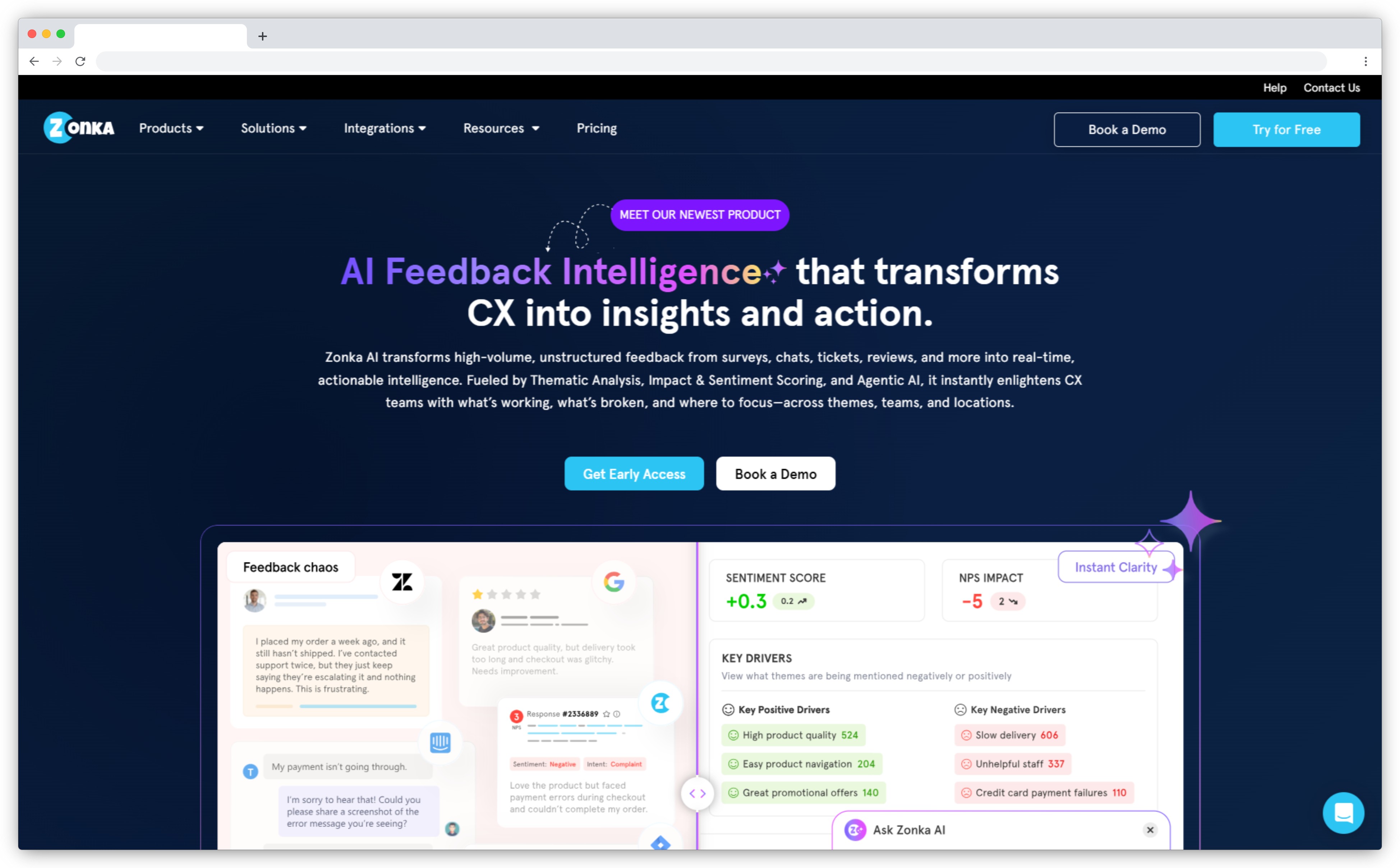
Zonka Feedback is built for the full feedback lifecycle: collect, unify, understand, and fix. It captures feedback across email, SMS, WhatsApp, web widgets, in-app, kiosk, and offline channels, unifies it with signals from tickets, reviews, and chats, then uses AI agents to surface themes, score sentiment, map signals to specific locations and agents, and route what matters.
SmartBuyGlasses increased NPS by 30% running multi-channel surveys across 30+ countries. Adani One collects in-app NPS across Indian airport touchpoints with 38,000+ monthly responses. SaaS companies run automated customer satisfaction surveys that route detractor responses to CS teams without manual intervention.
The core differentiator is the feedback intelligence layer. Where SurveyMonkey stops at charts, Zonka's AI agents cluster themes from open-text responses, score business impact, and deliver role-based signals: a branch manager sees their location's picture, the CCO sees everything.
Pricing is custom, so teams contact Zonka directly for a quote. For smaller teams or one-off surveys, lighter tools on this list serve better.
Key Features
-
Omnichannel collection: email, SMS, WhatsApp, web, in-app, kiosk, QR code, and offline
-
Multi-source unification: surveys, tickets, reviews, chats, and calls in one intelligence layer
-
AI agents: thematic analysis, sentiment scoring, entity mapping to locations and agents, impact scoring
-
Role-based signals: each function sees what matters to them, from frontline agent to CCO
-
Closed-loop workflows for NPS, CSAT, and customer effort score: detractor alerts, ticket creation, CRM sync, and follow-ups
Pros
-
Only platform on this list combining omnichannel collection, multi-source unification, and native AI agents
-
Goes live in under a week; no consulting engagement or data pipelines required first
-
Scales from 100 to 100,000+ responses per month on the same platform
Cons
-
Custom pricing requires contacting the team directly; no self-serve plan selection
-
Advanced configuration (custom entities, taxonomies) takes time for power users
-
No completely free plan: 14-day free trial available on request
Pricing
-
Custom pricing. Contact Zonka Feedback directly for a quote based on your program requirements.
"SurveyMonkey worked for basic surveys, but we needed better insights and faster action on feedback. Zonka gave us that visibility.", G2 reviewer
Best For: CX, product, and support teams in healthcare, SaaS, retail, and hospitality who need AI agents to surface signals and fix what matters, not just collect responses.
4. Sprig: Best for Enterprise Research & AI-Powered User Insights
G2 Rating: 4.3/5 (199 reviews)
Sprig is an enterprise survey and user research platform built for teams that study digital product experiences. Where Qualtrics optimizes for statistical research rigor and SurveySparrow for omnichannel CX collection, Sprig optimizes for understanding why users behave the way they do inside a product, then turning that into decisions for product, design, and research teams.
The platform's strength is analysis depth on open-ended feedback. Teams target surveys to specific user segments and launch across web, mobile, email, and link, then Sprig AI reads the open-text responses and returns themes, sentiment, and recommendations automatically, no manual tagging required. An AI study builder generates survey questions and targeting from a plain-language research goal, and responses can be paired with behavioral context so a survey answer sits next to what the user actually did.
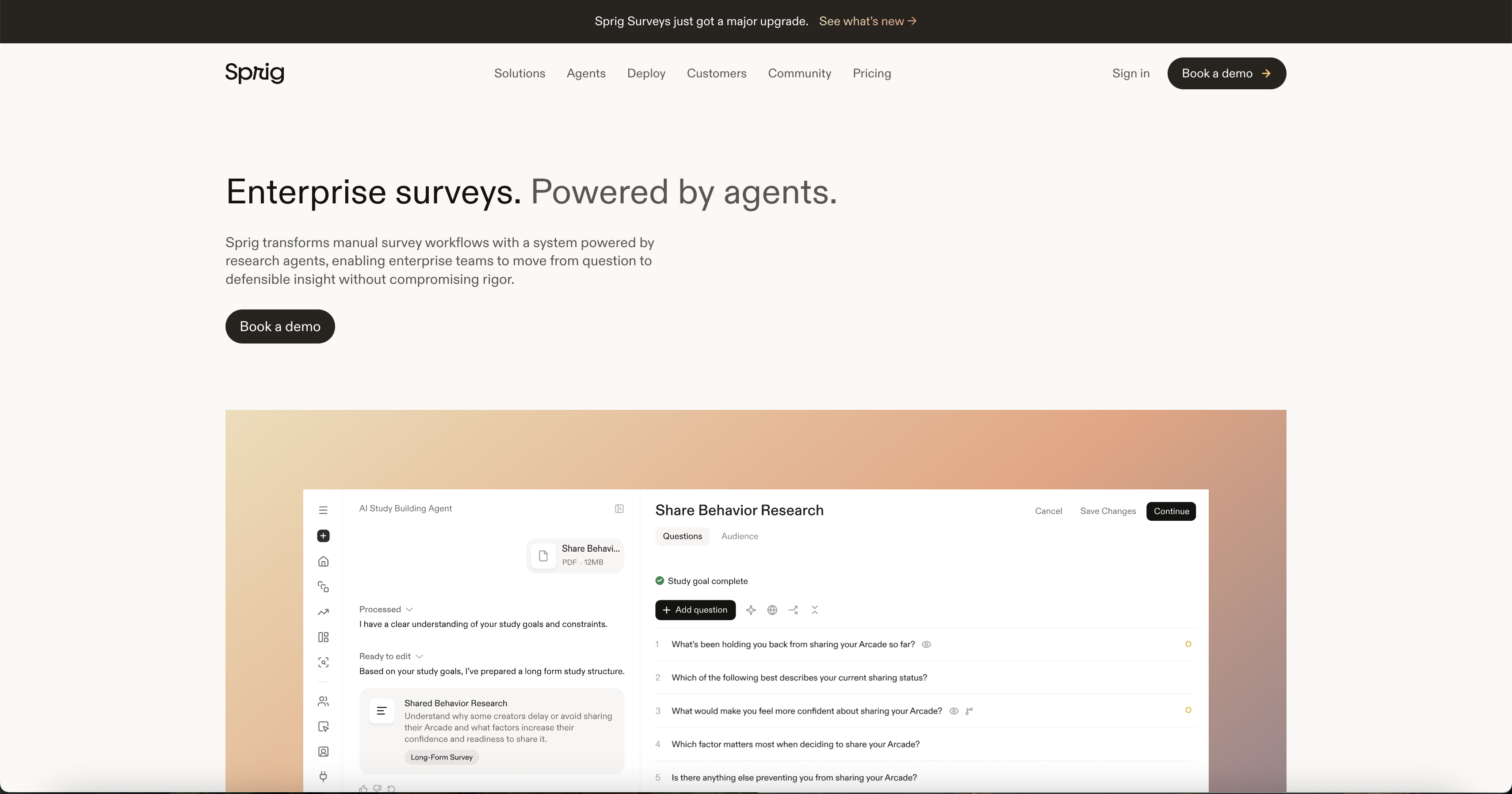
The tradeoff is scope and pricing. Sprig is purpose-built for digital product research rather than broad CX, offline, or market-research programs, and it uses custom, enterprise-oriented pricing rather than a published low-cost tier. For product and UX research teams that want AI to do the heavy lifting on qualitative analysis at scale, it is a strong fit. For small teams running simple one-off surveys, a lighter tool on this list will be more economical.
Key Features
-
Sprig AI analysis of open-text responses, surfacing themes, sentiment, and recommendations across studies
-
AI study builder that generates survey questions and targeting from a plain-language research goal
-
Behavioral targeting that delivers surveys to specific user segments based on in-product activity
-
Multi-channel distribution across web, mobile, email, and link with 30+ language support
-
AI-generated insight summaries with continuous recommendations for follow-up research
Pros
-
Generative AI turns open-text feedback into themed, decision-ready insight without manual coding
-
Connects survey responses to product behavior, giving context on why users answer as they do
-
Purpose-built for product and UX research teams operating at enterprise scale
Cons
-
Focused on digital product research, so it is less suited to offline or broad market-research programs
-
Custom, enterprise-oriented pricing is less accessible than tools with published low-cost tiers
-
Advanced AI and behavioral features carry a learning curve for non-research users
Pricing
-
Custom pricing that scales with your research program (response volume and activated capabilities). Free trial available; enterprise onboarding included.
"The AI-generated summaries are incredibly useful, capturing frequent themes, recognizing customer pain", G2 reviewer
Best For: Product, design, and research teams at growth-stage and enterprise companies that need to run surveys at scale and turn open-ended responses into insight with AI.
5. SurveySparrow: Best for Conversational CX Surveys
G2 Rating: 4.4/5 (2,015 reviews)
SurveySparrow positions itself as the more engaging alternative to traditional survey tools, and the chat-style survey format delivers. Surveys feel like text message conversations, which produces higher completion rates than static form-style surveys, especially on mobile. Teams frequently switch from SurveyMonkey to SurveySparrow specifically for the completion rate improvement, and G2 reviews back this up consistently.
Beyond the conversational format, SurveySparrow covers a broad set of CX use cases: NPS surveys, CSAT, CES, employee engagement, and 360-degree assessments. Omnichannel distribution, email, SMS, WhatsApp surveys, web, in-app, and recurring survey scheduling make it practical for teams running ongoing feedback programs rather than one-off surveys.
The free plan is one of the more generous on this list: 3 active surveys, 50 responses per month, and full access to the conversational survey format. Paid plans start at $19/month. The main limitation users note is customization depth, theme and branding options are good but don't match Typeform's design control. Analytics are solid for NPS tracking but don't reach Qualtrics or Zonka's AI analysis layer for large-scale text processing.
Key Features
-
Chat-style survey format that delivers higher completion rates than static surveys
-
NPS, CSAT, CES, and employee engagement templates with automatic score calculation
-
Recurring survey scheduling: set NPS programs to run automatically on defined intervals
-
Omnichannel distribution: email, SMS, WhatsApp, web, in-app, and survey links
-
AI survey creation and sentiment analysis on paid plans
Pros
-
Consistently higher completion rates than traditional survey formats
-
Strong free plan for a CX-focused tool
-
Covers both customer and employee feedback use cases in one platform
Cons
-
Design customization less flexible than Typeform for precise branding control
-
URL whitelabeling and Salesforce integration require Enterprise plan
-
Analytics depth below Qualtrics and Zonka for large-scale open-ended analysis
Pricing
-
Free (3 surveys, 50 resp/mo). Starter: $19/mo. Business: $49/mo. Enterprise: custom.
"What I like best about SurveySparrow is how easily and quickly you can make a customized survey that is attractive and makes your target audience want to answer! The facilities for making it look 'yours' are superior to what I have used before.", G2 reviewer
Best For: CX and marketing teams that want higher survey completion rates and need NPS/CSAT/employee feedback programs with omnichannel distribution.
6. Porsline: Best for AI-Assisted Survey Creation & Flexible Data Collection
G2 Rating: NA
Porsline is a survey and form platform that integrates AI into the creation process. You
can describe what you need and get an editable initial version, begin with a template or a
blank form, or convert an existing Word or Excel questionnaire into an online survey. It
supports surveys, forms, quizzes, and online tests, and allows you to opt for a
conversational style that presents one question at a time or a classic layout where all
questions are shown together on one page.
.png?width=1366&height=523&name=Screenshot%20(225).png)
What makes Porsline more intriguing is the level of control it offers over responses. Conditional logic, piping, calculations, scoring, timers, and quotas handle most survey and evaluation workflows. For projects where participation needs to be controlled, respondents can be authenticated by OTP, code, or email. You can also pass encrypted data through survey links, restrict a link to one submission, set quotas for specific choices, validate answers with custom patterns, and limit the file types respondents can upload.
The reporting features are practical rather than excessively complex. Results update in real time, datasets can be filtered and converted into shareable reports, and complete response data can be exported as a single Excel file rather than being divided among multiple downloads. Main workflow integrations are covered by Google Sheets, Zapier, webhooks, and API access.
Porsline's strength is in consolidating several data-collection workflows into a single platform, eliminating the need for teams to assemble separate tools for surveys, forms, quizzes, and online tests. That makes it a practical option for teams whose needs may start out simple but grow more structured over time, especially if they prefer to keep creation, response management, and analysis within one unified workflow.
Key Features
-
AI-assisted survey creation from prompts, with the option to begin from templates, blank forms, or existing Word and Excel questionnaires
-
Conversational and classic survey modes, along with conditional logic, piping, timers, and flexible question flows
-
Calculations and online testing tools for scoring, answer keys, automatic grading, question randomization, and scheduled grade release
-
Respondent and data-quality controls including custom validation, file-type restrictions, OTP/code/email authentication, encrypted variables, single-use links, and choice-level quotas
-
Real-time charts, advanced filters, shareable reports, single-file Excel and CSV exports, Google Sheets, Zapier, webhooks, and API access
Pros
-
Provides multiple ways to quickly create surveys without restricting teams to simple questionnaires as their needs become more advanced
-
Strong control over who can respond and how data is gathered, which is valuable for research, evaluations, employee surveys, and capacity-limited registrations
-
Paid plans allow unlimited responses under fair-use policies and permit complete datasets to be exported in one Excel file
Cons
-
AI features currently emphasize survey creation more than large-scale text and sentiment analysis
-
Less specialized for behavior-triggered in-app feedback compared to tools built specifically for product and PLG teams
-
Some advanced controls, reporting options, and integrations are exclusive to the Enterprise plan
Pricing
-
Free: 100 responses/month. A 7-day trial is also available. Pro: €23/month. Enterprise: €53/month. Paid plans include unlimited responses.
Best For: Startups, research, marketing, HR, education, operations, and customer-experience teams that need AI-assisted survey creation, flexible logic, respondent controls, online tests, and practical reporting tools.
7. Survicate: Best for In-app & Multi Channel Feedback for Product & SaaS Teams
G2 Rating: 4.6/5 (213 reviews)
Survicate is a customer feedback platform built for product, research, and CX teams that need to collect feedback inside the product, not just via email or shareable links. Native SDKs for iOS, Android, React Native, Flutter, and Unity let teams trigger micro-surveys based on user behavior, session attributes, or specific events, deployed in minutes without heavy engineering setup.
.png?width=1366&height=618&name=Screenshot%20(73).png)
Survicate's AI research repository connects feedback sources and turns open-text responses into stakeholder-ready reports, with a Research Assistant that lets teams query their data in plain language. The Intercom integration surveys deploy directly inside Intercom Messenger conversations, and the platform connects natively to tools including HubSpot, Salesforce, Zendesk, Amplitude, and Braze.
Where Survicate falls short is closed-loop automation: detractor routing, case management, and ticket creation require external workflows via Zapier or native integrations, and there's no account-level view for aggregating feedback across contacts from the same company. AI analytics and behavioral targeting are also locked to the Growth plan and above.
Key Features
-
Native in-app SDKs for iOS, Android, React Native, Flutter, and Unity for behavioral survey targeting
-
AI research repository (Research Hub) with topic categorization, sentiment detection, and natural-language querying
-
Native integrations including Intercom Messenger surveys, HubSpot, Salesforce, Zendesk, and Amplitude
-
Recurring survey scheduling for ongoing NPS and CSAT programs
-
Customizable dashboards with real-time NPS, CSAT, and CES tracking
Pros
-
Native in-app SDKs and behavioral targeting not available in most link-based survey tools
-
AI-powered Research Hub collapses manual open-text analysis into the platform
-
Broad integration ecosystem, especially strong with Intercom, Braze, and Amplitude
Cons
-
AI analytics and behavioral targeting locked to the Growth plan and above
-
No native closed-loop automation: routing and case management require external workflows
-
No account-level feedback view across contacts from the same company
Pricing
-
Free (25 responses/mo, 1 active survey). Starter: $89/mo. Growth: from $56/mo (billed annually). Pro: from $349/mo. Enterprise: from $569/mo.
"Survicate makes it easy to create and launch surveys across multiple channels, and the Insights feature really helps analyze open-text answers without manual work.", G2 reviewer
Best For: SaaS product teams and PLG companies that need in-app feedback collection with behavioral targeting and AI-assisted analysis, particularly those already using Intercom, Braze, or Amplitude.
8. QuestionPro: Best for Research Surveys with Advanced Question Types
G2 Rating: 4.5/5 (1,124 reviews)
QuestionPro occupies a strong position in market research and academic research. It offers 50+ question types, including MaxDiff, conjoint, Van Westendorp, and ranking formats, alongside panel management tools and a research audience marketplace. For teams running data collection projects that require statistical rigor, it's one of the best options under $100/month.
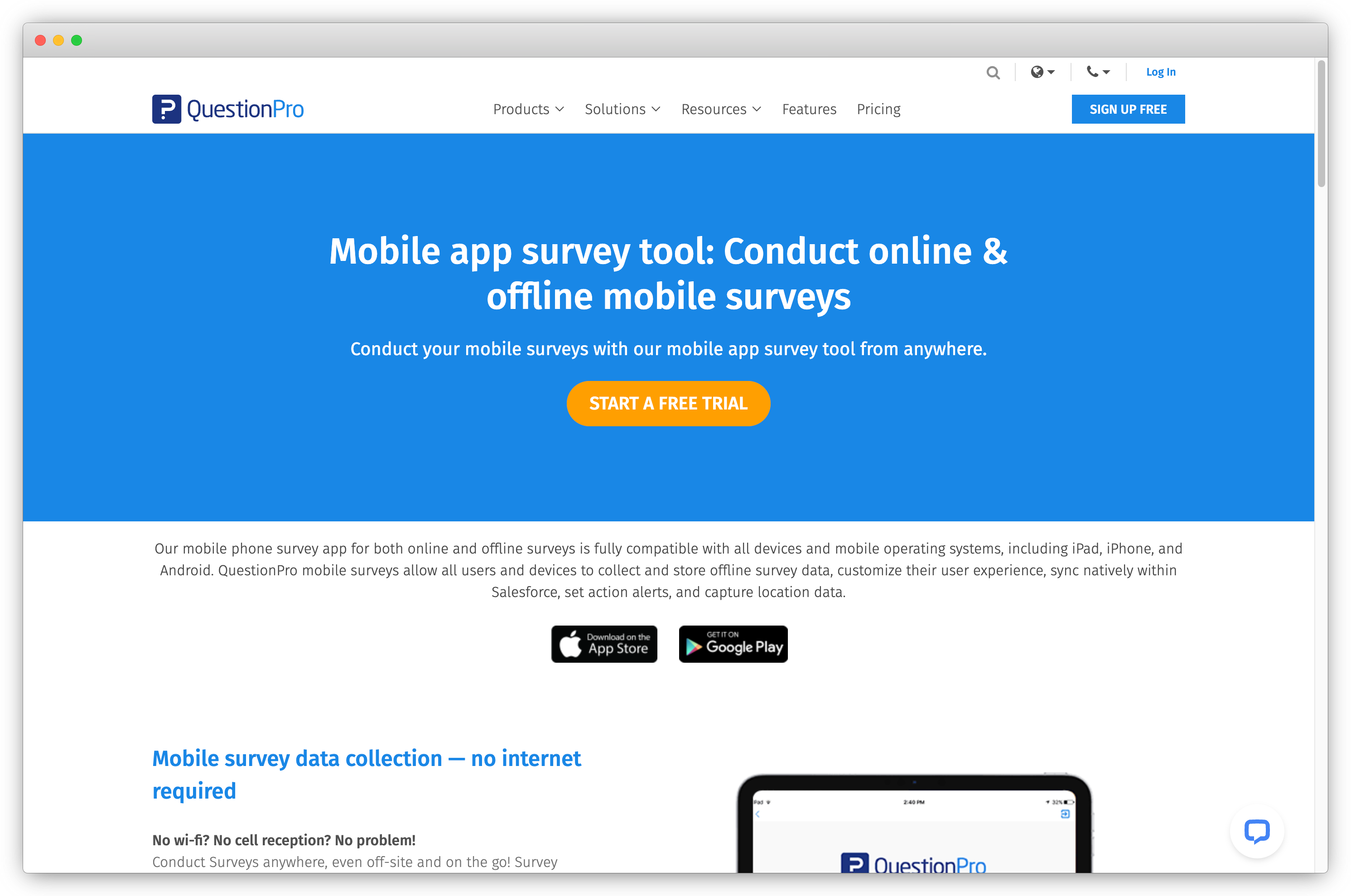
The free plan is more capable than most: unlimited surveys with up to 200 responses per survey and access to basic branching and reporting. This makes QuestionPro genuinely usable for testing and small-scale projects at no cost, a significant advantage over Alchemer or Qualtrics for budget-constrained research teams.
The Community platform (higher tiers) lets organizations build branded survey communities for longitudinal studies. This is a unique feature not found in most tools here. AI-powered sentiment analysis and automated text coding for open-ended responses have improved significantly in 2026, for teams specifically evaluating sentiment analysis tools, QuestionPro is one of the stronger options in the research tier. For CX programs with automated workflows and real-time AI signals, Zonka Feedback or SurveySparrow will serve better. QuestionPro's strength is research sophistication, not CX automation.
Key Features
-
50+ question types including MaxDiff, conjoint analysis, and Van Westendorp price sensitivity
-
Panel management and research audience marketplace for targeted sample collection
-
Community platform for longitudinal studies and branded research panels
-
AI-powered sentiment analysis and automated text coding for open-ended responses
-
ISO-compliant and HIPAA-ready for regulated research environments
Pros
-
Free plan is one of the most capable for research-grade survey data collection
-
Advanced question types not available in most tools on this list
-
Community platform is a genuinely unique feature for ongoing research programs
Cons
-
Interface complexity is a barrier for users who need simple surveys quickly
-
CX automation and closed-loop workflows not as strong as dedicated CX platforms
-
Pricing jumps significantly when you need enterprise research features
Pricing
-
Free (unlimited surveys, 200 resp/survey). Advanced: $85/mo (billed annually) / $129/mo (monthly). Enterprise: custom.
"With a vast array of templates, QuestionPro makes it easy to create surveys right out of the gate. This is essential for small office staff. QuestionPro allows us to get immediate feedback from our graduates.", G2 reviewer
Best For: Market researchers, academic teams, and organizations that need advanced research question types, panel management, and statistical analysis at a competitive price point.
9. Alchemer: Best for Enterprise Survey Customization and CRM Integration
G2 Rating: 4.4/5 (1,680 reviews)
Alchemer (formerly SurveyGizmo) sits in a useful position: more advanced than SurveyMonkey, less expensive than Qualtrics, and more CRM-focused than either. It's the survey platform built for teams that need survey data flowing directly into Salesforce, HubSpot, or other business systems with automated follow-up workflows triggered by specific responses.
The customization depth is a real differentiator. Alchemer supports 40+ question types, advanced piping and text substitution, custom CSS and scripting, and a highly flexible data management layer. The survey builder scores 9.2 on G2, the highest on this list for builder quality, and handles complex survey designs without the enterprise price tag of Qualtrics.
What Alchemer lacks is a generous free plan and a straightforward pricing structure. There's no free forever option: trial only, then $55/user/month minimum. For individual researchers or small teams, that's a significant entry point. For enterprise CX and research teams that need survey-to-CRM automation without Qualtrics pricing, it's the strongest choice in this range.
Key Features
-
40+ question types with advanced logic, piping, and text substitution
-
Bidirectional Salesforce and HubSpot integration: responses sync directly to CRM records
-
Survey-triggered workflows for automated follow-up based on specific answers
-
Custom CSS and scripting for precise design and behavioral control
-
HIPAA, SOC 2, and ISO 27001 compliant
Pros
-
Best CRM integration depth for survey-to-action workflows on this list
-
Advanced survey logic without Qualtrics-level complexity or pricing
-
Strong compliance coverage for enterprise and healthcare use cases
Cons
-
No free plan: trial only, then $55/user/month minimum
-
Offline capability limited compared to some tools on this list
-
Interface navigation can feel cluttered without familiarity with enterprise survey tools
Pricing
-
No free plan. Collaborator: $55/user/mo. Professional: $110/user/mo. Enterprise: custom.
"Alchemer has a ton of functionalities and actions that allow you to tailor the use of the application. It fills the gap between SurveyMonkey and Qualtrics well for teams that need advanced logic without enterprise pricing.", G2 reviewer
Best For: Enterprise research and CX teams that need advanced survey customization, direct Salesforce/HubSpot integration, and automated follow-up workflows.
10. SoGoSurvey: Best for SMBs and Educators Needing a Generous Free Plan
G2 Rating: 4.6/5 (84 reviews)
SoGoSurvey (by Sogolytics) offers one of the most capable free plans for small businesses and educational institutions. Unlimited surveys with solid branching logic, real-time reporting, and multilingual support at zero cost. For teams that need professional survey functionality without budget, SoGoSurvey's free tier is a strong argument against defaulting to Google Forms.
The platform shines in mobile optimization and email distribution. Surveys render well on any device, and the email delivery system, with tracking, reminders, and completion rate monitoring, is better than most free tools. Reporting includes comparison reports, trend analysis, and crosstab functionality that most tools reserve for paid plans.
Where SoGoSurvey is less competitive is AI features and CX-specific automation. Automated workflows, AI text analysis, and closed-loop feedback management are limited compared to Zonka Feedback or SurveySparrow. It's a strong data collection and analysis tool for teams that need professional survey functionality without the cost, not a feedback intelligence platform.
Key Features
-
Unlimited surveys on the free plan with branching logic and email distribution
-
Real-time data visualization and comparison reports on the free tier
-
Multilingual survey support with LTR/RTL language compatibility
-
Mobile-optimized surveys with high response rates on smartphone devices
-
Salesforce integration and API access on paid plans
Pros
-
One of the most capable free plans for professional survey creation and reporting
-
Strong mobile optimization and reliable email delivery
-
Trend and comparison reports available without upgrading
Cons
-
AI analysis features limited compared to dedicated CX platforms
-
Closed-loop workflow automation requires paid plans
-
Interface design feels dated compared to newer tools on this list
Pricing
-
Free Pro plan (unlimited surveys, 200 responses/year). Pro: $39/mo (billed annually). Pro Max: $99/mo (billed annually).
"SoGoSurvey has proven to be an exceptional tool for conducting surveys. Its user-friendly interface and seamless mobile optimization make creating and distributing surveys on any device easy. For in-depth data collection, Sogolytics is unmatched.", G2 reviewer
Best For: SMBs, academic researchers, and educators who need professional survey functionality: logic, mobile optimization, and real-time reports, without a budget.
Form Builders & Conversational Tools
11. Typeform: Best for Conversational Surveys with High Completion Rates
G2 Rating: 4.5/5 (956 reviews)
Typeform changed how people think about surveys when it launched, and it still holds up. The one-question-at-a-time format makes surveys feel like a conversation rather than a form to fill out, which consistently produces higher completion rates than traditional survey formats. User reviews repeatedly highlight how noticeably smoother the respondent experience is compared to standard survey builders.
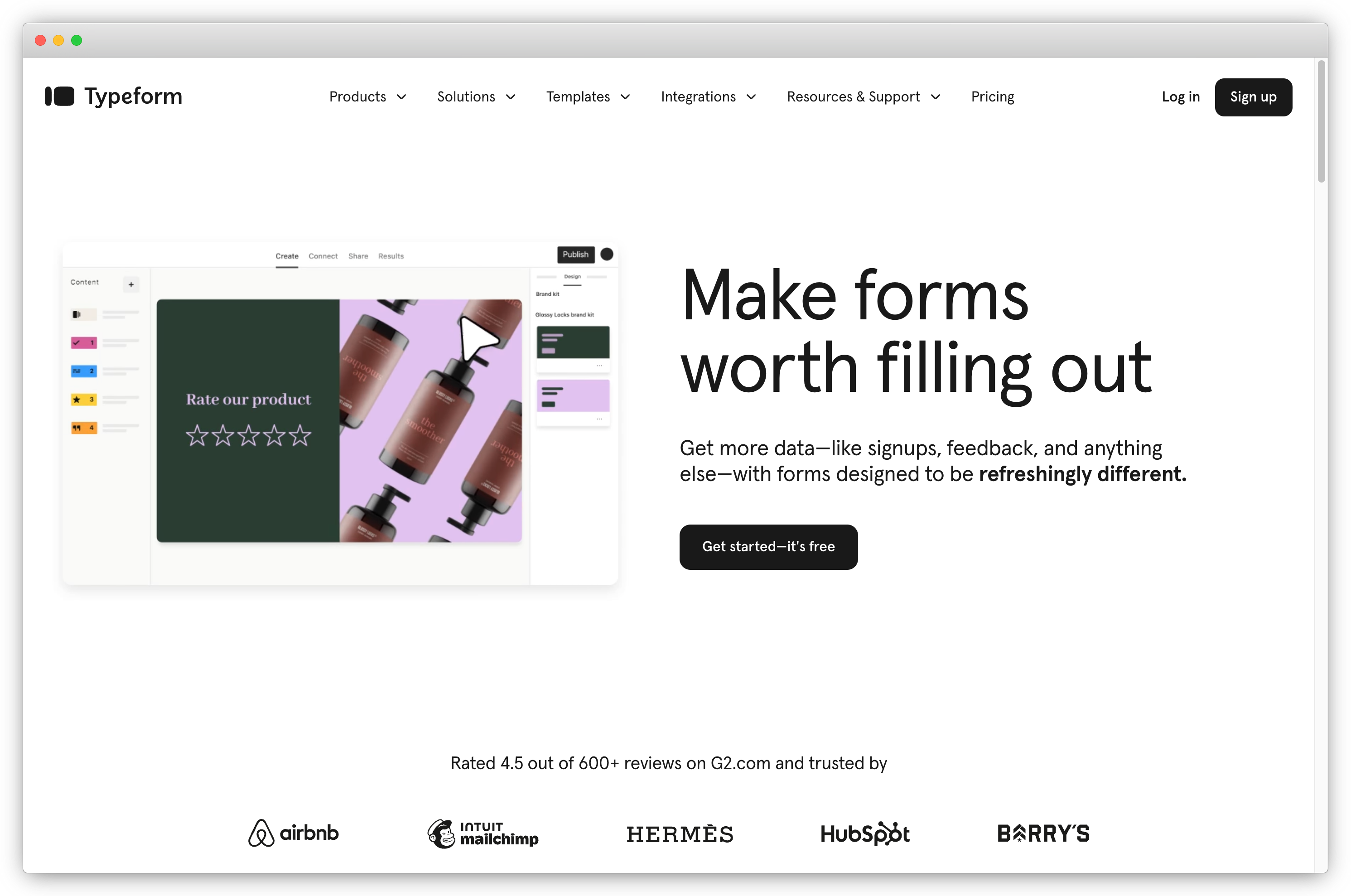
The builder delivers the best design control on this list. Precise color, font, and layout customization matches surveys to any brand. The logic editor handles complex branching without needing technical skills. AI survey generation from a text prompt is available on paid plans and produces a solid first draft quickly.
Where Typeform doesn't compete with Zonka or Qualtrics is in analytics depth. It's a collection and experience tool, not a feedback intelligence platform. If you need AI to analyze open-ended text at scale or run CX programs across multiple channels, you'll hit the ceiling. But for the use cases it's designed for, conversational data collection with a premium respondent experience, it's the best choice.
Key Features
-
Conversational one-question-at-a-time format with high completion rates
-
AI survey generation from a text prompt on paid plans
-
Logic jumps, recall information, and hidden fields for personalized survey flows
-
Integrations with HubSpot, Salesforce, Zapier, Google Sheets, and 500+ apps
-
Mobile-optimized and embeddable in websites and apps
Pros
-
Highest completion rates of any traditional survey format on this list
-
Best-in-class design and branding control
-
Logic editor is powerful without requiring technical expertise
Cons
-
Free plan caps at 10 responses per month total across all forms: exhausted quickly for any active program
-
Limited analytics compared to CX-focused platforms
-
Can feel complex to set up for users who just need a simple survey quickly
Pricing
-
Free (10 responses/month). Basic: $29/mo. Plus: $59/mo. Business: $99/mo.
"What I like best about Typeform is its intuitive drag-and-drop interface that makes form creation straightforward, even for those who aren't tech-savvy. Users appreciate the ability to customize forms to match their brand.", G2 reviewer
Best For: Marketing teams, UX researchers, and businesses that prioritize respondent experience and completion rates over deep analytics depth.
12. Jotform: Best for Form Workflows with 10,000+ Templates
G2 Rating: 4.7/5 (4,985 reviews)
Jotform is the most versatile form and survey builder on this list. It handles surveys, payment collection, file uploads, approval workflows, and event registrations, all from one platform. If you need to do more than collect survey responses, Jotform's breadth is hard to match.
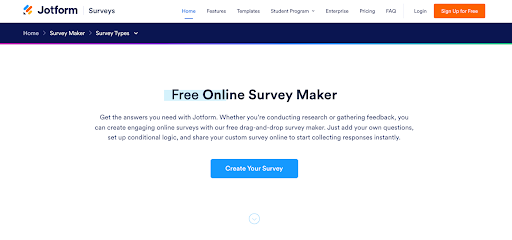
The template library with 10,000+ pre-built templates is the standout. Whatever your use case (patient intake forms, event registration, employee onboarding surveys, order forms, there's almost certainly a template covering 90% of what you need. The drag-and-drop survey builder handles 20+ question types with conditional logic and calculations, and the free plan is genuinely useful with 5 forms and 100 submissions per month.
For survey programs specifically, Jotform competes well on question variety, logic, and integrations (200+ apps). Where it doesn't specialize is in CX-specific features like NPS auto-calculation, sentiment analysis, or closed-loop automation. It's a builder, not an intelligence platform, and for the use cases where that matters, other tools serve better.
Key Features
-
10,000+ ready-made form and survey templates covering virtually every use case
-
Drag-and-drop builder with 20+ question types, conditional logic, and calculations
-
Payment collection via Stripe, PayPal, and Square built into form flows
-
200+ integrations and native iOS/Android apps for mobile data collection
-
HIPAA-compliant form options on paid plans for healthcare use cases
Pros
-
Best template library on this list: significantly reduces setup time
-
Handles more use cases than any other tool here beyond pure survey collection
-
Strong free plan for individual and small business use
Cons
-
No CSAT/NPS auto-calculation or dedicated CX metrics dashboard
-
Not designed for ongoing feedback programs: better suited to individual projects
-
Removing Jotform branding requires Enterprise tier custom pricing
Pricing
-
Free (Starter: 5 forms, 100 submissions/mo). Bronze: $34/mo (billed annually). Silver: $49/mo. Gold: $129/mo.
"With a vast array of templates, Jotform makes it easy to create surveys right out of the gate. The drag-and-drop builder and ready-made templates made customization straightforward, essential for small office staff.", G2 reviewer
Best For: Small businesses, nonprofits, healthcare teams, and event organizers that need a versatile form builder for multiple data collection use cases beyond surveys alone.
13. Woorise: Best for Surveys + Lead Generation in One Platform
G2 Rating: 4.4/5 (112 reviews)
Woorise isn't a pure survey tool. It's a lead generation and engagement platform that includes surveys alongside giveaways, quizzes, landing pages, and popups. If you need to combine survey data collection with marketing campaigns, contest management, or lead capture, Woorise handles all of it from one dashboard without stitching multiple tools together.
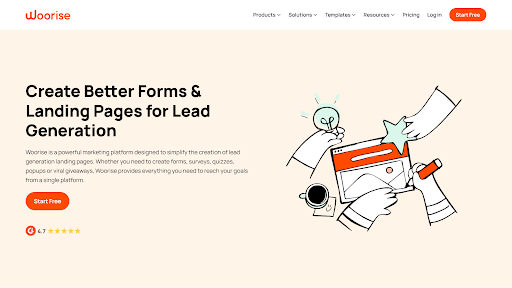
The interactive forms feature, which uses one-question-at-a-time conversational delivery, produces higher completion rates similar to Typeform. Combined with built-in social sharing, referral mechanics, and campaign analytics, it's particularly useful for growth teams that want to use surveys as part of a broader engagement strategy rather than as a standalone feedback program.
The limitations are clear: Woorise isn't designed for CX programs, doesn't calculate NPS/CSAT automatically, and analytics are campaign-focused rather than feedback-intelligence-focused. For pure survey use cases, the price-to-feature ratio is lower than other tools here. Its value is in the all-in-one marketing platform combination.
Key Features
-
All-in-one platform: surveys, giveaways, quizzes, landing pages, and popups in one tool
-
Conversational form delivery with one-question-at-a-time interface
-
Built-in social sharing, referral mechanics, and viral campaign tools
-
Drag-and-drop builder with 100+ templates across all content types
-
Integrations with HubSpot, Mailchimp, Zapier, and 30+ marketing tools
Pros
-
Replaces multiple tools if you need surveys, lead gen, and contests in one platform
-
Conversational form delivery improves completion rates
-
Good template library for getting campaigns live quickly
Cons
-
Not designed for CX programs or ongoing feedback management
-
Interface can feel cluttered when building complex forms or multi-step campaigns
-
Essential features require paid plans that are expensive relative to survey-only alternatives
Pricing
-
Free (limited). Basic: $23/mo. Grow: $39/mo. Pro: $79/mo.
"I switched to Woorise after struggling with Jotform's limitations around real-time tracking and user management. It handled all my complex form logic with ease, and the built-in dashboard made managing sign-ins and sign-outs a breeze.", G2 reviewer
Best For: Marketing and growth teams that need to combine survey data collection with lead generation campaigns, giveaways, or interactive content in one platform.
14. forms.app: Best for Simple Surveys with Clean Design
G2 Rating: 4.5/5 (479 reviews)
forms.app delivers what many tools promise but don't: genuinely good-looking surveys with minimal design effort. The template library is well-designed, the builder is clean, and the output looks professional without requiring design skills or customization time. For teams that want branded-feeling surveys quickly, forms.app consistently delivers.
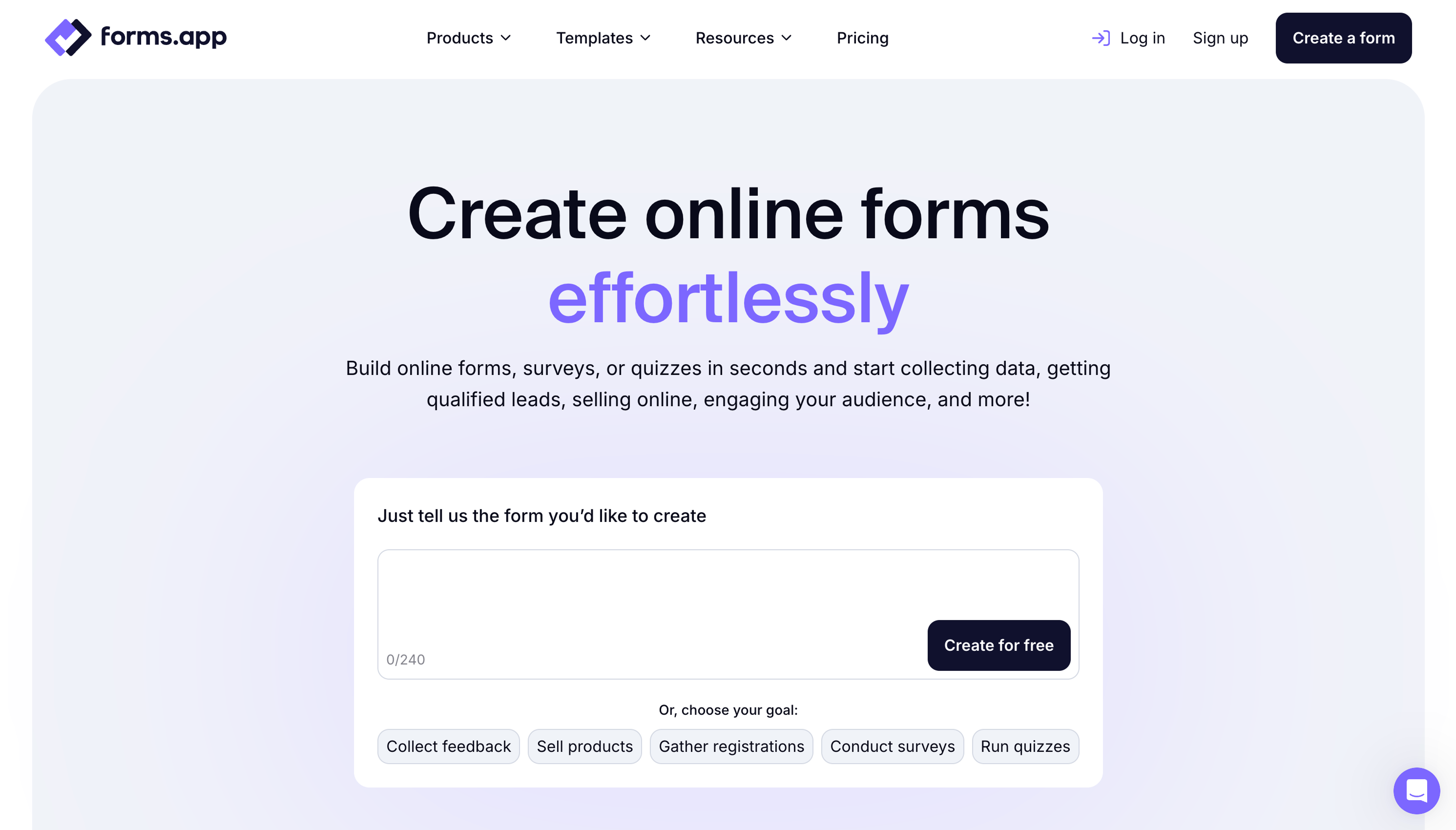
The AI features generate surveys from prompts and suggest questions based on your goals, useful for getting a first draft without starting from blank. Integration coverage includes Zapier, HubSpot, Slack, and Google Sheets for basic workflow automation. The free plan has response limits that require upgrading for active use, but the paid plans are competitively priced.
forms.app doesn't compete on analytics depth, CX features, or complex research methodology. It's a form builder that happens to be particularly clean and fast to use. For straightforward survey data collection from a defined audience where design quality matters, it's a solid choice.
Key Features
-
Clean, professionally designed survey templates with minimal customization needed
-
AI survey generation and question suggestions from text prompts
-
Conditional logic, calculations, and hidden fields on paid plans
-
Integration with Zapier, HubSpot, Slack, and Google Sheets
-
Mobile-optimized surveys with responsive design across all devices
Pros
-
Best-looking survey output with minimal design work of any tool on this list
-
AI features available at lower price points than most platforms
-
Clean, fast interface that reduces time-to-first-survey
Cons
-
Limited analytics: basic response summaries and charts only
-
Free plan has response caps that require upgrading for active programs
-
Not suitable for CX programs or ongoing feedback management
Pricing
-
Free (5 forms, 100 responses/mo). Basic: $19/mo (billed annually). Pro: $29/mo. Premium: $59/mo.
"forms.app is great for teams that want clean, professionally designed surveys without spending hours on customization. The AI question suggestions save significant setup time.", G2 reviewer
Best For: Small businesses, freelancers, and teams that prioritize clean design and ease of use for straightforward data collection without complex analytics or CX requirements.
15. Opinion Stage: Best for Interactive Surveys and Quizzes
G2 Rating: 4.8/5 (108 reviews)
Opinion Stage focuses on interactive content (surveys, quizzes, polls, and assessments) designed to increase engagement and collect data simultaneously. It's popular with publishers, marketing teams, and content creators who want survey-style data collection wrapped in a more engaging format than a traditional survey form.
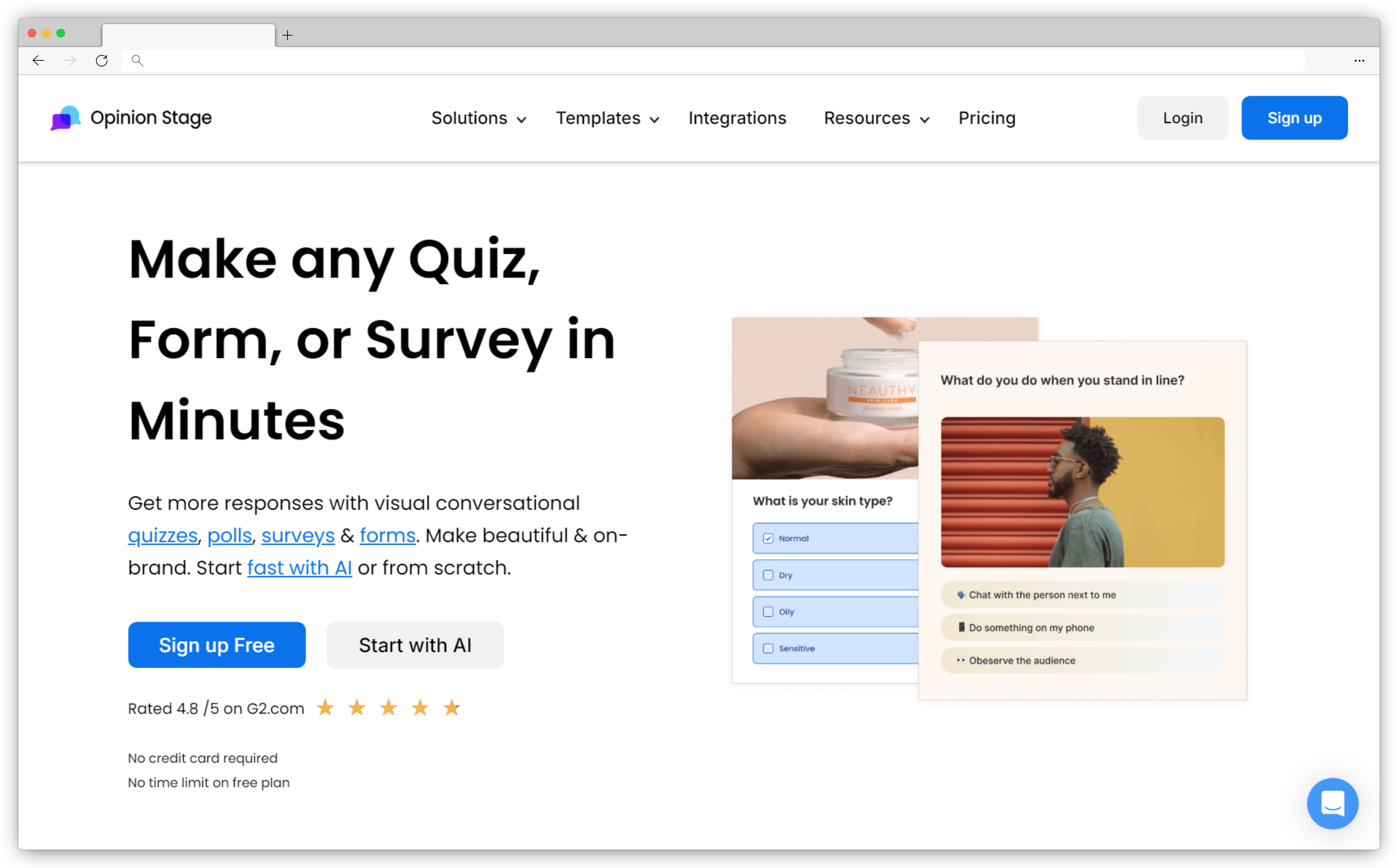
The quiz and poll formats drive higher completion rates through immediate feedback mechanisms: respondents see their results as they answer, creating motivation to finish. For lead generation surveys or brand engagement campaigns, Opinion Stage offers features that pure survey tools don't cover. AI-powered question generation and content optimization speed up the creation process.
The limitation is depth: Opinion Stage isn't built for sophisticated research methodology, CX program automation, or large-scale feedback analysis. It's a content engagement tool with survey functionality, not the reverse. For standard survey programs, other tools on this list serve better.
Key Features
-
Interactive quiz, poll, and survey formats with gamification elements
-
AI-powered question generation and content optimization
-
Lead capture forms embedded naturally in quiz and survey flows
-
Analytics showing completion rates, question-level engagement, and lead data
-
Direct integrations with Mailchimp, HubSpot, and marketing automation tools
Pros
-
Higher engagement and completion rates through interactive gamified formats
-
Good for combining survey data collection with lead capture and engagement
-
Easy to embed on websites and share across social media channels
Cons
-
Not suitable for CX programs, research surveys, or large-scale feedback analysis
-
Limited conditional logic and branching compared to dedicated survey tools
-
Analytics focused on engagement metrics rather than actionable feedback insights
Pricing
-
Free (25 responses/mo). Paid plans from $39/mo.
"Opinion Stage makes it easy to create engaging interactive content that collects valuable data. The quiz formats get much higher completion than traditional surveys, and the lead capture integration with our CRM makes it immediately useful.", Verified reviewer
Best For: Marketing teams, publishers, and content creators who want to combine survey data collection with interactive quizzes and lead generation campaigns.
16. Tally: Best Free Unlimited Form Builder for Developers and No-Code Teams
G2 Rating: 4.8/5 (89 reviews)
Tally is the most generous free survey and form builder on this list. Unlimited forms, unlimited responses, and no Tally branding on the free plan, features that paid tools typically charge $20-$30/month for. The Notion-like block editor is fast and intuitive, making it popular with developers, product teams, and no-code builders who want a modern alternative to Google Forms.
The building experience is distinct: forms are built as text documents where you add question blocks inline, rather than dragging widgets onto a canvas. For users already comfortable with Notion, the transition is instant. The native integrations with Notion, Airtable, and Google Sheets cover most workflows no-code teams rely on.
Where Tally is not competitive is analytics depth and distribution channels. There's no WhatsApp or SMS distribution, no AI analysis of open-ended responses, and no CX-specific metrics. For a free tool collecting survey data from a defined audience, internal research, product feedback, lead capture, it's excellent. For running customer feedback programs at scale, other tools serve better.
Key Features
-
Unlimited forms and responses on the free plan with no branding requirements
-
Notion-like block editor: fast and intuitive for document-style users
-
Native integrations with Notion, Airtable, and Google Sheets
-
Conditional logic, hidden fields, and calculations on both free and paid plans
-
Custom domains and white labeling on paid plans
Pros
-
Most generous free plan in terms of form and response limits: genuinely unlimited
-
Clean, developer-friendly interface with no unnecessary complexity
-
Native Notion and Airtable integrations that most survey tools don't offer
Cons
-
No AI analysis, no NPS/CSAT auto-calculation, no sentiment tools
-
Analytics are basic: good for collection, not for feedback intelligence
-
No WhatsApp, SMS, or in-app distribution channels
Pricing
-
Free (unlimited forms and responses). Pro: $29/mo. Business: $89/mo.
"Tally is the most generous free survey creator available in 2026 for teams that want a modern interface without the Google Forms aesthetic. Genuinely unlimited on the free plan, no hidden catches.", G2 reviewer
Best For: Developers, product teams, and no-code builders who need unlimited free forms with a fast, modern interface and native integrations with Notion and Airtable.
Free Survey Tools
17. Google Forms: Best Completely Free Tool for Simple Surveys
G2 Rating: 4.6/5
Google Forms is the most genuinely free survey tool on this list. Unlimited surveys, unlimited questions, unlimited responses, at zero cost, as long as you have a Google account. For teams that need to create surveys quickly without budget, technical setup, or learning curve, nothing beats it.
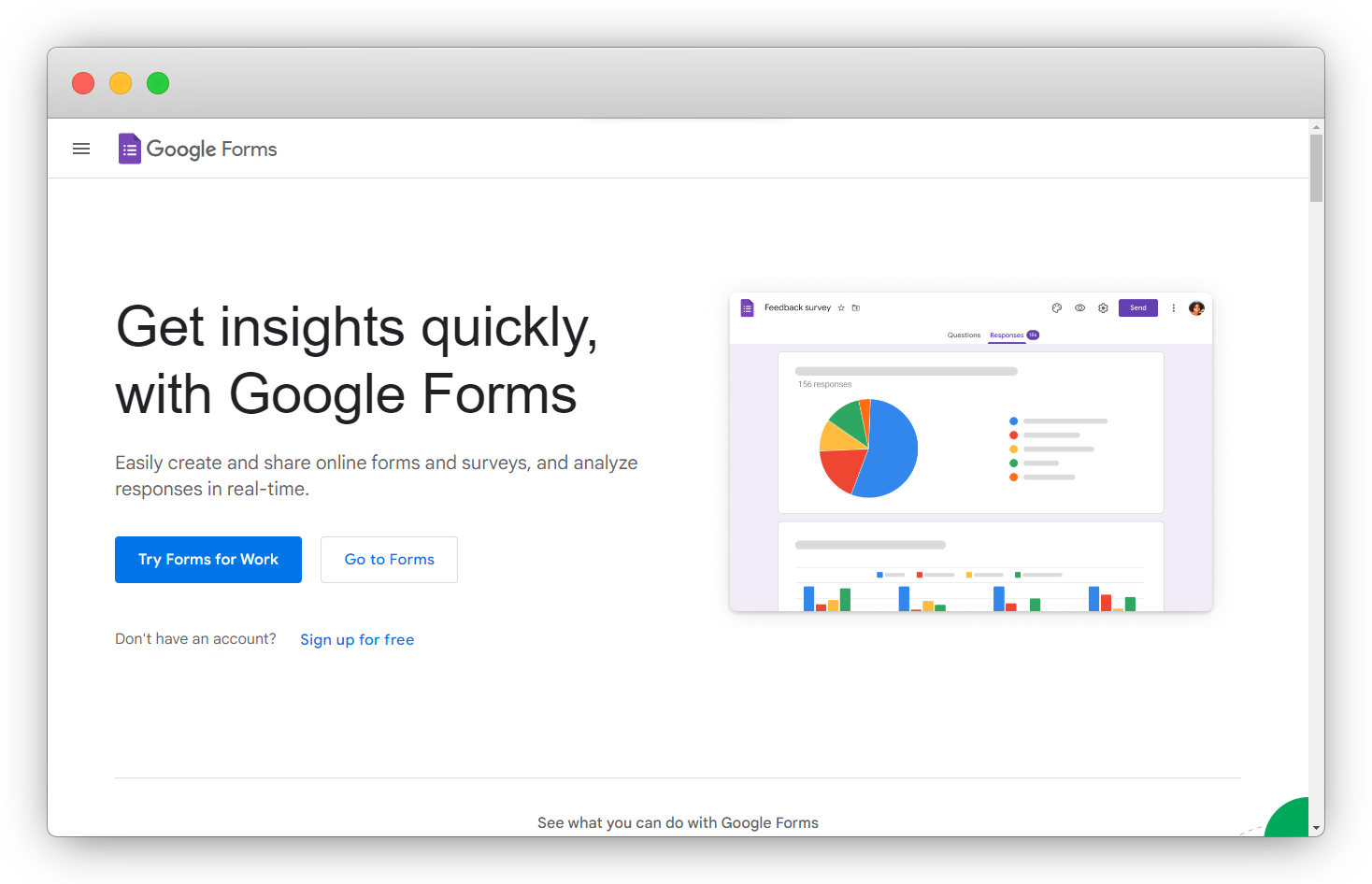
The builder is basic but fast: multiple choice, short answer, checkboxes, dropdowns, linear scale, and file uploads. Conditional logic works through a simple show/hide rules system. Responses go directly to Google Sheets, making data export and basic analysis effortless for anyone already working in Google Workspace.
Where Google Forms hits its ceiling is anywhere beyond basic data collection. No AI analysis, no NPS/CSAT auto-calculation, no distribution automation, no integrations beyond the Google ecosystem, and minimal design customization. For best in-app survey tools or multi-channel CX programs, it runs out of capability quickly. For internal polls, quick research surveys, and event feedback from a defined group, it's unbeatable.
Key Features
-
Unlimited surveys, questions, and responses at zero cost
-
Auto-connects to Google Sheets for real-time response collection and analysis
-
Collaborative editing: multiple team members can build and edit surveys simultaneously
-
Basic conditional logic and question randomization
-
Works across all devices without installation or downloads
Pros
-
Genuinely free with no hidden limits and no paid tier required for core functionality
-
Zero learning curve for anyone already familiar with Google Workspace
-
Sheets integration makes sorting and filtering response data immediate
Cons
-
No AI features, no NPS/CSAT auto-calculation, no sentiment analysis
-
Limited design customization: looks like a Google form, not a branded survey
-
No survey distribution automation or CRM/helpdesk integrations
Pricing
-
Free. Google Workspace plans start at $6/user/month for business features.
"Google Forms is the best free option: simple, fast, and genuinely unlimited responses at zero cost, though design and analytics are basic.", G2 reviewer
Best For: Students, educators, small teams, and individuals who need quick, simple survey data collection at zero cost with no setup required.
18. SurveyMars: Best Completely Free Platform with AI Features
G2 Rating: 4.7/5 (119 reviews)
SurveyMars does what most free tools don't: it's actually completely free. Unlimited surveys, unlimited questions, unlimited responses, no credit card, no capped free tier, no upgrade pressure. Add AI survey generation, 50+ question types, and SPSS-compatible data export, and it's more capable at zero cost than many tools that charge $20-$30/month.
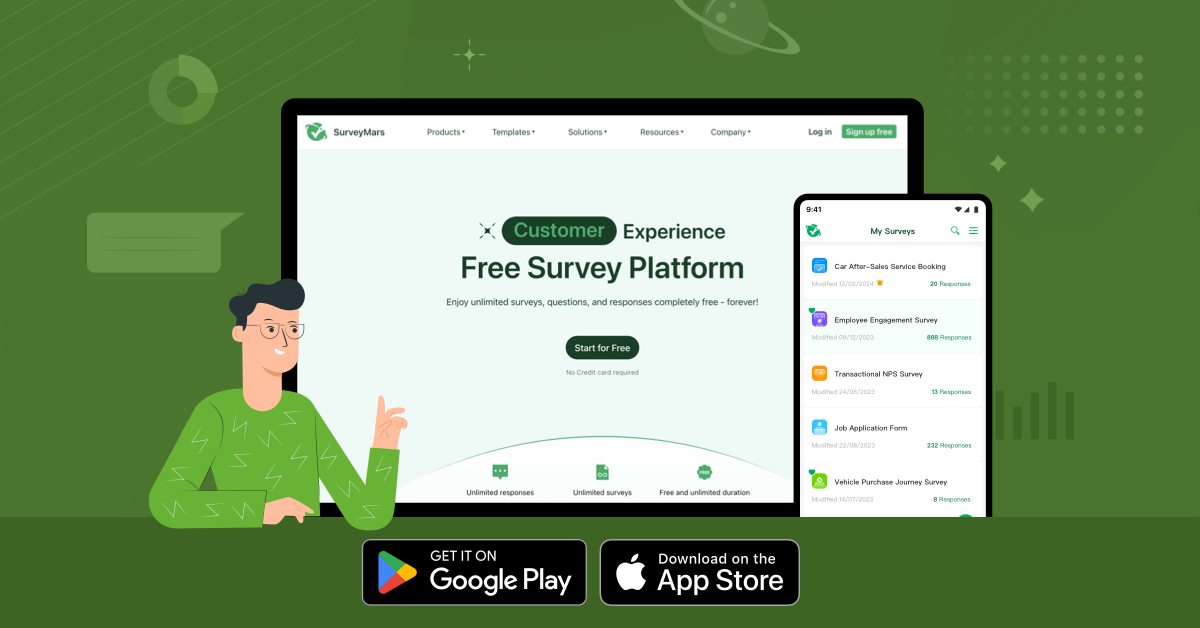
The platform is particularly strong for teams that need AI assistance creating surveys without budget for premium tools. AI generates surveys from a text prompt, suggests follow-up questions based on responses, and produces automated reports, features that SurveyMonkey and Typeform gate behind paid plans.
Where SurveyMars has clear limits is distribution channels and customization. It covers email, web links, QR codes, and embeds, but doesn't support WhatsApp, SMS, or in-app deployment. Design customization is basic, surveys are clean and functional but not precisely branded. For professional branded surveys or SMS surveys, other tools on this list are better equipped.
Key Features
-
Completely free: unlimited surveys, questions, and responses with no hidden limits
-
AI survey generation from text prompts and AI follow-up question suggestions
-
50+ question types including Constant Sum, Rank Order, and Matrix formats
-
SPSS analysis, crosstab reports, and dashboards included at no cost
-
Multiple sharing methods: survey links, email, QR codes, website embed
Pros
-
Most generous free plan on this list: genuinely unlimited with no response caps
-
AI features at zero cost, unusual for a free tool at this level
-
Supports research-grade question types not typically available in free options
Cons
-
No WhatsApp, SMS, or in-app distribution channels
-
Limited design customization: not suitable for precisely branded survey experiences
-
Smaller community and fewer native integrations than established paid platforms
Pricing
-
Completely free for all features.
"What I like most about SurveyMars is its clean, no-nonsense approach to survey creation. The interface is easy to navigate, so building and sharing surveys feels quick and intuitive even for first-time users.", G2 reviewer
Best For: Individuals, educators, startups, and budget-conscious teams that need unlimited survey data collection with AI features at zero cost.
19. Microsoft Forms: Best for Microsoft 365 Teams
G2 Rating: 4.4/5 (364 reviews)
Microsoft Forms is the Google Forms equivalent for teams inside the Microsoft 365 ecosystem. If your organization runs on Teams, SharePoint, and Excel, Forms integrates naturally, surveys feed directly into Excel for analysis, and results can be shared in Teams channels without additional tools or budget.
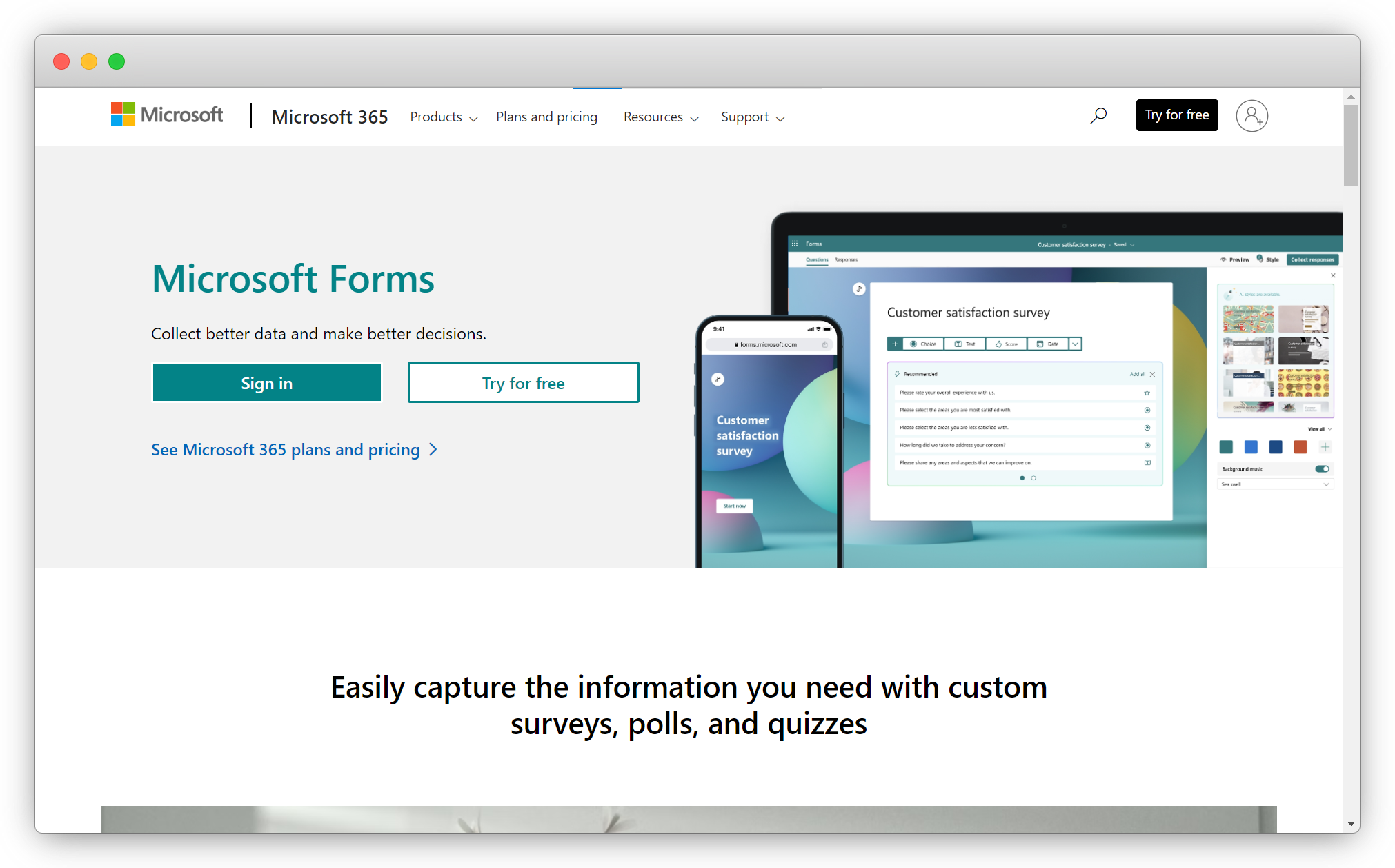
The survey builder handles basic question types, branching logic, and clean design. Multilingual support through Microsoft Translator covers global teams. For internal pulse surveys, training feedback, and event registrations within a Microsoft environment, it requires no additional cost or technical setup.
The limitation is clear: Microsoft Forms is designed for internal use cases, not customer feedback programs. Distribution is primarily via link or email, no web widget, no in-app deployment, no WhatsApp or SMS. Analytics stay inside the Microsoft ecosystem. For anything beyond collecting simple data from a defined internal group, the platform runs out of capability fast.
Key Features
-
Native Microsoft 365 integration: Excel for data analysis, Teams for distribution, SharePoint for embedding
-
Multilingual survey support through Microsoft Translator
-
Basic branching logic, question randomization, and file uploads
-
Real-time results visualization directly in the Forms interface
-
Included in all Microsoft 365 business subscriptions at no additional cost
Pros
-
Zero additional cost for Microsoft 365 subscribers
-
Seamless integration with Excel, Teams, and SharePoint
-
Works well for internal surveys with no technical setup required
Cons
-
Not suitable for customer-facing feedback programs: limited distribution channels
-
Analytics stay within Microsoft ecosystem with no third-party CRM integrations
-
Design is functional but not customizable for branded surveys
Pricing
-
Included in Microsoft 365 plans from $6/user/month.
"Microsoft Forms gives us the freedom and ability to create professional forms that can be used to send out surveys to clients in a straightforward way that integrates well with our existing Microsoft tools.", G2 reviewer
Best For: Organizations already using Microsoft 365 that need simple internal survey data collection integrated into their existing Teams and Excel workflows.
20. LimeSurvey: Best Open-Source Survey Tool for Academic Research
G2 Rating: 4.2/5 (32 reviews)
LimeSurvey is the only fully open-source option on this list. Self-hosting on your own server costs nothing, and you get full control over data, customization, and feature configuration. For universities, government organizations, and research institutions with strict data residency requirements, self-hosted LimeSurvey is often the only acceptable option.
The feature set is genuinely extensive: 30+ question types, advanced logic and branching, 80+ language support, quota management, and panel integration. Export options, SPSS, R, CSV, Excel, cover every major analysis environment researchers use. For academic survey data that requires precise methodology control and custom question design, LimeSurvey can be configured to match almost any research requirement.
The tradeoff is technical complexity. Self-hosting requires a server, PHP knowledge, and comfort with configuration files. The interface is functional but dated compared to modern cloud tools. Cloud-hosted plans are available from $39/month, but at that point QuestionPro or Alchemer offer more polished alternatives at similar pricing.
Key Features
-
Fully open-source and self-hostable with complete data sovereignty
-
30+ question types with advanced logic, quota management, and panel integration
-
80+ language support with right-to-left layout compatibility
-
Export to SPSS, R, CSV, and Excel for statistical analysis
-
No response limits on self-hosted installations
Pros
-
Completely free to self-host with genuinely no response limits
-
Full data sovereignty: your data stays on your own infrastructure
-
Research-grade question types and quota controls at zero cost
Cons
-
Technical server setup required: not suitable for non-technical users
-
Interface is dated and harder to navigate than cloud-based alternatives
-
No real-time AI analysis or CX automation features
Pricing
-
Free (self-hosted). Community Cloud: $49/mo. Professional: $149/mo.
"LimeSurvey offers a robust solution for survey creation, particularly for those needing extensive customization. The ability to preview questions before launching ensures clarity and flow, which is crucial for effective academic data collection.", G2 reviewer
Best For: Academic institutions, government agencies, and research organizations that need full data control through self-hosting and research-grade survey methodology at zero software cost.
Niche & Purpose-Built Survey Tools
21. Mentimeter: Best for Live Audience Engagement During Presentations
G2 Rating: 4.7/5 (779 reviews)
Mentimeter is purpose-built for one use case: making presentations interactive. It's the tool to reach for when you need real-time audience polling during a workshop, conference session, or corporate training. Live polls, word clouds, quizzes, and open Q&A transform a one-way presentation into a session where every participant contributes.
The workflow is simple: build slides in Mentimeter's editor, participants join on their phones via a code or QR, and results appear on the presenter's screen in real time. No app download required. Zoom and Teams integrations make it work well in virtual settings. For real-time survey data from large groups, Mentimeter collects in minutes what a traditional survey takes days to gather.
Where Mentimeter falls short is outside the live presentation context. It's not designed for ongoing survey programs, CX tracking, or research data collection. The free plan limits you to 3 surveys, and advanced customization requires paid plans. If you need survey software beyond live event use, you'll need a different tool.
Key Features
-
Live polling, word clouds, quizzes, open Q&A, and real-time ranking during presentations
-
Instant code-based participation: no app download required for audience members
-
Zoom and Microsoft Teams integration for virtual and hybrid sessions
-
Export results to PowerPoint, Excel, and PDF for post-session analysis
-
Anonymous response collection to encourage honest audience participation
Pros
-
Best tool for live audience engagement during presentations and workshops on this list
-
Real-time results visible to the entire audience, creating dynamic participation
-
No participant download needed: just a URL or QR code to join
Cons
-
Not designed for asynchronous surveys or ongoing CX programs
-
Free plan limits to 3 surveys with limited interactive question types
-
Relies on a stable internet connection, which can be problematic in low-connectivity venues
Pricing
-
Free (3 surveys). Basic: $11.99/mo. Pro: $24.99/mo. Enterprise: custom.
"Mentimeter solves the problem of low audience engagement during presentations and workshops. It benefits me by making sessions more interactive, encouraging participation from everyone, even quieter participants, and providing instant insights through live results.", G2 reviewer
Best For: Event hosts, trainers, teachers, and corporate presenters who need real-time audience engagement, live polling, and interactive Q&A during presentations and workshops.
22. piHappiness: Best for Kiosk and Tablet Survey Deployments
G2 Rating: N/A
piHappiness is built specifically for physical touchpoint feedback collection via tablets and kiosks. If you're running patient satisfaction surveys in a clinic, customer feedback stations in a retail store, or employee pulse checks at a physical location, piHappiness is designed for exactly that use case, with features general survey platforms don't include.
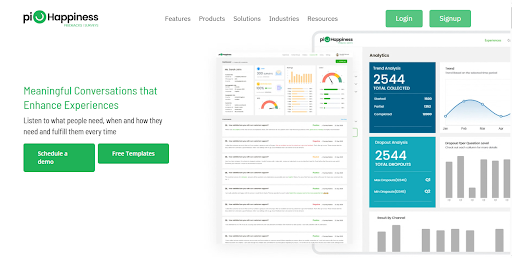
The platform supports multiple CX metrics (NPS, CSAT, emoticon ratings, and open text) in a kiosk-optimized format that's fast for respondents to complete at a physical touchpoint. Real-time alerts and location-level dashboards let managers see scores as they come in and respond to negative feedback before customers leave the premises. The looped survey mode keeps kiosk stations continuously ready for the next respondent without staff involvement.
For online survey programs, piHappiness is a narrower choice. Distribution channels are primarily tablet, kiosk, and QR code, not the omnichannel email, SMS, and WhatsApp distribution most tools on this list support. It's a specialist tool for on-premise feedback.
Key Features
-
Kiosk and tablet survey deployment optimized for physical touchpoints
-
NPS, CSAT, emoticon ratings, and multi-question survey support
-
Real-time alerts when negative feedback is submitted at specific locations
-
Location-level dashboards for multi-site feedback monitoring
-
Looped survey mode for continuous high-traffic kiosk deployments
Pros
-
Purpose-built for physical touchpoint feedback with better kiosk UX than general tools
-
Real-time location-level reporting for multi-site operations
-
Simple setup for non-technical staff at physical locations
Cons
-
Limited distribution channels: not suitable for email, SMS, or in-app programs
-
Analytics depth below CX platforms for large-scale feedback analysis
-
Pricing not publicly listed: requires contact with the sales team
Pricing
-
Contact for pricing.
"piHappiness has been excellent for our kiosk feedback stations. The real-time alerts mean we can respond to unhappy customers before they leave the premises. The looped survey mode keeps the kiosk ready for the next respondent automatically.", Verified reviewer
Best For: Retail stores, healthcare facilities, hospitality venues, and businesses running physical touchpoint feedback collection through tablets and kiosk stations.
23. UXArmy: Best for End-to-End UX Research and User Testing
G2 Rating: N/A
UXArmy is a remote user research platform that includes surveys as part of a broader UX research toolkit. Where most tools stop at survey responses, UXArmy captures screen recordings, audio, video, heatmaps, and behavioral data alongside surveys, giving UX teams both "what users said" and "what they actually did" in a single platform.
The platform is particularly strong in Asia-Pacific, with a participant panel and multilingual support covering 17+ languages and 23 auto-transcription languages. Card sorting, tree testing, and moderated interview tools are included alongside surveys, making it a full UX research suite. For teams that need to run usability tests and collect survey data from the same participants in the same session, no other tool on this list handles this combination.
For standard survey programs (NPS tracking, customer feedback, employee engagement), UXArmy is more tool than needed. The setup is more involved than consumer survey platforms, and pricing is geared toward research team budgets.
Key Features
-
Unmoderated usability tests with screen/audio/video recordings alongside survey data
-
Card sorting, tree testing, and moderated interview capabilities in one platform
-
Global participant panel with particularly strong Asia-Pacific coverage
-
17+ tester UI languages with auto-transcription in 23 languages
-
Native iOS and Android mobile app testing: not simulations or prototypes
Pros
-
Combines behavioral data and survey responses for richer user insights than surveys alone
-
Strong multilingual and Asia-Pacific coverage for regional research programs
-
All major UX research methods in one platform without stitching tools together
Cons
-
More complex setup than consumer survey tools: not suited for quick surveys
-
Pricing requires contact: not suitable for teams on basic survey budgets
-
Overkill for standard customer satisfaction or market research surveys
Pricing
-
Free (up to 10 participants). Paid plans on request.
"UXArmy stands out for its intuitive interface and comprehensive toolset, which simplify the process of conducting user research. The ability to capture both behavioral data and survey responses in the same session is genuinely useful for product teams.", G2 reviewer
Best For: UX and product research teams that need to combine survey data with behavioral observation: usability testing, card sorting, and tree testing, in a single research platform.
24. ProductLogz: Best for In-Product Feedback and Feature Prioritization
G2 Rating: N/A
ProductLogz takes a different approach to feedback collection. Rather than general survey creation, it's built specifically for product teams, combining in-app feedback collection with feature request management, roadmap prioritization, and changelog publishing in one platform. It's less of a survey tool and more of a continuous product feedback system.
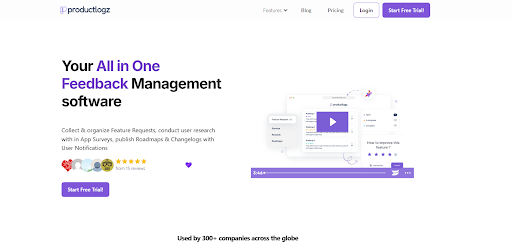
The feedback widget sits inside your product, capturing user input on features, bugs, and improvement requests. AI automatically categorizes and prioritizes requests based on frequency, user segment, and business impact, turning raw feedback into a ranked list of product decisions. The voting system lets users upvote features and signal priority directly, and the public roadmap closes the loop by showing users what's being built.
For teams that need general survey distribution across email and web, not specifically product feedback tools, ProductLogz is too narrow. Its strength is connecting customer input directly to product roadmap decisions rather than managing a broad survey program.
Key Features
-
In-app feedback widget for continuous product feedback collection
-
AI-powered feature request categorization and roadmap prioritization
-
Public roadmap and changelog to close the loop transparently with users
-
Voting system for users to upvote and signal feature priority
-
Segmentation to filter feedback by user type, subscription tier, or behavior
Pros
-
Connects feedback directly to product decisions, not just data collection
-
AI prioritization reduces time product managers spend deciding what to build next
-
Public roadmap builds transparency and sustained user trust
Cons
-
Not a general survey tool: limited to in-product use cases
-
No email, SMS, or WhatsApp survey distribution
-
Limited analytics compared to broader survey platforms
Pricing
-
Contact for pricing.
"ProductLogz has made our product feedback process significantly more structured. The AI prioritization means our team spends less time debating what to build next, the data does that work.", Verified reviewer
Best For: Product managers and SaaS teams that need a dedicated in-product feedback and feature prioritization system connecting customer input directly to the product roadmap.
What Free Plans Won't Tell You
Every tool on this list markets a free plan. Here's what the pricing pages don't always make clear.
SurveyMonkey's free plan caps you at 25 responses per survey. The 26th respondent can submit, but that response gets deleted after a year without an upgrade. Typeform's free plan restricts you to 10 responses per month total across all your forms, not per survey. One active survey can exhaust that in hours. Porsline's free plan allows up to 100 responses per month and still includes Excel and CSV exports; and new users also get a 7-day trial. Alchemer has no free plan at all, "free trial" and "free plan" are different things, and Alchemer is one of several tools on this list where the distinction matters significantly.
Tools that are genuinely unlimited free with no hidden catches: Google Forms, SurveyMars, and Tally. LimeSurvey self-hosted gives you no response limits at zero software cost. SoGoSurvey offers unlimited surveys with a response cap that's higher than most. SurveySparrow's free plan gives you 3 surveys and 50 responses per month, usable for testing, not for active programs.
The practical test before committing: build a real survey, try to export the data, and check what happens as you approach the response limit. That 10-minute test reveals more than any pricing page.
Which Online Survey Tool Is Right for Your Team?
If you're choosing between these 21 tools, the most important question isn't which one has the most features. It's what you're actually trying to do.
For CX programs — NPS, CSAT, CES, closed-loop workflows, AI analysis — Zonka Feedback or SurveySparrow will serve you significantly better than any general survey maker. For enterprise research with statistical rigor requirements, Qualtrics is the standard. For teams that need advanced survey capabilities without the complexity of a full enterprise XM platform, Porsline is a practical middle ground. For product and UX research with AI-powered analysis, Sprig is the answer. For completely free unlimited surveys, Google Forms, SurveyMars, and Tally are the honest answers. For survey software that flows directly into Salesforce or HubSpot with automated follow-ups, Alchemer is the right call.
The right survey software isn't the one with the longest feature list. It's the one that matches how your team works, and that you're still actively using three months from now.