.svg)
 Healthcare
 Finance
 Retail
 SaaS & Digital
 eCommerce
 Education
 Salesforce
  HubSpot
 Pipedrive
 Mailchimp
 Zendesk
  Intercom
 Freshdesk
 HelpScout
  Front
Front Jira
Jira Slack
Slack  MS Teams
 Zoom
Zoom Google Sheets
  Zapier
  Integrately
 Make
Make  Webhooks




 MS Teams
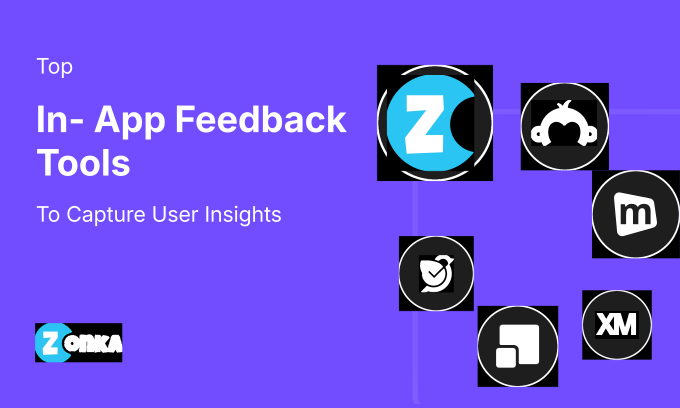


The best in-app feedback tools in 2026 are Zonka Feedback, Refiner, Survicate, Qualtrics, and Luciq. These platforms embed surveys directly inside mobile and web apps using native SDKs, capturing user feedback at the moment of interaction, not hours later when context is gone. The right pick depends on your stack, your team type, and how deep you need to go on SDK integration.
TL;DR
- In-app feedback tools embed surveys directly inside your app: no redirects, no separate survey links, no asking users to come back later.
- SDK-based tools (Zonka Feedback, Refiner, Luciq) give you the deepest native integration. Widget-based tools (Usersnap, Mopinion) deploy faster with less developer involvement.
- Best overall for product and CX teams: Zonka Feedback. Best for SaaS micro-surveys: Refiner. Best for enterprise VoC: Qualtrics. Best for mobile developers combining bug reporting and feedback: Luciq.
- We evaluated each tool on SDK stability, targeting depth, AI analytics capability, pricing transparency, and real G2 user sentiment.
- This guide covers 10 tools with verified pricing, G2 ratings, pros, cons, and a three-dimension decision framework for mobile-first and SaaS teams.
Most product teams reach for a feedback tool after something goes wrong. A feature ships, adoption is flat, the support queue fills with the same question, and someone finally says: "We should have asked users first."
This guide is for teams who want to ask users first, inside the app, where users are actually present, not three days later in a follow-up email they won’t open. It covers 10 in-app feedback tools evaluated specifically for mobile SDK quality, targeting depth, and developer implementation reality. For the broader framework on how in-app feedback fits into a complete feedback program, the product feedback guide covers the strategic layer. If you’re building a mobile app and need a tool your engineering team can actually work with, you’re in the right place.
Comparison Table: Best In-App Feedback Tools in 2026
| Tool | Best For | Standout Feature | G2 Rating | Starting Price | Free Plan |
| Zonka Feedback | Product & CX teams | AI sentiment + closed-loop workflows | 4.7/5 | Custom | 14-day trial |
| Refiner | SaaS micro-surveys | Targeting precision | 4.6/5 | $99/mo | No |
| Survicate | Multi-channel in-app + website | Mobile SDK + behavior triggers | 4.6/5 | Verify from live site | Free tier |
| Qualtrics | Enterprise VoC | Predictive analytics | 4.4/5 | Custom | No |
| SurveyMonkey | Simple template-driven surveys | SDK for iOS & Android | 4.4/5 | $18/mo | Limited |
| Alchemer | Mobile-first app lifecycle | Event-based sentiment | 4.4/5 | $55/mo | No |
| Mopinion | UX & CRO teams | Visual feedback + screenshot annotation | 4.1/5 | $271/mo | No |
| SurveySparrow | Conversational feedback | Chat-style survey UI | 4.4/5 | Custom | No |
| Luciq (Instabug) | Mobile developers | Bug reporting + feedback in one SDK | 4.3/5 | Custom (DAU-based) | No |
| Usersnap | Product & QA teams | Visual bug + feedback triage | 4.5/5 | $40/mo | No |
What are In-App Feedback Tools?
In-app feedback tools are software platforms that collect user feedback directly inside a mobile or web application using embedded surveys, widgets, or SDKs, without redirecting users to an external form. For a deeper look at survey types, question formats, and best practices, see our guide to in-app surveys.
Why Does In-App Feedback Matter for Mobile and SaaS Teams?
The case is short. The numbers make it.
- Response rates are higher. In-app surveys average 30%+ completion rates. Post-session email surveys average 5–10%. The difference is context: users respond when they’re still inside the experience.
- Feedback stays attached to the moment. A rating tied to a specific screen or user action tells you something. A rating submitted three days later tells you almost nothing about what triggered it.
- Shipping without it is expensive. Teams that skip in-app feedback regularly build features users don’t want, or ship UX that users struggle with silently. The cost of rework is always higher than the cost of asking.
- Mobile is where users live. Nearly 90% of smartphone time is spent inside apps. If your feedback mechanism lives outside the app, you’re asking users to leave the environment where they just had an experience.
Here’s a mobile app feedback survey template that shows how to structure surveys for different in-app moments, from onboarding to post-feature interactions.

What Should You Look for in an In-App Feedback Tool?
Not every tool that calls itself an in-app feedback platform is built the same way. Here’s what actually separates the ones worth using.
- SDK stability and framework coverage. A tool that supports iOS but not Flutter is a problem if you’re a cross-platform team. Check coverage across iOS (Swift), Android (Kotlin/Java), React Native, and Flutter before you commit. SDK bugs or heavy memory footprints show up in production.
- Survey triggering and targeting depth. Event-based triggers: "show this survey after a user completes onboarding" or "trigger when a user taps this screen for the third time", are what make in-app feedback contextual. If a tool only supports time-based triggers or manual sends, it’s not doing the job.
- Survey type flexibility. NPS survey, CSAT survey, and CES survey cover the core metrics. But feature-rating surveys, open-text prompts, and microsurveys serve different moments. You want a tool that gives you the right format for each touchpoint, not one format forced into every situation.
- AI analysis for open-text responses. Open-text feedback is where the real signal lives. Most teams stop reading after the first 50 responses. Sentiment analysis, theme clustering, and auto-tagging turn that wall of text into something a product team can actually act on.
- Closed-loop workflows. Collecting feedback you never act on trains users to stop giving it. Tools that route low scores to a case queue, trigger follow-up tasks, or alert your Slack channel when a detractor responds close the gap between feedback and action. The product feedback loop covers how that routing works in practice.
- Integration depth. A feedback tool that doesn’t talk to your CRM, helpdesk, or analytics stack creates a separate data silo. Look for native integrations: not just Zapier workarounds.
- Pricing model clarity. Some tools price per response, some per monthly active user, some by survey volume. Understand what scales with your growth: and what will surprise you at renewal.
How Do You Choose the Right In-App Feedback Tool for Your Team?
Three dimensions. Work through all three before making a decision.
Dimension 1: Team Type and Primary Use Case
| If you are… | Start with… |
| Mobile-first team shipping iOS/Android apps | Zonka Feedback, Luciq, Alchemer |
| SaaS product team collecting feedback across web + mobile | Refiner, Survicate, SurveySparrow |
| Enterprise running a formal VoC or UX research program | Qualtrics |
| QA-heavy team that needs visual bug reporting alongside feedback | Luciq, Usersnap, Mopinion |
| Small team or early stage, budget is the constraint | SurveyMonkey ($18/mo), Usersnap ($40/mo) |
Dimension 2: SDK vs Widget: Pick the Right Delivery Method
SDK-based tools (Zonka Feedback, Refiner, Luciq, Alchemer) embed surveys natively into your app’s codebase. Developer setup required. You get event-based triggers, offline response capture, full UI customization, and native performance. If you are shipping a mobile app, this is the default choice.
Widget-based tools (Usersnap, Mopinion) deploy via a JavaScript snippet or lightweight embed with minimal dev involvement. Faster to launch, less control over trigger logic, less native feel on mobile. Better fit for web products where speed of deployment matters more than SDK depth.
The honest trade-off: SDK tools take longer to implement and require QA. Widget tools go live in a day but you’ll hit their limits faster as your feedback program grows.
Dimension 3: Budget
| Budget range | Options |
| Free or trial only | Survicate (free tier), SurveyMonkey (limited), Zonka Feedback (14-day trial) |
| Under $100/mo | SurveyMonkey ($18), Usersnap ($40), Alchemer ($55) |
| $100–$300/mo | Refiner ($99), Mopinion ($271) |
| Custom / enterprise | Zonka Feedback, Qualtrics, SurveySparrow, Luciq ($249+) |
For open-source options: Formbricks is the main self-hosted alternative, free, but requires your engineering team to manage infrastructure. See FAQ #16 for details.
For mobile app surveys to include in your surveys once you’ve picked a tool, our dedicated guide covers placement and timing by use case. For a comparison of survey-first platforms, see product survey tools. For the broader feedback category including feature request boards and bug reporting, see product feedback tools.
How Did We Evaluate These In-App Feedback Tools?
We evaluated each tool across six criteria:
- SDK stability and framework coverage (iOS, Android, React Native, Flutter)
- Survey targeting and triggering depth
- AI analytics capability on open-text responses
- Integration ecosystem (CRM, helpdesk, analytics, project management)
- Pricing transparency and value at scale
- G2 rating and real user sentiment (minimum 50 reviews per tool)
Our evaluation drew from G2 reviews, hands-on product documentation review, and direct testing where access was available. Every tool’s features and pricing were verified against their live website as of Q1 2026. For question design guidance, product feedback questions covers the framework.
Full disclosure: this guide is written by the Zonka Feedback team. Zonka Feedback is included in this list, evaluated by the same criteria as every other tool.
What are the Best In-App Feedback Tools in 2026?
Best Overall In-App Feedback Tools
Full-stack platforms that combine native mobile SDKs, survey targeting, AI analysis, and closed-loop workflows. The right starting point for most product and CX teams. For a comparison focused specifically on survey platforms with SDK support, see best in-app survey tools.
1. Zonka Feedback: Best for Product and CX Teams Needing AI-Powered In-App Surveys
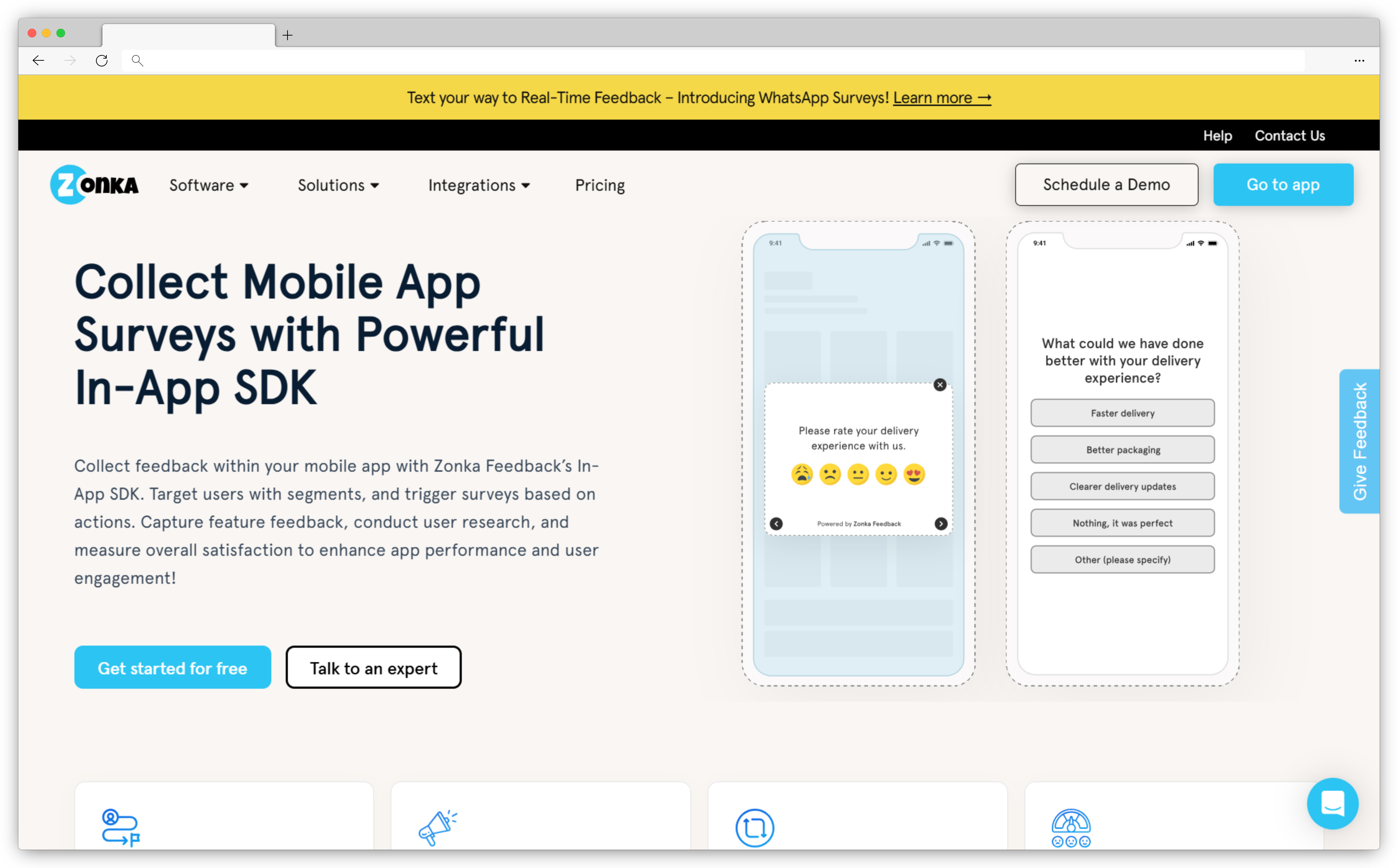
Zonka Feedback is an AI Customer Feedback & Intelligence Platform built for product and CX teams that need in-app surveys with intelligence behind them, not just a dashboard of scores. It supports native SDKs for iOS, Android, React Native, and Flutter, which puts it ahead of most tools in this list on framework coverage alone. Surveys can be triggered based on user behavior, lifecycle stage, or specific product events, including product feedback software workflows triggered at key moments inside web apps. You're not limited to time delays or manual sends.
What distinguishes Zonka from the pure survey tools is the AI feedback intelligence layer. Open-text responses go through thematic analysis, sentiment scoring, and entity mapping that connects feedback to specific features, workflows, and user segments automatically. Instead of manually tagging 800 responses to find out why NPS dropped after a feature release, AI agents surface what's driving the shift and who needs to act on it. There's also a closed-loop workflow system: low scores create cases, cases get assigned, alerts reach the right person.
It integrates natively with Salesforce, HubSpot, Zendesk, Intercom, Slack, and Jira. For teams that already have a CRM or helpdesk workflow, feedback lands where it belongs, not in a separate dashboard nobody checks.
Key Features
- Native mobile SDK for in-app surveys for iOS, Android, React Native, and Flutter with one-click token setup
- Event-based and behavior-based survey triggers with user segmentation feature by lifecycle stage, device, and custom attributes
- NPS, CSAT, CES, feature rating, and open-text survey types with 100+ templates
- AI sentiment analysis, theme clustering, and entity detection on open-text responses
- Closed-loop case management: auto-assign, alert routing, and follow-up tracking
- Native integrations with Salesforce, HubSpot, Zendesk, Intercom, Jira, and Slack
Zonka Feedback Pros
- SDK setup is fast: one-click token generation, well-documented across all four frameworks
- AI analysis works on high volumes of open-text feedback without manual tagging
- Closed-loop workflows mean feedback has a destination, not just a dashboard
- Native integrations cover the major CRM and helpdesk platforms product teams already use
Zonka Feedback Cons
- Custom pricing means you need a demo call before knowing your number: no self-serve pricing page
- Niche integrations outside the listed partners require manual Zapier setup
- Advanced AI features sit on higher-tier plans
Zonka Feedback Pricing
- Custom pricing based on business requirements and survey volume
- 14-day free trial, available on request
G2 Rating: 4.7/5 on G2
Best use case: Product teams at mid-market or enterprise SaaS companies that need mobile SDK surveys, AI analysis on open text, and closed-loop workflows in a single platform.
2. Refiner: Best for SaaS Teams Running Targeted Micro-Surveys
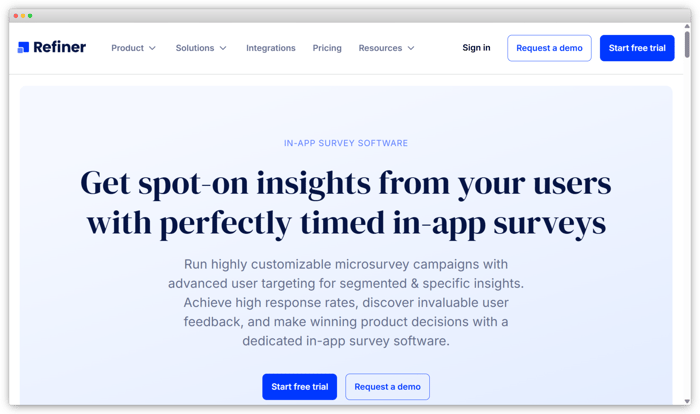
Refiner is built specifically for SaaS product teams who want to ask one sharp question at exactly the right moment. It doesn’t try to be a full CX platform. The focus is narrow: get a beautifully designed micro-survey in front of the right user at the right lifecycle stage, with the least friction possible.
The segmentation engine is where Refiner earns its reputation. You can target users by plan type, feature usage, login frequency, lifecycle stage, custom traits, and in-app events, all without touching the backend beyond the initial SDK setup. A team running NPS at 30 days post-onboarding, CSAT after a feature interaction, and churn reason surveys on downgrade intent can configure all three independently with different audience rules and response handling.
Analytics are clean and focused. You get response breakdowns, sentiment trend lines, NPS movement over time, and user-level attributes attached to each response. It integrates with HubSpot, Intercom, Segment, Amplitude, and Slack. For SaaS companies that already have a product analytics stack, Refiner connects survey responses to product usage data without much effort.
Key Features
- Lightweight SDKs for web, iOS, Android, and React Native
- Segmentation engine: target by plan type, lifecycle stage, custom user traits, and in-app events
- Automated workflows for recurring surveys: NPS, CSAT, CES, onboarding feedback, churn surveys
- Pixel-perfect micro-survey UI: branded, low-interruption, built to feel native
- Analytics with response breakdowns, sentiment trends, and user-level attributes
- Integrations with HubSpot, Segment, Intercom, Amplitude, and Slack
Refiner Pros
- Targeting precision is best-in-class for SaaS use cases: multi-condition audience rules work reliably
- Survey UI is polished; completion rates are consistently high
- Clean analytics dashboard with user-level drill-down
- Easy integration with product analytics stacks (Segment, Amplitude)
Refiner Cons
- No native Android SDK: mobile coverage limited compared to Zonka Feedback or Luciq
- Limited AI analysis on open-text responses compared to enterprise tools
- Not suited for teams that need visual feedback, bug reporting, or closed-loop case management
Refiner Pricing
- Starts at $99/month
- Custom plan available for higher volumes
- No free plan: paid plans only
G2 Rating: 4.6/5 on G2
Best use case: SaaS product teams running targeted NPS, CSAT, and churn surveys on web or mobile, where targeting precision and clean survey UI matter more than AI analysis depth.
3. Survicate: Best for Multi-Channel In-App and Website Feedback
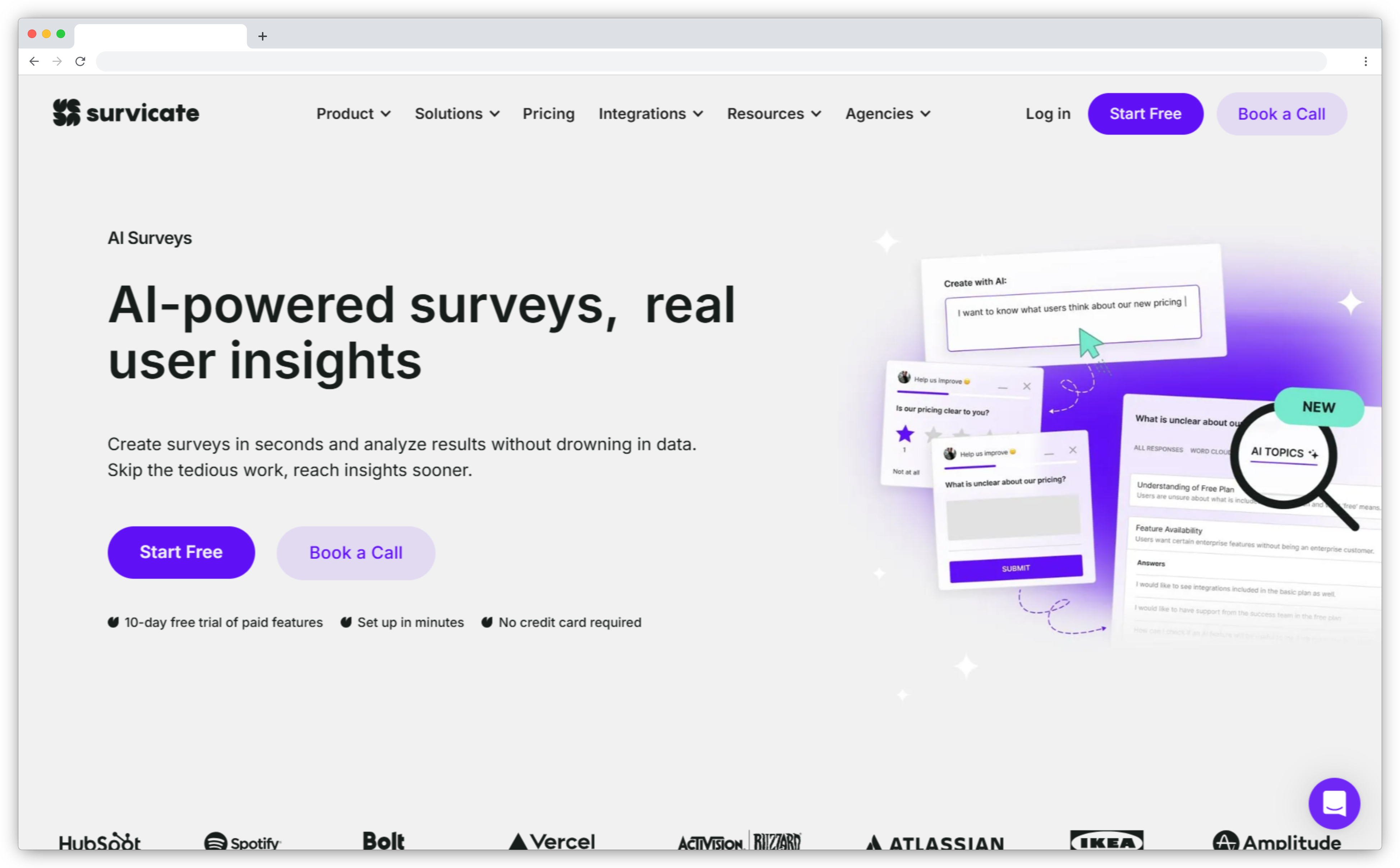
Survicate covers in-app feedback alongside website surveys, making it a natural fit for SaaS teams that collect feedback across both web and mobile. The mobile SDK supports iOS and Android with easy installation, and it fires surveys based on specific user actions, completing onboarding, interacting with a feature, reaching a specific screen.
The survey builder offers 15+ question types and 125+ templates, including NPS, CSAT, and CES. Surveys are fully brandable with custom colors, logos, and CSS. Survicate integrates with Intercom, HubSpot, Salesforce, Mixpanel, Amplitude, and Productboard, covering both the CRM/support stack and the product analytics stack in one integration list.
Where Survicate stands out for early-stage and growing teams is accessibility. It has a free tier, an approachable setup process, and solid documentation. Teams that aren’t ready for a full enterprise feedback platform but need something more capable than a basic widget often land here.
Key Features
- Mobile SDK for iOS and Android with event-based survey triggers
- 15+ question types and 125+ survey templates including NPS, CSAT, and CES
- Full branding control: custom colors, fonts, logos, and CSS
- Behavior-based targeting: trigger surveys based on specific user actions and screen visits
- Real-time response notifications via email and Slack
- Integrations with Intercom, HubSpot, Salesforce, Mixpanel, Amplitude, and Productboard
Survicate Pros
- Free tier available: lower barrier to getting started than most tools in this list
- SDK installation is fast; React Native and Cordova packages available alongside native iOS/Android
- Multi-channel coverage: website surveys and in-app surveys from one platform
- Strong integration list covers both product analytics and CRM/support tools
Survicate Cons
- AI analysis is limited compared to Zonka Feedback or Qualtrics
- Closed-loop case management requires manual routing via integrations
- Flutter SDK not natively supported: check documentation before committing if Flutter is your stack
Survicate Pricing
- Free tier available with limited features and response volume
- Paid plans start at [Verify from live site]
G2 Rating: 4.6/5 on G2
Best use case: SaaS teams collecting feedback across web and mobile from a single platform, particularly teams at early or growth stage who want a free tier to start with before scaling.
Best for Enterprise and Research Programs
Tools built for scale, compliance, and advanced analytics. Suited for organizations running formal VoC programs or large-scale UX research with complex data requirements.
4. Qualtrics: Best for Enterprise UX and Voice of Customer Programs
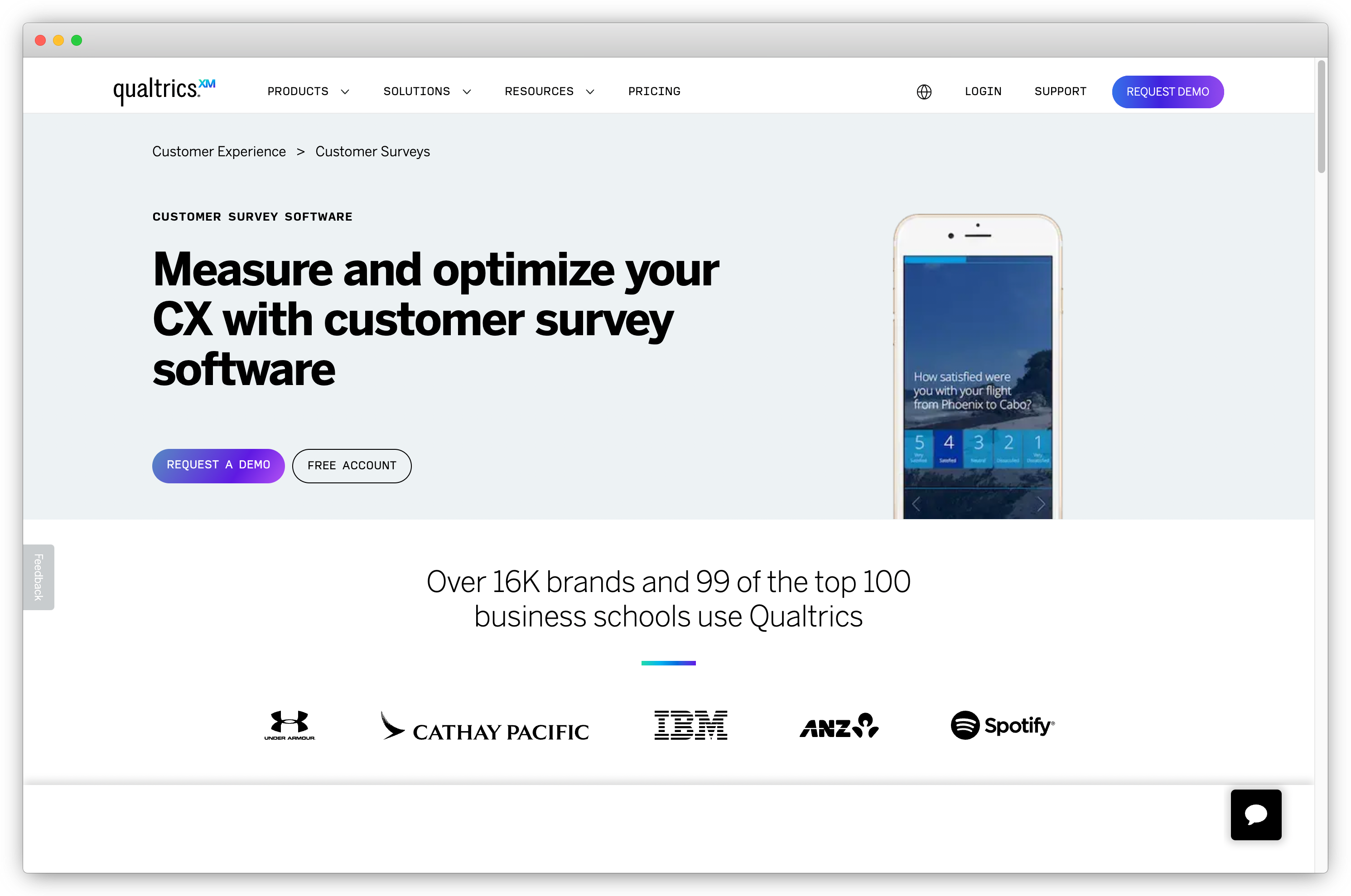
Qualtrics is what you reach for when your feedback program is too large and too complex for most tools to handle. The platform combines behavioral data, predictive analytics, and in-app surveys through SDK-based implementation on iOS, Android, Flutter, and React Native.
The real value sits in the analytics layer. Qualtrics can detect rage clicks and session drop-offs, fire intercept surveys when a user shows frustration signals, and connect those responses to Google Analytics, Adobe Analytics, and your CDP. That connection is the whole point. For enterprise product and UX teams running formal research programs, that’s the capability that justifies the price.
The trade-off is complexity and cost. Setup requires developer involvement and usually a professional services engagement. Teams running simple NPS surveys or early-stage product feedback programs will find it over-engineered and expensive. It’s an enterprise research platform, not a lightweight in-app survey tool.
Key Features
- SDK support for iOS, Android, Flutter, and React Native
- Behavioral trigger surveys: detect rage clicks, scroll depth, session drop-offs, and UI friction
- Predictive analytics and AI-driven sentiment categorization on open-text responses
- Pre-built digital feedback intercepts with branded templates and display options
- Integrations with Google Analytics, Adobe Analytics, CDPs, and major CRMs
- Adaptive follow-up logic: surveys adjust based on earlier responses in the same session
Qualtrics Pros
- Behavioral signal detection (rage clicks, drop-offs) for context-aware survey triggers
- Best-in-class analytics for enterprise research programs
- Strong compliance and data security posture for regulated industries
- Integrates with the full enterprise analytics and CRM stack
Qualtrics Cons
- Requires developer implementation and often a professional services engagement
- Pricing is enterprise: significant investment for smaller teams
- Learning curve is steep; smaller product teams rarely use the full platform
Qualtrics Pricing
- Custom pricing: contact sales for a quote
- No free plan or self-serve trial available
G2 Rating: 4.4/5 on G2
Best use case: Enterprise product, UX, and VoC teams running formal research programs that need behavioral signal detection, advanced analytics, and deep integration with existing enterprise data infrastructure.
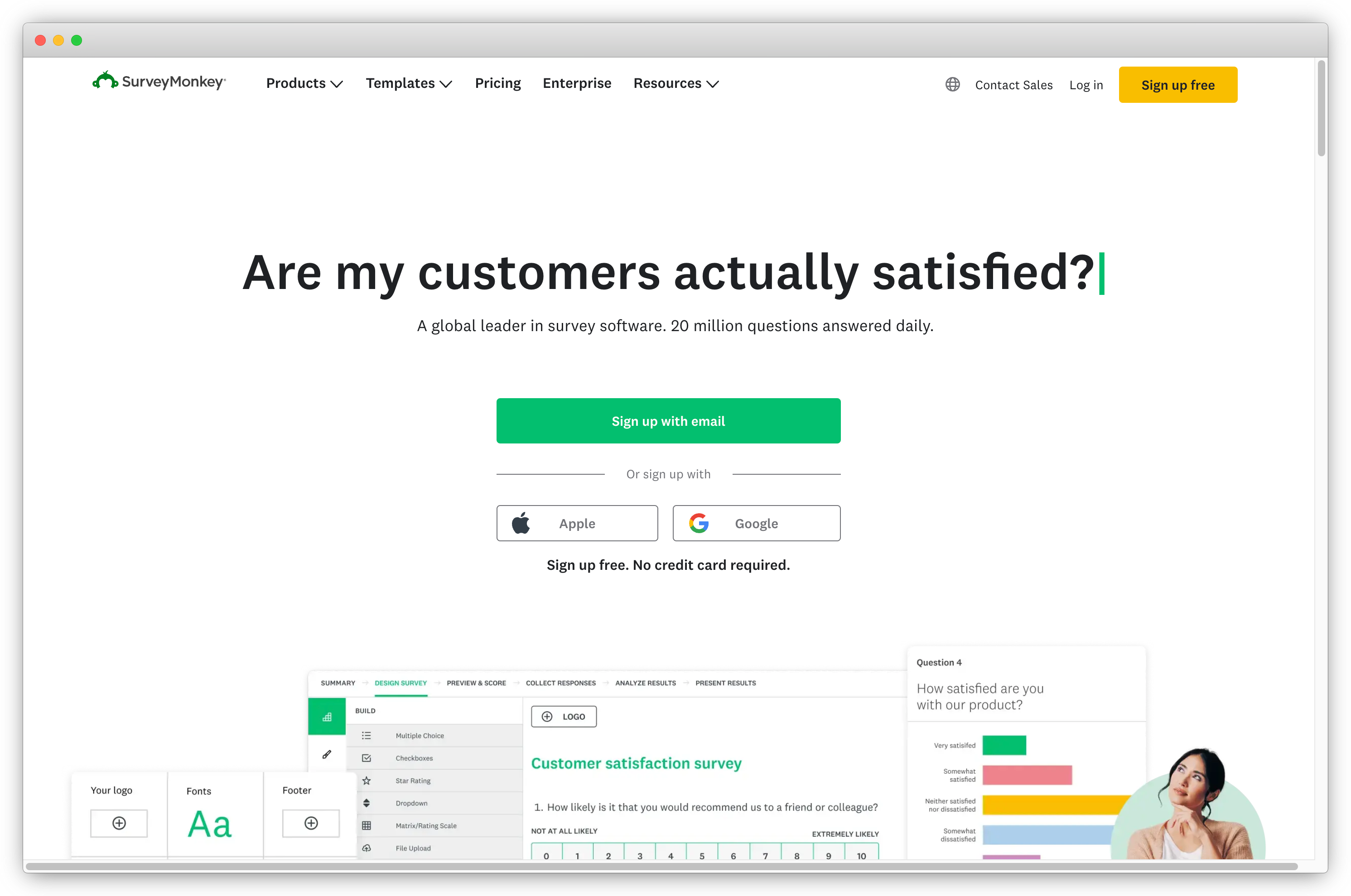
5. SurveyMonkey: Best for Quick, Template-Driven In-App Surveys
SurveyMonkey is the most accessible entry point in this list. Most teams already have it. Its in-app SDK for iOS and Android is newer and less featured than purpose-built tools, but it works, and for teams that need to get a basic NPS or satisfaction survey running inside their app without a procurement process or extended setup, that matters.
The survey builder is strong on templates and usability. AI-driven response analysis is available on higher-tier plans, though it’s less capable than Zonka Feedback or Qualtrics for pattern detection across large response sets. The in-app SDK supports event-based triggers and custom audience filters, covering the basic targeting use cases.
Where SurveyMonkey falls short for serious mobile feedback programs is depth. Advanced logic, complex segmentation, and closed-loop workflows all require workarounds or aren’t available. If your feedback needs grow beyond simple periodic surveys, you’ll outgrow it quickly.
Key Features
- SDK for iOS and Android with event-based survey triggers
- 250+ survey templates with customizable themes and branding
- AI-driven analysis of open-text responses on paid plans
- Audience segmentation and custom variable filtering
- Mobile-optimized survey display with offline response support
- Integrations with Salesforce, HubSpot, Slack, and Tableau
SurveyMonkey Pros
- Low cost entry point: $18/mo is the lowest in this list for a paid plan
- Familiar interface most teams already know how to use
- Template library is the most extensive of any tool here
SurveyMonkey Cons
- In-app SDK is less mature than purpose-built mobile feedback tools
- Advanced features locked to higher-tier plans: $18/mo plan is limited
- No closed-loop workflow support for following up on responses
SurveyMonkey Pricing
- Paid plans start at $18/month
- Limited free plan available
- Advanced features (AI analysis, logic branching) on higher tiers
G2 Rating: 4.4/5 on G2
Best use case: Small teams and early-stage products that need a basic in-app survey setup quickly without significant budget or developer investment.
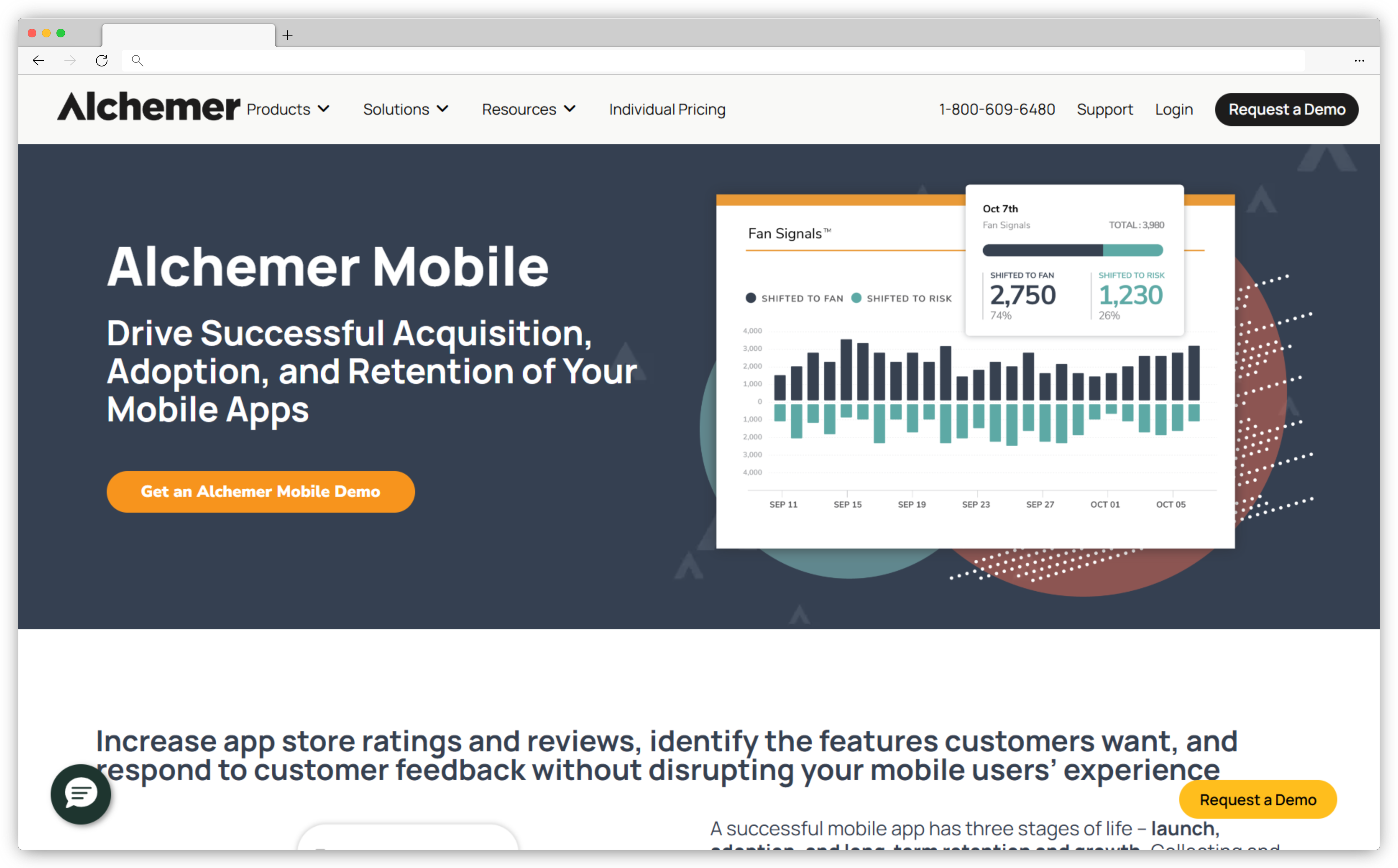
6. Alchemer: Best for Mobile-First Teams Tracking Sentiment Across the App Lifecycle
Alchemer (formerly Apptentive) is purpose-built for mobile app feedback. It covers the full app lifecycle, from acquisition through onboarding, feature adoption, and retention, with SDK-based surveys triggered by in-app events and behavioral signals including rage touches and session drop-offs.
The platform is known for app store rating optimization: it detects satisfied users after positive interactions and prompts them for app store reviews at the right moment. That’s a specific use case most tools don’t handle well. For consumer mobile apps where app store ratings drive download volume, it’s a meaningful capability.
The analytics layer is centered on sentiment shifts over time, tracking how user sentiment at a specific in-app event changes across app versions or after product updates. This makes it particularly useful for release validation: did the new onboarding flow improve sentiment compared to the previous version? For teams validating features before a full rollout, a beta testing survey triggered at specific app versions captures structured feedback from early access cohorts.
Key Features
- Lightweight SDK for iOS and Android with minimal performance impact
- Event-based triggers: fire surveys after specific in-app milestones, rage touches, or session events
- App store rating optimization: detect satisfied users and prompt for review at the right moment
- AI-powered sentiment tracking across app versions and releases
- Audience targeting by demographics, app version, behavior, and sentiment history
- Integrations with CRM, analytics platforms, and customer data platforms
Alchemer Pros
- App store rating optimization is a differentiated capability: most tools don’t do this reliably
- Sentiment tracking across app versions is valuable for release validation
- Mobile-first focus means the SDK is genuinely optimized for app performance
Alchemer Cons
- UI can feel dated compared to newer tools
- Not suited for teams that need web survey support alongside mobile
- Limited AI analysis on open-text responses relative to enterprise platforms
Alchemer Pricing
- Starts at $55/month
- No free plan
- Enterprise plans available on request
G2 Rating: 4.4/5 on G2
Best use case: Consumer mobile app teams that need release-by-release sentiment tracking, app store rating prompts, and event-based survey triggers on iOS and Android.
Best for Mobile App Developers
SDK-first tools that go beyond surveys — combining bug reporting, crash analytics, and session replay alongside feedback collection. Built for engineering-led teams shipping native and cross-platform apps.
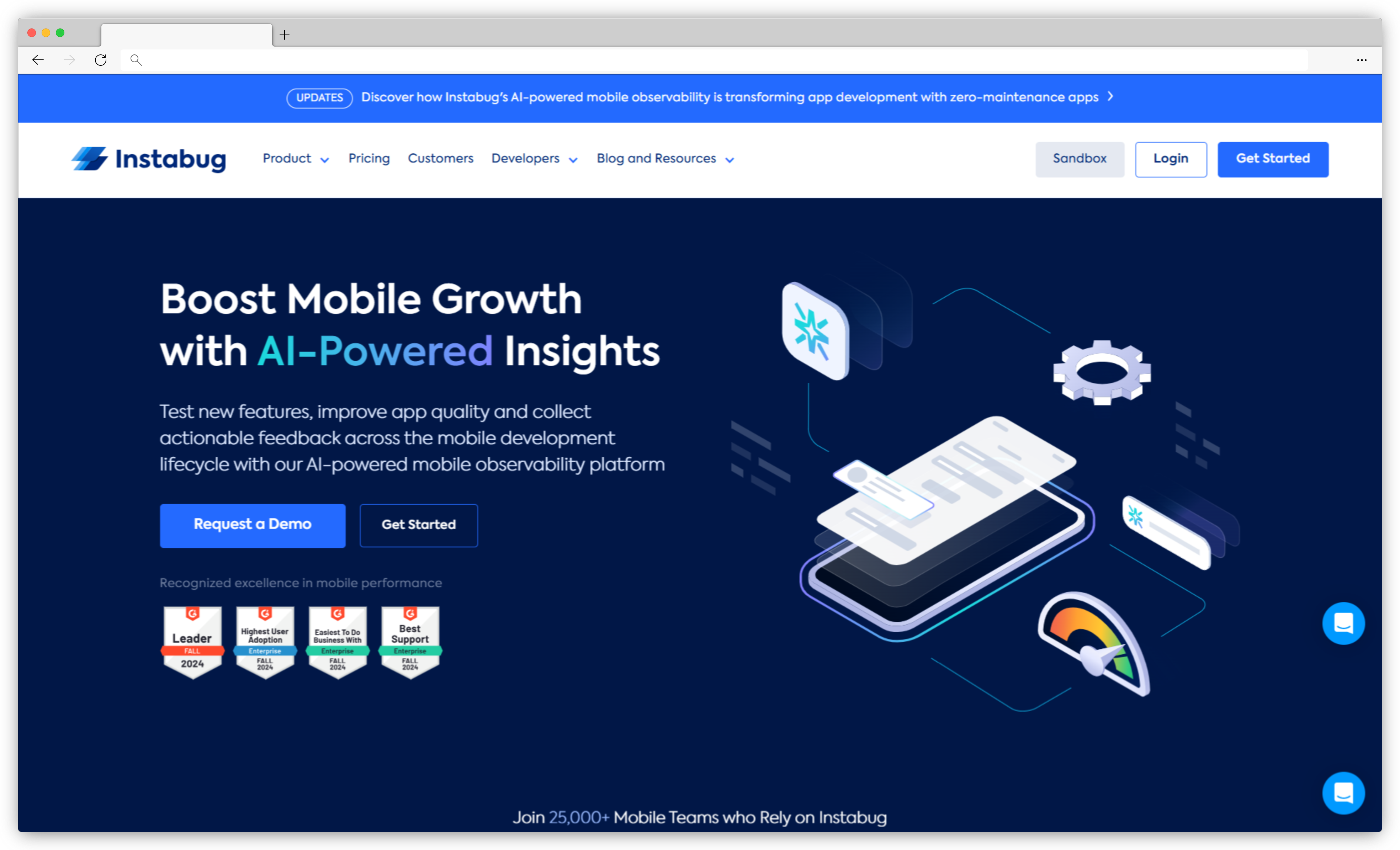
7. Luciq (formerly Instabug): Best for Mobile Developers Combining Bug Reporting and In-App Feedback
Luciq (formerly Instabug) is the tool mobile developers reach for when they need bug reporting, crash analytics, and user feedback from a single SDK. Most in-app feedback tools treat bugs and surveys as separate concerns. Luciq treats them as the same concern: understanding what’s breaking and what users think about it.
The SDK covers iOS, Android, React Native, Flutter, Xamarin, Cordova, and Unity, the broadest framework coverage in this list. Session replays show exactly what was happening in the app when a user submitted feedback or a crash occurred. That context (the screen state, the tap sequence, the network conditions at the moment of failure) turns a bug report from a description into evidence. For structured bug reporting survey design, bug report form questions covers the question framework.
The feedback layer supports in-app surveys with event-based triggers, NPS and app rating prompts, and sentiment detection on open text. For mobile development teams in particular, having both crash analytics and feedback in one integration simplifies the tech stack and reduces the number of SDKs running in production.
Key Features
- SDK coverage for iOS, Android, React Native, Flutter, Xamarin, Cordova, and Unity
- In-app bug reporting with automatic attachment of device state, logs, and network data
- Session replay: view user interactions leading up to a feedback submission or crash
- NPS, app rating prompts, and custom surveys with event-based triggers
- Crash analytics and performance monitoring alongside feedback collection
- Integrations with Jira, Slack, Zendesk, Trello, and GitHub
Luciq Pros
- Broadest SDK framework coverage in this list: supports 7 platforms including Unity and Xamarin
- Bug reporting + crash analytics + surveys in one SDK reduces integration overhead
- Session replay gives genuine context that text-based bug reports can’t match
- Strong fit for development-led teams that own the feedback collection infrastructure
Luciq Cons
- Starts at $249/mo: highest entry price in this list for a non-custom plan
- Not designed for CX or VoC programs: limited closed-loop case management
- Overkill if you only need surveys and don’t need crash/performance monitoring
Luciq Pricing
- Starts at $249/month
- No free plan: 14-day free trial available
- Enterprise plans available on request
G2 Rating: 4.3/5 on G2
Best use case: Mobile development teams that need bug reporting, crash analytics, and in-app feedback surveys from a single SDK, particularly teams on multiple frameworks including Flutter, Xamarin, or Unity.
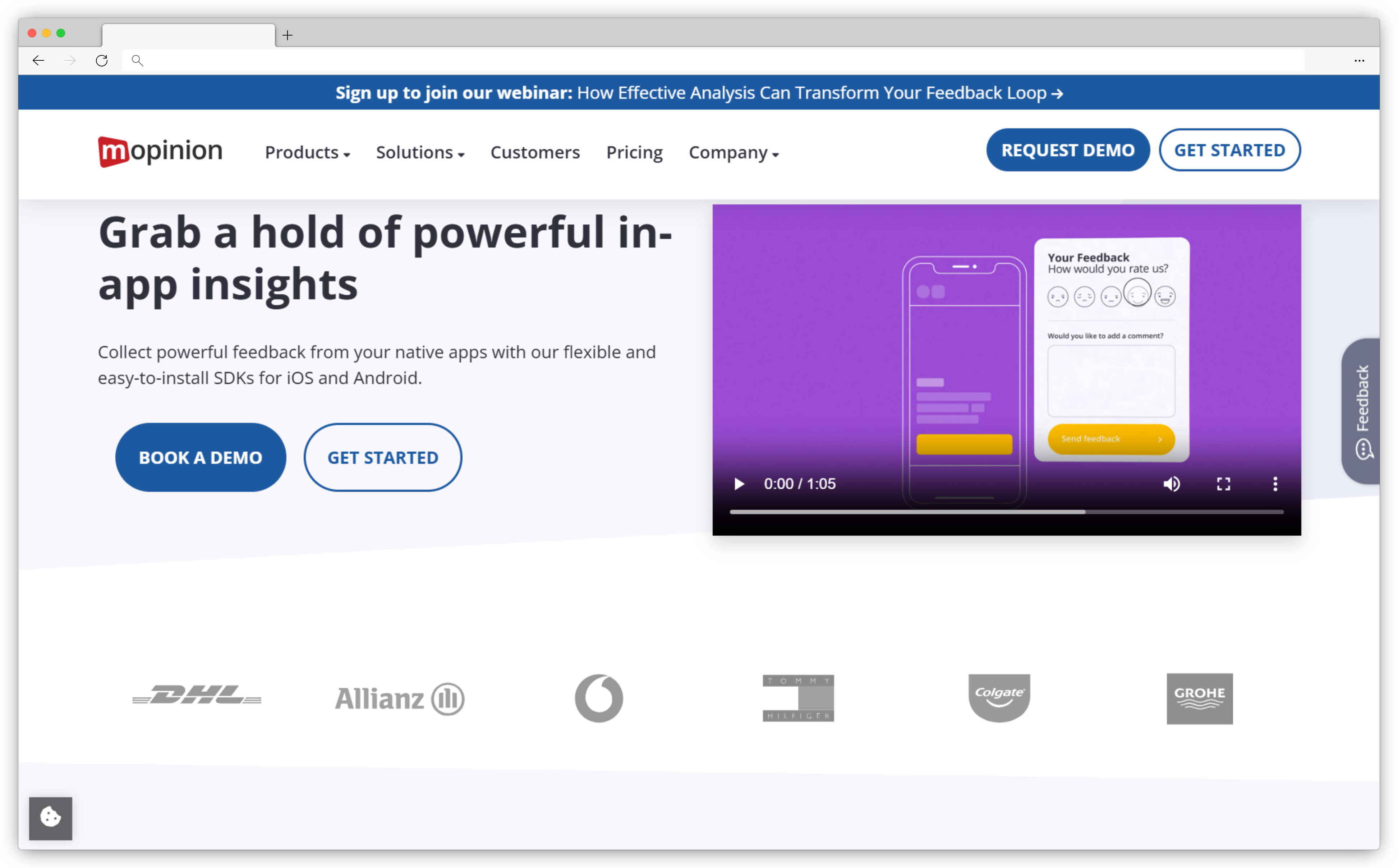
8. Mopinion: Best for UX and CRO Teams Collecting Visual In-App Feedback
Mopinion is built for teams that need more than a score, they need to see what users are looking at and pointing to. The platform’s standout capability is visual feedback: users can submit screenshots with annotations, marking exactly which element confused them, broke, or impressed them. For UX teams running usability reviews or CRO teams diagnosing friction points, this turns vague feedback into specific design intelligence.
The SDK covers iOS, Android, Flutter, React Native, Cordova, and Ionic. Mopinion is now part of Netigate, which has added AI-powered feedback analysis, sentiment summaries, filtering of open-text, and cross-channel reporting, on top of the core SDK functionality.
Triggering logic supports user behavior events, app version, device type, and screen-level context. The survey builder is drag-and-drop with a strong template library. At $271/mo, it’s one of the pricier mid-tier options, but the visual feedback capability justifies the premium for teams that make it their primary use case.
Key Features
- SDK for iOS, Android, Flutter, React Native, Cordova, and Ionic
- Visual feedback with screenshot annotation: users mark specific UI elements
- Behavior-based and metadata-based survey triggers (app version, device, screen)
- AI-powered sentiment analysis and open-text summarization (via Netigate integration)
- App store rating prompt to encourage positive reviews
- Integrations with Jira, Slack, Zendesk, and major analytics platforms
Mopinion Pros
- Screenshot annotation is genuinely differentiated: turns feedback into UX evidence
- Metadata-rich responses: device type, app version, location all attached automatically
- AI analysis improved significantly since the Netigate acquisition
Mopinion Cons
- $271/mo is high for teams that don’t use the visual feedback feature regularly
- Initial setup for advanced customization can take time
- Less suitable for NPS/CES programs at scale: better suited for UX-specific feedback
Mopinion Pricing
- Starts at $271/month
- No free plan
- Enterprise plans available via sales
G2 Rating: 4.1/5 on G2
Best use case: UX researchers and CRO teams that need annotated visual feedback tied to specific screens or UI elements, not just satisfaction scores.
Best for UX Research and Visual Feedback Workflows
Tools focused on what users see and interact with, not just what they score. Ideal for UX researchers, CRO teams, and QA workflows that need annotated screenshots, screen recordings, and visual bug triage.
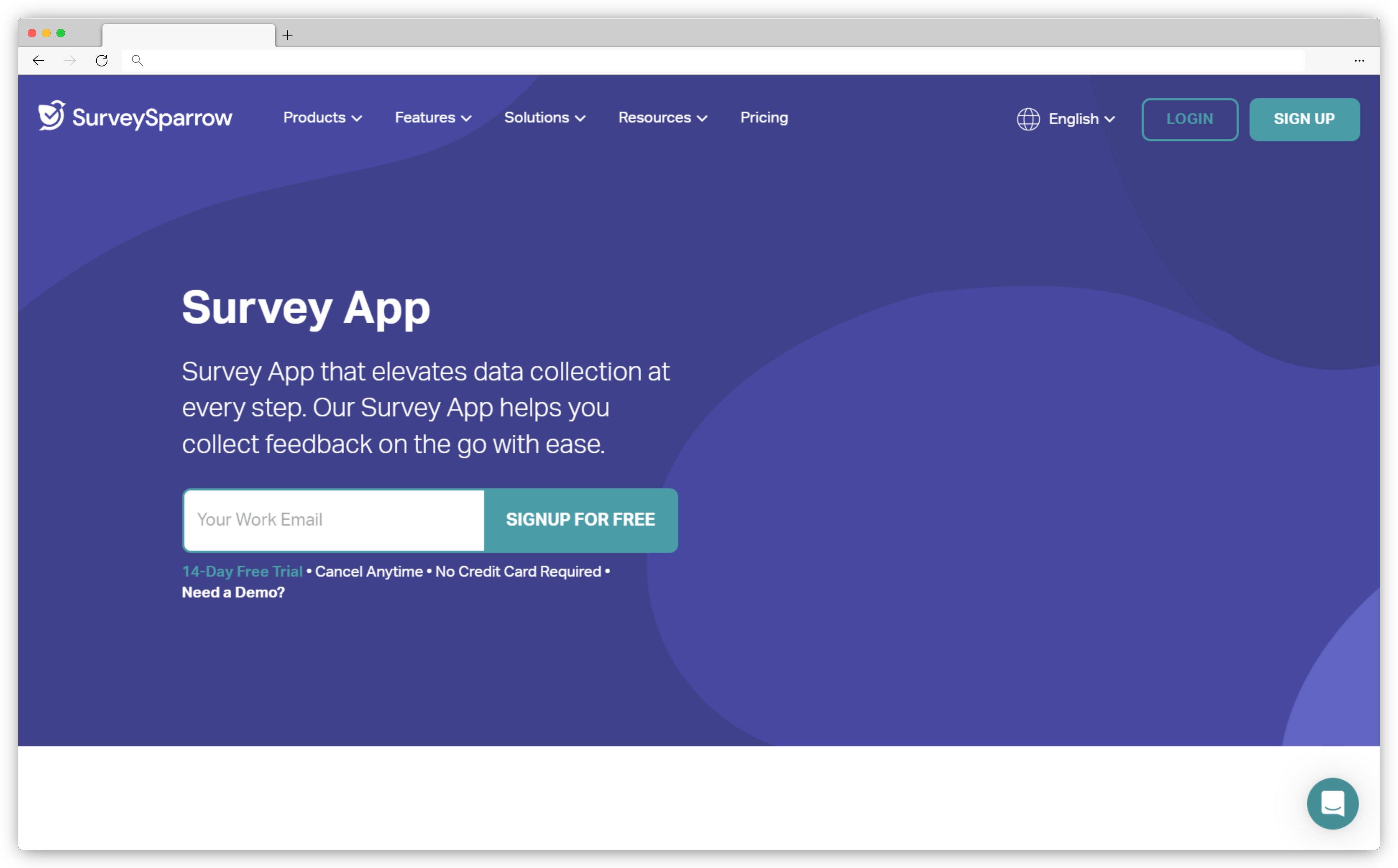
9. SurveySparrow: Best for Conversational, Chat-Style In-App Surveys
SurveySparrow’s in-app feedback feature SpotChecks delivers surveys in a conversational chat format rather than a traditional form layout. For consumer apps and products where the tone is informal and the user base is mobile-native, the chat UI drives noticeably higher completion rates than a standard survey widget.
The SDK supports iOS, Android, React Native, and Flutter with a one-time setup. Surveys trigger based on in-app events, user segments, or time conditions, and the platform offers 100+ templates with custom CSS styling. SurveySparrow also supports recurring survey programs, useful for teams running quarterly NPS or monthly CSAT cadences without manual resends.
The 2,000+ integration catalog is wide, though depth varies by integration. For teams already using Salesforce, HubSpot, or Zapier, connecting survey data to their existing workflow is straightforward.
Key Features
- SDK for iOS, Android, React Native, and Flutter: one-time setup for unlimited surveys
- Chat-style conversational survey UI with custom branding and CSS
- Event-based triggers: post-purchase, session drop-off, specific in-app actions
- Recurring survey programs with automated scheduling
- Audience segmentation by demographics, behavior, and custom attributes
- 2,000+ integrations including Salesforce, HubSpot, Slack, and Zapier
SurveySparrow Pros
- Conversational survey UI genuinely improves completion rates on mobile
- One-time SDK setup covers unlimited surveys: no per-survey integration work
- Recurring survey programs are well-designed and reliable
SurveySparrow Cons
- Custom pricing with no public rates: requires a sales conversation to get a number
- AI analysis on open-text responses is basic compared to Zonka Feedback or Qualtrics
- Some users report variable customer support response times
SurveySparrow Pricing
- Custom pricing: contact sales for a quote
- No free plan for in-app features
- Demo available on request
G2 Rating: 4.4/5 on G2
Best use case: Consumer mobile app teams where conversational survey UI drives higher engagement, and B2C SaaS teams running recurring NPS or CSAT programs across mobile and web.
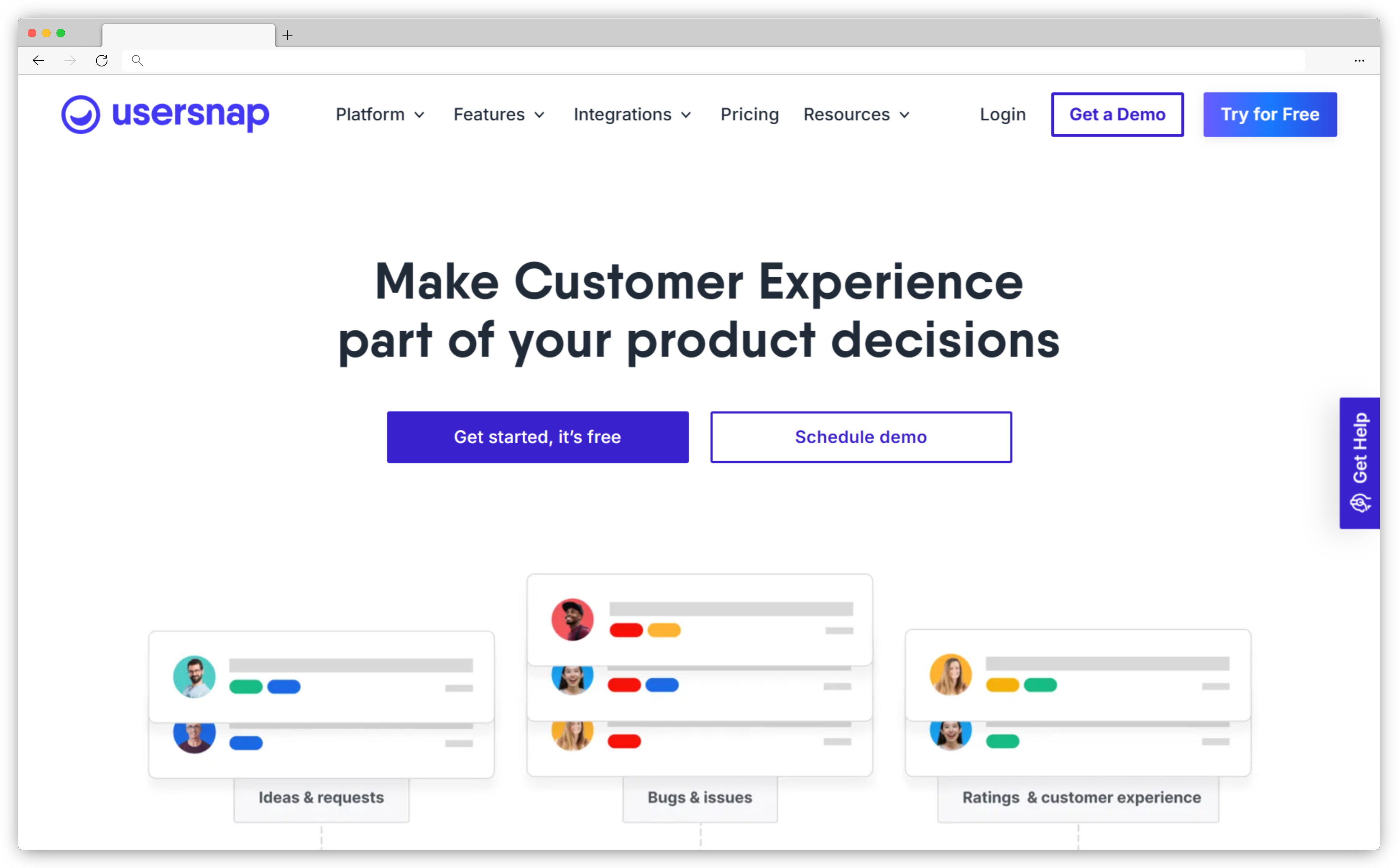
10. Usersnap: Best for Product and QA Teams Needing Visual Feedback and Bug Triage
Usersnap is the lowest-cost entry into visual feedback in this list at $40/mo. It covers in-app surveys alongside screen recording, screenshot capture, and a Kanban-style triage dashboard, giving product and QA teams a workflow for managing feedback as well as a tool for collecting it.
The SDK is native for iOS and Android. Surveys support NPS, CSAT, multi-choice, and feature request formats with event-based triggers. What makes Usersnap distinct in its price range is the combination: you get bug reporting and survey functionality together, a triage board for managing incoming feedback, and a changelog feature for announcing new releases inside the app.
It integrates with Jira, Trello, Azure DevOps, Slack, and GitHub, which means feedback flows directly into the development tools your team is already using. For product teams that want developers and PMs working from the same feedback queue without building a custom routing workflow, the Jira integration alone is worth the price.
Key Features
- Native SDK for iOS and Android, plus React Native support
- NPS, CSAT, multi-choice, and feature request surveys with event-based triggers
- Screen recording and screenshot capture with annotation
- Kanban-style triage dashboard with automated workflow routing
- In-app changelog announcements to communicate releases to users
- Integrations with Jira, Trello, Azure DevOps, Slack, and GitHub
Usersnap Pros
- $40/mo is the most accessible price point for visual feedback in this list
- Triage dashboard + Jira integration create a complete feedback-to-ticket workflow
- In-app changelogs close the loop with users in the same tool that collects feedback
Usersnap Cons
- Mobile SDK is only available on the highest-tier plan: check your plan before committing
- Limited scalability for large enterprise programs with high feedback volumes
- AI analysis is minimal: primarily metadata-based rather than open-text pattern detection
Usersnap Pricing
- Starts at $40/month
- Mobile SDK available on higher-tier plans only: verify before selecting a plan
- No free plan
G2 Rating: 4.5/5 on G2
Best use case: Product and QA teams that need bug reporting, in-app surveys, and a triage workflow connecting directly to Jira or Trello, particularly at teams under 50 people where the $40/mo entry price matters.
What Mistakes Do Product Teams Make When Collecting In-App Feedback?
Most feedback programs don’t fail because teams chose the wrong tool. They fail because the tool gets configured in ways that undermine what they’re trying to learn.
Triggering surveys at the wrong moment. An NPS survey on first login is the most common version of this. The user has spent four minutes in your product. They have no relationship to measure. What you get back is noise. NPS is a relationship metric, it belongs 30 to 60 days into onboarding, after the user has hit a value moment, not at the first sign of life. The irony is that triggering surveys at the right moment is exactly what most of these tools are built to do. Teams just don’t configure it that way.
Asking five questions when one would do. The research on microsurveys is consistent: completion rates drop sharply after the second or third question on mobile. A single rating question plus one optional open-text field outperforms a five-question survey on every metric, response rate, data quality, and user tolerance. Most teams build the survey they wish they could send, not the one users will actually complete.
Collecting feedback into a dashboard nobody reviews. This is the loop problem. Feedback lands, scores appear, and then nothing happens. Users stop responding after two or three unanswered submissions, not because they noticed they were being ignored, but because the pattern registers. Tools with closed-loop workflows force the question: who is responsible for acting on a low score? If nobody owns that answer before you launch the survey, the data is decoration.
Using NPS at every touchpoint. NPS after a support ticket resolution. NPS after a feature tutorial. NPS after an onboarding call. NPS is measuring relationship loyalty, it’s not the right instrument for individual interactions. CSAT is for transactions. CES is for effort and friction. Using the wrong metric at the wrong moment gives you a number that doesn’t explain anything about what happened.
Treating new users and power users as the same audience. A user three days into onboarding and a user who’s been in your product for 18 months have completely different contexts, pain points, and expectations. Sending them the same survey at the same moment produces averaged-out data that represents neither of them accurately. User segmentation by lifecycle stage isn’t optional for programs that want to act on what they hear.
Skipping product-market fit survey measurement entirely. Most teams run NPS and CSAT but never ask the PMF question. If fewer than 40% of your users would be "very disappointed" without your product, no amount of feature feedback will fix the core problem. PMF surveys belong in every in-app feedback program, triggered at the 30-day mark for active users.
What Should You Know About Mobile App SDKs Before Choosing a Tool?
The implementation reality of in-app feedback SDKs is different from the marketing copy. Here’s what matters before you commit.
Framework coverage determines compatibility, not just preference. In practice, this is where most teams get caught out. If your app is built in Flutter and a tool only supports Swift and Kotlin, their in-app SDK isn’t available to you. Full stop. Before evaluating any other capability, confirm SDK support for your exact stack: native iOS (Swift), native Android (Kotlin/Java), React Native, or Flutter. Luciq and Zonka Feedback have the broadest coverage across all four. Most other tools support two or three.
Documentation quality predicts implementation time. A well-documented SDK with clear initialization guides, event trigger examples, and troubleshooting for common errors takes days to implement. A poorly documented one takes weeks and consumes engineering capacity that was supposed to go elsewhere. Review the documentation, not the marketing page, before putting a tool on a shortlist. Zonka Feedback’s developer documentation is worth reviewing as a benchmark for what good SDK docs look like.
SDK size affects app performance. Every SDK adds to your app’s binary size and startup time. Ask vendors for their SDK size and any published performance benchmarks. A heavy SDK that slows app startup or increases memory pressure will create problems that survive the feedback program.
"15-minute setup" is for the happy path. Vendors routinely quote initialization time without factoring in event mapping, QA in staging, edge case handling, or the back-and-forth when trigger behavior doesn’t match what was configured. Budget for a realistic implementation sprint, especially if your surveys use complex targeting rules.
For step-by-step implementation guides by framework:
- in-app feedback with React Native SDK
- in-app feedback with Flutter SDK
- in-app feedback with iOS SDK
- in-app feedback using Android SDK
Which In-App Feedback Tool is Right for Your Team?
The tool category is genuinely varied, and the right answer depends on what you’re building, how your team is structured, and what you plan to do with what you hear.
If you’re a mobile-first team that needs native SDK surveys with AI analysis behind them, Zonka Feedback is the most complete option at a non-enterprise price point. If you’re a SaaS product team that lives and dies by micro-survey targeting precision, Refiner is purpose-built for you. If you need bug reporting and feedback from one SDK without managing two integrations, Luciq solves the problem cleanly. And if budget is the constraint right now, Usersnap at $40/mo gets you farther than most teams expect.
The mistake to avoid is choosing a tool based on features you might need someday rather than the workflow you’ll actually use in the first 90 days. A feedback program that runs with 70% of a tool’s capabilities and actually closes the loop is worth more than one configured to capture everything and reviewed by nobody. We’ve seen this pattern consistently: simpler programs that ship beat elaborate ones that stall.
If you’re still working out your broader product feedback strategy before committing to a tool, that guide covers the full picture. For teams whose needs extend beyond in-app feedback into behavioral analytics and adoption tooling, our guide on product experience management software covers the broader category.
Schedule a demo with Zonka Feedback to see how it fits your specific stack and use case.



-3.png)
-Feb-11-2025-06-44-08-4705-AM.png)
-1.png)