

.svg)
 Healthcare
 Finance
 Retail
 SaaS & Digital
 eCommerce
 Education
 Salesforce
  HubSpot
 Pipedrive
 Mailchimp
 Zendesk
  Intercom
 Freshdesk
 HelpScout
  Front
Front Jira
Jira Slack
Slack  MS Teams
 Zoom
Zoom Google Sheets
  Zapier
  Integrately
 Make
Make  Webhooks




 MS Teams


Zonka Feedback is the best overall customer satisfaction tool in 2026 for businesses that need omnichannel feedback collection, AI-powered analysis, and closed-loop workflows in a single platform. For support-focused teams, Nicereply delivers one-click CSAT tied directly to helpdesk tickets. For enterprise programs, Qualtrics and Medallia handle multi-department complexity at scale. All tools on this list measure CSAT, NPS, and CES: the core metrics that tell you whether customers are satisfied, loyal, and likely to return.
TL;DR
- Customer satisfaction tools help businesses collect, analyze, and act on CSAT, NPS, and CES feedback across email, in-app, SMS, web, and other channels
- This guide covers 14 tools evaluated on feedback collection depth, AI capabilities, loop-closure workflows, integration strength, ease of setup, and pricing
- Best picks by use case: Zonka Feedback (multi-channel, full lifecycle), Nicereply (support and helpdesk), Qualtrics (enterprise), AskNicely (frontline NPS), Medallia (large-scale VoC), Crescendo.ai (AI-native, no manual surveys required)
- Every tool entry includes key features, a verified G2 rating, pricing, and a one-line best use case
- The comparison table below includes a Free Trial column to help you shortlist quickly
Picking the wrong customer satisfaction tool costs more than the subscription fee: it costs you signal clarity. Scores pile up with no way to know what's driving them or, worse, no workflow to act when something goes wrong. This guide covers 14 platforms built specifically to measure satisfaction, evaluated on what happens after the score comes in.
What are Customer Satisfaction Tools?
Customer satisfaction tools are software platforms that help businesses collect, measure, and analyze feedback to understand how satisfied customers are with their products, services, or interactions. They distribute customer feedback surveys across channels, email, in-app, SMS, web, kiosk, and offline, then aggregate user feedback into scores, themes, and customer sentiment that teams can act on.
The three core metrics these tools measure:
- CSAT (Customer Satisfaction Score): How satisfied was a customer with a specific interaction? Scored on a simple scale right after it happens.
- NPS (Net Promoter Score): Would a customer recommend you? Measures long-term loyalty, not just a single touchpoint.
- CES (Customer Effort Score): How easy was it? Measures the effort a customer had to put in to complete a task or get an issue resolved.
Modern customer satisfaction software goes beyond collecting survey responses. The best platforms handle open-text analysis, trigger-based alerts, and workflow automation, connecting feedback to support tickets, CRM records, and team notifications so that customer insights translate into action rather than sitting in a dashboard.
Why Use Customer Satisfaction Tools?
- Catch problems before they become churn. These tools surface dissatisfied customers before they cancel. Teams that act on negative feedback in real time see measurable improvements in customer retention and loyalty.
- Go beyond scores to understand the "why." A CSAT score of 3/5 tells you something is wrong. AI-powered sentiment analysis and thematic analysis tell you it's your onboarding flow, your billing process, or a specific support agent.
- Connect feedback to business outcomes. Data-driven companies are 23 times more likely to acquire customers. Customer satisfaction metrics feed directly into product roadmaps, support coaching, and retention strategy, driving measurable business growth and long-term business success.
- Understand what customers actually need. Customer expectations have risen sharply. Satisfaction programs that surface customer needs and customer opinions across touchpoints give product and service teams the qualitative data to act on what matters.
- Close the loop at scale. Automated alerts, ticket creation, and follow-up workflows mean every piece of critical feedback triggers real action: not just a row in a dashboard.
How We Evaluated These Customer Satisfaction Tools
To build this list, we assessed each platform against six criteria:
- Feedback collection depth: support for CSAT, NPS, and CES across email, in-app, SMS, web, kiosk, and offline channels
- AI capabilities: sentiment analysis, thematic analysis, and automated scoring
- Loop-closure workflows: alerts, ticket creation, integrations, and automation for acting on feedback
- Integration strength: compatibility with CRMs (Salesforce, HubSpot), helpdesks (Zendesk, Freshdesk), and collaboration tools (Slack, Teams)
- Ease of setup: time to first insight, learning curve, and usability based on verified G2 and Capterra reviews
- Pricing transparency: availability of free trials, published pricing tiers, and scalability for growing teams
We also referenced verified customer reviews from G2 and Capterra to ground each recommendation in documented user experience.
Transparency note: Zonka Feedback is our own product and appears on this list. It was evaluated against the same six criteria as every other tool, with no adjustments to scoring, feature framing, or placement criteria. The pros, cons, pricing, and G2 rating are held to the same standard applied across the list.
14 Best Customer Satisfaction Tools Compared
| Tool | Best For | Key Feature | Starting Price | Free Trial | G2 Rating |
| Zonka Feedback | Multi-channel feedback + closed-loop workflows | AI Feedback Intelligence + omnichannel | Custom | Free trial | 4.7/5 |
| Nicereply | Support & helpdesk teams | One-click post-ticket CSAT | $59/month | 14-day trial | 4.5/5 |
| Qualtrics | Enterprise CX programs | XM Discover + predictive analytics | Contact for pricing | Limited | 4.3/5 |
| Survicate | Multi channel feedback for product & SaaS teams | In-app behavioral targeting + AI research hub | $56/month | Limited | 4.6/5 |
| AskNicely | Frontline NPS + real-time coaching | Individual frontline coaching dashboards | $449/month | Free trial | 4.7/5 |
| Medallia | Large enterprise VoC programs | Signal-based experience management | Contact for pricing | No | 4.5/5 |
| Wootric (InMoment) | SaaS + customer success teams | Lifecycle NPS + behavioral triggers | $89/month | 14-day trial | 4.7/5 |
| Crescendo.ai | AI-native CSAT without manual surveys | Automated scoring across 100% of interactions | $1.25/resolution + $2,900/month | No | N/A |
| piHappiness | In-person kiosk feedback | Tablet/kiosk mode with real-time alerts | $49/month | Available | Verify |
| Famewall | Converting promoters into social proof | Multi-format testimonial collection | $9.99/month | Free plan | 4.5/5 |
| Lumoa | AI feedback analysis for mid-market | Multi-source AI impact analysis | $593/month | - | 4.4/5 |
| SmileBack | MSP customer satisfaction | Emoji-based CSAT for PSA integrations | $99/month | - | 4.8/5 |
| Sogolytics | Multi-channel survey + analytics | Predictive analytics + custom dashboards | $25/month | Free plan | 4.6/5 |
| Feedbackly | Emotional journey measurement | Emotional Value Index (EVI) | $199/month | - | 4.3/5 |
What are the Best Customer Satisfaction Tools in 2026?
The best customer satisfaction tools are platforms that help businesses collect feedback at key touchpoints, analyze both scores and open-text responses, and close the loop through real-time alerts, integrations, and automated workflows. Here are the 13 that earn a place on this list.
1. Zonka Feedback: Best Customer Satisfaction Tool for Multi-Channel Feedback and Closed-Loop Workflows
Zonka Feedback is built around one arc: Collect, Unify, Understand, Fix. Teams collect CSAT surveys across email, SMS, WhatsApp, in-app, web, kiosk, and offline channels. All responses, alongside support tickets, reviews, and CRM records, unify into one platform. AI agents then analyze that data for recurring themes, sentiment, entity-level signals, and impact scores, surfacing what needs fixing without manual analysis. Role-based signals ensure each person sees only the feedback relevant to them: a support agent sees their scores, a branch manager sees location-level data, a CX leader sees the full picture. SmartBuyGlasses, operating across 30+ countries, increased NPS by 30% after switching. Adani One collected 38,000+ in-app responses across major Indian airport touchpoints in a single deployment.
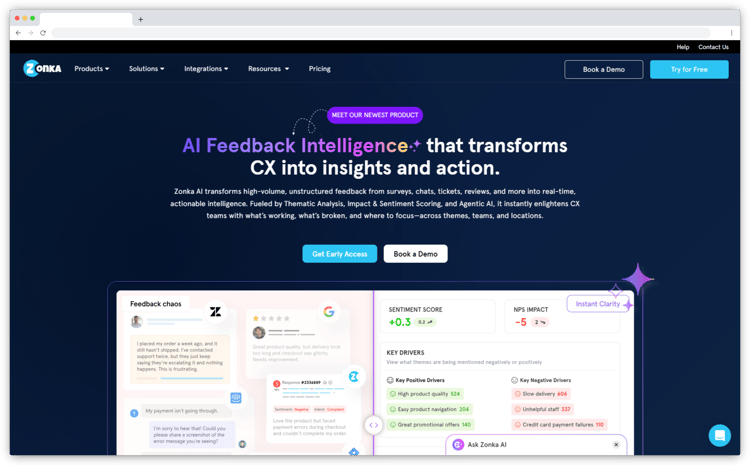
"Hands down the best feedback software." - Verified G2 Reviewer
Key Features
- Omnichannel collection: email, SMS, WhatsApp, in-app, web widgets, kiosk, offline, QR code
- AI Feedback Intelligence: thematic analysis, sentiment scoring, intent detection, and entity mapping
- Role-based signals: agent, manager, and executive views connected to the same underlying data
- Automated workflows: route detractor responses to support, create Jira tickets from feature requests, trigger Slack alerts on score drops
- Multi-source unification: surveys, tickets, reviews, chats, and CRM records in one platform
- Multilingual surveys: 30+ languages with AI auto-translation
Pros
- AI agents surface emerging themes and score drops without manual monitoring
- Every feedback channel in one platform, with no separate tools to stitch together
- Workflow automation closes the loop without developer involvement
Cons
- Custom pricing requires a sales conversation before evaluation
- Niche or legacy system integrations may need API configuration
Best Use Case: Businesses that need to collect feedback across every channel, unify it with operational data, and have AI agents surface what to fix, without managing multiple tools.
2. Nicereply: Best Customer Satisfaction Tool for Support and Helpdesk Teams
Nicereply is purpose-built for support satisfaction measurement. It integrates directly with helpdesks (Zendesk, Freshdesk, HelpScout, Intercom, and Front) and triggers one-click CSAT, NPS, or CES surveys automatically when a ticket is resolved. The setup takes under an hour. Reporting focuses on what support managers actually need: individual agent scores, team satisfaction trends, and response rates over time. Teams that run satisfaction surveys separately from their helpdesk, or rely on manual survey sending, will notice the difference immediately. It doesn't try to do everything, and that focus is its strength.
-png.png?width=2022&height=1258&name=frame_generic_light%20(6)-png.png)
"Nicereply helps us to understand if our support service is the best for our customers." - Verified G2 Reviewer
Key Features
- One-click CSAT, NPS, and CES surveys triggered automatically on ticket resolution
- Native integrations with Zendesk, Freshdesk, HelpScout, Intercom, Front, and Pipedrive
- Agent-level performance dashboards with trend tracking and leaderboard views
- Survey delivery via email signature or in-ticket embed for high response rates
- Frequency and throttle controls to prevent over-surveying
- Automated alerts on low scores for immediate follow-up
Pros
- Fast setup: no developer involvement needed for major helpdesk connections
- Agent-level scoring gives support managers data to coach with, not just to report on
- High response rates from in-ticket and email signature placement
Cons
- Limited to post-support interactions: not built for product, onboarding, or purchase feedback
- Survey customization is basic compared to broader platforms
- Analytics depth doesn't match enterprise tools like Qualtrics or Medallia
Best Use Case: Support teams that need post-ticket CSAT, NPS, and CES measurement integrated directly into their existing helpdesk, without adding a separate survey workflow.
3. Qualtrics: Best Customer Satisfaction Tool for Enterprise CX Programs
Qualtrics is a full-scale experience management platform built for large organizations running complex, multi-channel satisfaction programs. Its XM Discover module consolidates feedback from surveys, support tickets, social mentions, chat transcripts, and call recordings into a single AI-powered view. Text iQ automatically clusters open-text responses into themes with sentiment tagging. Predict iQ uses machine learning to forecast NPS and churn shifts before they materialize. For enterprise teams that need cross-departmental satisfaction tracking with executive-ready reporting, it's among the most analytically comprehensive options available. Teams running straightforward CSAT surveys will find it overkill. If Qualtrics is above your budget, there are best CSAT survey software in 2026 options worth comparing.
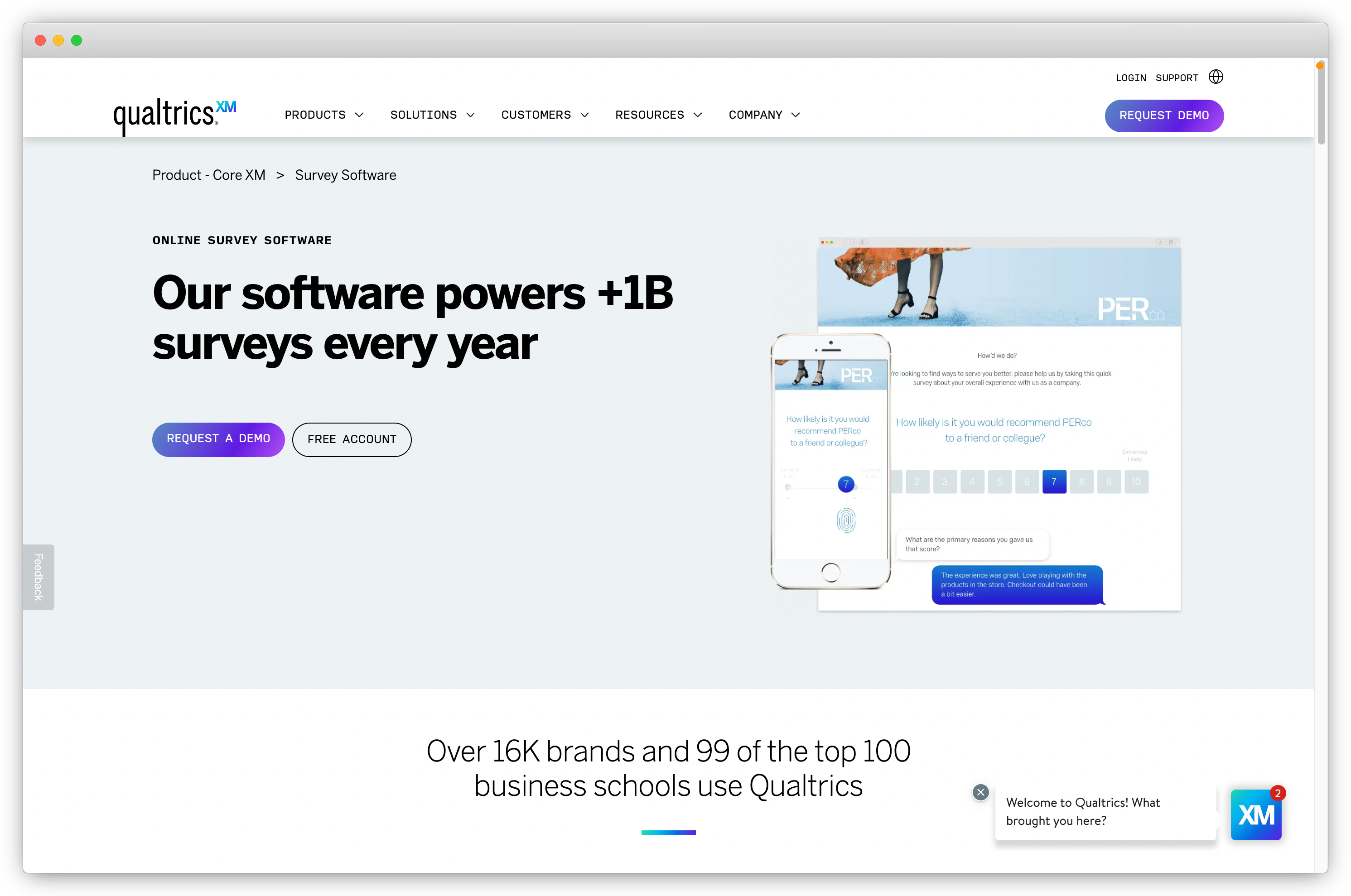
"From technical integrations to features, Qualtrics offers the full experience in-house." - Verified G2 Reviewer
Key Features
- XM Discover: consolidates survey, social, ticket, chat, and call data into one AI-powered view
- Text iQ: automatically clusters open text into themes with sentiment and intent tagging
- Predict iQ: forecasts NPS and churn shifts using deep learning models
- xFlow: AI-triggered workflows route at-risk responses to ServiceNow, Salesforce, or Slack
- Role-based dashboards with driver analysis for executives, managers, and frontline teams
- Speech analytics for contact center call analysis
Pros
- Extremely deep analytics: driver analysis, predictive modeling, and sentiment scoring in one platform
- Handles massive response volumes across multiple departments and geographies
- Strong enterprise integration ecosystem
Cons
- High cost and long implementation timeline: not suited for smaller or mid-market teams
- Interface complexity draws mixed reviews, particularly for branching logic setup
- Limited design customization without CSS knowledge
Best Use Case: Large enterprises running cross-departmental VoC programs that need predictive analytics, multi-source data unification, and role-based signal routing at scale.
4. Survicate: Best Customer Satisfaction Tool for Multi-Channel Feedback & In-App Behavioral Targeting
Survicate approaches satisfaction measurement from inside the product rather than through an inbox. Native SDKs for iOS, Android, React Native, Flutter, and Unity fire CSAT, NPS, and CES surveys at the moment a user completes an action, such as a checkout, a support chat, or a feature interaction, instead of waiting on an email days later. The response, plus feedback pulled from connected sources, feeds into Research Hub, an AI research repository that clusters open-text answers into themes and lets teams query results conversationally through the Research Assistant. Teams already running on Intercom get an added edge: surveys can fire directly inside Messenger conversations, alongside native syncs with HubSpot, Salesforce, Zendesk, Amplitude, and Braze that keep satisfaction data connected to the rest of the stack. The tradeoff shows up after a low score comes in: there's no built-in way to route a detractor to a case owner or roll satisfaction up to the account level, so teams typically pair it with a helpdesk or CRM workflow to close the loop.
"Survicate makes it easy to create and launch surveys across multiple channels, and the Insights feature really helps analyze open-text answers without manual work." - Verified G2 Reviewer
Key Features
- Event-triggered CSAT, NPS, and CES surveys fired by real in-app actions via native SDKs, not just link or email sends
- Research Hub: AI-driven theme clustering and sentiment tagging across connected feedback sources
- Conversational Research Assistant for querying satisfaction data without manual filtering
- Intercom Messenger-embedded surveys alongside HubSpot, Salesforce, Zendesk, Amplitude, and Braze syncs
- Recurring survey cadences to track CSAT/NPS trends over time without rebuilding programs
- Real-time dashboards covering NPS, CSAT, and CES side by side
Pros
- Catches sentiment at the moment of the interaction rather than days later by email
- AI theme clustering means open-text responses don't pile up unanalyzed
- Deep tooling for teams already standardized on Intercom, Braze, or Amplitude
Cons
- Detractor follow-up needs a separate workflow: no built-in case routing or ticket creation
- Satisfaction data sits at the individual respondent level, with no rollup by account or company
- The AI and targeting capabilities that make this list only unlock on the Growth plan and higher
Pricing
- Free plan covers 25 responses to 1 survey. Starter runs $89/month. Growth starts at $56/month billed annually with AI features included. Pro and Enterprise scale to $349 and $569/month for advanced integrations.
G2 Rating
- 4.6/5
Best Use Case: Teams that want CSAT, NPS, and CES triggered by real product moments rather than a fixed send schedule, and who already have Intercom, Braze, or Amplitude in their stack to plug the results into.
5. AskNicely: Best Customer Satisfaction Tool for Frontline NPS and Real-Time Coaching
AskNicely is built for organizations where satisfaction is delivered by frontline teams: field service companies, home services, healthcare providers, and franchise businesses. When a customer rates a technician, driver, or agent, that person sees their score and feedback in real time through a mobile app. Managers get coaching dashboards showing who needs attention and what customers are saying about specific team members. This closes the loop at the individual level, not just at the team or location level. The platform sends NPS and CSAT surveys via email and SMS and integrates with Salesforce, HubSpot, and Zendesk.
"Helps us keep our finger on the pulse of what we are doing right for our customers." - Verified G2 Reviewer
Key Features
- Real-time NPS and CSAT measurement via email and SMS
- Individual frontline coaching dashboards: agents see their own scores and customer comments
- Automated coaching workflows triggered by low scores
- Streak and recognition features that surface positive feedback to motivate frontline staff
- Scheduled survey cadences with throttle controls to prevent over-surveying
- Integrations with Salesforce, HubSpot, Zendesk, and major CRMs
Pros
- Individual-level feedback loop is genuinely differentiated: most competitors stop at team or location level
- Mobile-first experience makes it accessible for non-desk, distributed frontline teams
- Automation reduces the manual follow-up burden on managers
Cons
- Less suited for product feedback, in-app surveys, or multi-source data unification
- No published pricing: a sales conversation is required before evaluation
- Multi-metric programs (CSAT + CES alongside NPS) have less depth than full-platform tools
Best Use Case: Service businesses and franchises where frontline employee performance directly drives customer satisfaction scores and where individual coaching matters as much as aggregate reporting.
6. Medallia: Best Customer Satisfaction Tool for Large-Scale Enterprise VoC Programs
Medallia is an enterprise experience management platform that processes feedback from surveys, social media, contact center interactions, digital behavior, and operational data, then maps those signals to specific locations, agents, products, and moments in the customer journey. Its AI engine, Medalllia Athena, detects emerging themes, flags anomalies, and predicts which customers are at risk before they show obvious signs of dissatisfaction. For organizations managing feedback at the scale of thousands of locations or millions of monthly interactions, Medallia handles volume and complexity that mid-market tools can't. It's one of the most referenced platforms when enterprises evaluate AI sentiment analysis software given the depth of its NLP capabilities across unstructured data.
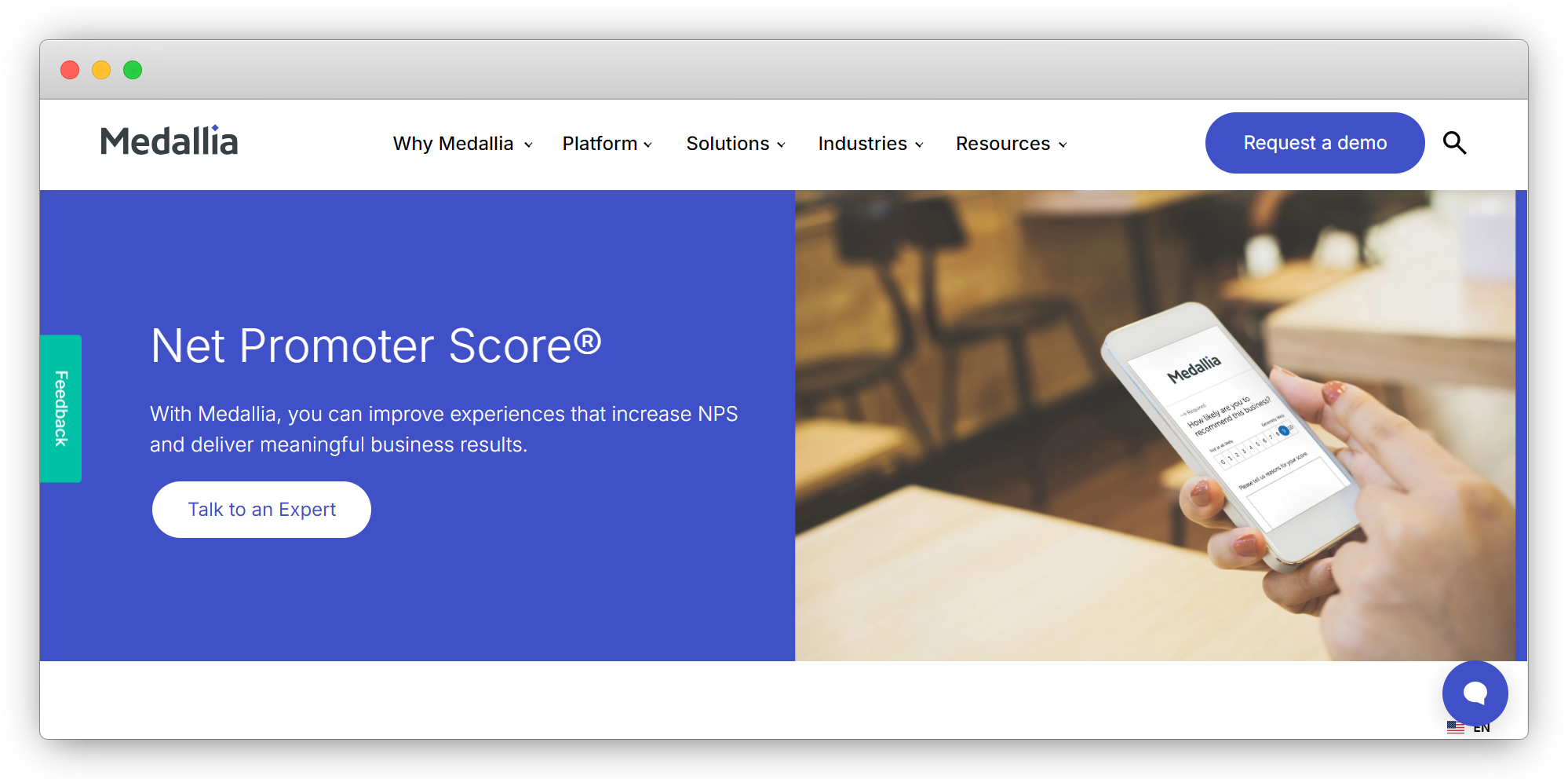
"Text analytics and being able to see true customer pulse and comments." - Verified G2 Reviewer
Key Features
- Multi-source signal capture: surveys, contact center, social, digital behavior, and operational data
- Medallia Athena: anomaly detection, emerging theme identification, and churn prediction
- NLP-powered emotion, effort, and intent detection across unstructured feedback
- Location and agent-level feedback mapping for multi-location enterprises
- Role-based dashboards for CX leaders, operations teams, and frontline managers
- Closed-loop case management for acting on critical feedback signals
Pros
- Handles enterprise-scale feedback volumes across complex organizational structures
- Signal-based approach surfaces insights without waiting for manual analysis runs
- Deep integration capabilities with enterprise tech stacks
Cons
- Long implementation timeline: requires dedicated support resources, not a self-serve tool
- Custom pricing is typically significant: not accessible for most SMBs or mid-market teams
- Steep learning curve for teams that aren't running a dedicated VoC function
Best Use Case: Large enterprises and multinational organizations that need to manage VoC programs at scale across multiple locations, departments, and customer segments.
7. Wootric (InMoment): Best Customer Satisfaction Tool for SaaS and Customer Success Teams
Wootric, now part of InMoment, is a satisfaction measurement tool designed for SaaS companies and customer success teams tracking loyalty across the product lifecycle. It focuses on in-app and email NPS, CSAT, and CES surveys triggered by specific user behaviors: feature adoption, account upgrades, support interactions, or time-based milestones. The platform filters results by segment so CS teams can compare satisfaction across cohorts rather than aggregate scores. Native integrations with Salesforce, HubSpot, Segment, and Intercom connect satisfaction data with account health metrics. Teams evaluating customer feedback tools for SaaS renewal workflows will find the behavioral triggering and cohort segmentation practical.
-png.png?width=2022&height=1258&name=frame_generic_light%20(5)-png.png)
"Easy to customise and provides flexible filter options for analysing the NPS." - Verified G2 Reviewer
Key Features
- In-app and email NPS, CSAT, and CES with behavioral trigger logic
- Segment-based filtering by plan tier, geography, and usage cohort
- Driver analysis to identify what most influences satisfaction scores
- Industry benchmarking to compare NPS and CSAT against sector standards
- Integrations with Salesforce, HubSpot, Segment, Intercom, and Zendesk
- Text analytics for categorizing open-ended responses at scale
Pros
- Strong SaaS lifecycle coverage: onboarding, feature adoption, and renewal feedback all covered
- Cohort filtering lets CS teams compare satisfaction across different customer segments
- Behavioral triggering reduces survey fatigue by asking at the right moment
Cons
- Wootric and InMoment product lines have not fully merged: some users report interface inconsistencies
- Less suited for offline, kiosk, or in-person feedback collection
- Doesn't match Medallia or Qualtrics in analytics depth for large enterprise programs
Best Use Case: SaaS companies and customer success teams that need lifecycle-based satisfaction tracking with behavioral survey triggers and CRM integration.
8. Crescendo.ai: Best AI-Native Customer Satisfaction Tool for Automated Interaction Scoring
Crescendo.ai takes a fundamentally different approach to satisfaction measurement. Instead of asking customers to fill out surveys, it automatically calculates a CSAT score for every customer service interaction using AI. By analyzing tone, resolution time, keyword patterns, and conversation dynamics across chat, email, voice, and messaging, it produces a satisfaction score without a single manual survey response. This eliminates the survey blind spot that affects most CSAT tools: typically only 10–20% of customers respond to surveys, meaning scores reflect a self-selected minority. Teams that need full interaction coverage will find this approach more representative than traditional survey sampling. Its AI CSAT module is part of Crescendo's broader AI-powered customer feedback platform and is included at no additional cost.
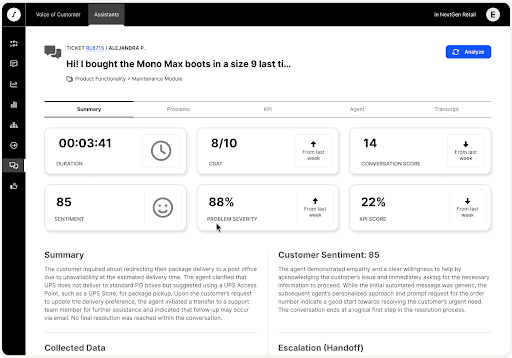
"CSAT rose from 40% to 70%. Leadership described support operations as completely transformed." - Crescendo.ai Customer (crescendo.ai/case-studies)
Key Features
- Automated CSAT scoring across 100% of support interactions with no manual surveys
- Multi-channel coverage: chat, email, voice, and messaging platforms
- VoC dashboard with satisfaction trend analysis and sentiment tracking
- Real-time alerts on interactions flagged as low satisfaction
- AI-native resolution capabilities alongside satisfaction measurement
- Integrations with major customer service platforms and CRMs
Pros
- 100% interaction coverage eliminates sampling bias in satisfaction data
- No survey fatigue: customers aren't asked to rate every interaction
- Fast deployment: no survey design or distribution setup required
Cons
- Pricing model ($1.25/resolution + $2,900/month platform fee) is high for teams with large interaction volumes
- AI-scored CSAT may diverge from self-reported satisfaction in some scenarios
- Not suitable for teams that need traditional survey-based NPS or CES programs
Pricing
- $1.25 per resolution + $2,900/month platform fee.
G2 Rating
- Not listed on G2
Best Use Case: Mid-market to enterprise support teams that need CSAT measurement coverage across every customer interaction without relying on manual survey response rates.
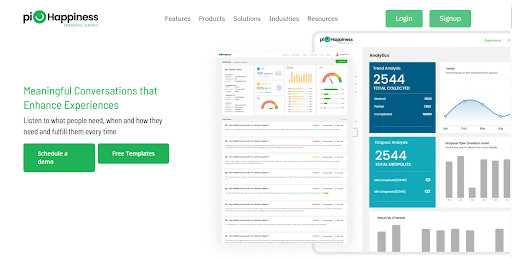
9. piHappiness: Best Customer Satisfaction Tool for In-Person and Kiosk Feedback
piHappiness is designed for feedback collection at physical locations: retail stores, hospital reception areas, hotel lobbies, bank branches, and service desks. Its kiosk and tablet mode presents short, visually simple surveys (smiley faces, star ratings, thumbs up/down) that customers complete in seconds without staff involvement. Negative responses trigger immediate alerts to the relevant manager. Hierarchical access controls let regional managers see their locations while corporate teams see aggregate performance. It's not built for deep AI analysis or complex survey logic. But for high-frequency, low-friction in-person CSAT collection, the kind where long surveys kill response rates, it's purpose-matched in a way that general-purpose platforms aren't. For multi-location businesses running in-person satisfaction programs, the per-location branding and multi-language support also reduce setup time significantly across sites.
[Pull from g2.com/products/pihappiness-customer-feedback-app/reviews before publishing]
Key Features
- Kiosk and tablet survey mode with auto-loop restart for continuous collection
- Real-time dashboards and threshold-based alerts for negative responses
- Multi-location hierarchy with role-based access for regional and corporate teams
- Multi-channel distribution: email, SMS, QR code, and in-person
- Customizable survey themes and branding per location
- Multilingual support for diverse customer bases
Pros
- High response rates from short, in-person surveys at physical touchpoints
- Immediate manager alerts on negative feedback enable fast service recovery
- Easy to deploy across multiple locations without technical setup
Cons
- Limited AI analytics and deep text analysis compared to enterprise platforms
- Better suited for structured (rating-based) feedback than open-ended qualitative research
- Feature depth varies across plan tiers
Best Use Case: Retail chains, healthcare clinics, hospitality businesses, and service desks that need real-time, in-person CSAT collection at physical customer touchpoints.
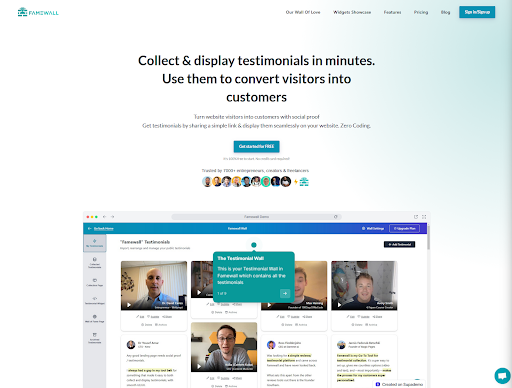
10. Famewall: Best Tool for Converting Promoter Feedback into Social Proof
Famewall sits at the intersection of satisfaction measurement and reputation management. It's not a CSAT tool in the traditional sense. It's designed for what comes after a customer gives a high satisfaction score. Using Famewall alongside a dedicated CSAT platform, teams can route promoters into a testimonial collection flow where they submit text, video, or audio reviews. Famewall then displays those testimonials across websites and marketing channels through customizable widgets. For businesses with active satisfaction programs who want to convert positive feedback into visible social proof without managing a separate review platform, it fills that specific gap in the workflow. It works best as a complement to a CSAT or NPS tool, not as a standalone measurement solution.
"I love how simple it is to create a widget to showcase testimonials." - Verified G2 Reviewer
Key Features
- Text, video, and audio testimonial collection via personalized collection pages
- Import reviews from 30+ platforms including Google, LinkedIn, and Twitter
- AI-powered review summary and sentiment analytics
- Customizable wall-of-fame widgets for website embedding
- No-code setup with embed codes for individual testimonials
- AI testimonial composer to help customers draft their responses quickly
Pros
- No-code testimonial collection and display: minimal setup required
- Supports multiple testimonial formats including video and audio
- Affordable entry price for small to medium businesses
Cons
- Not a CSAT measurement tool: needs a dedicated satisfaction platform alongside it
- Limited traditional survey and direct satisfaction metric features by design
- Most useful for B2C businesses with strong promoter bases
Best Use Case: Businesses that already measure customer satisfaction and want to convert high-scoring customers into testimonials, reviews, and marketing-ready social proof.
11. Lumoa: Best AI-Powered Customer Satisfaction Tool for Mid-Market Analysis
Lumoa is an AI-driven feedback analysis platform that consolidates customer satisfaction data from surveys, support tickets, online reviews, and chat transcripts, then uses AI to surface the themes and drivers most affecting scores. Its core differentiator is impact analysis: rather than showing what customers are saying, it quantifies how much each theme is influencing NPS or CSAT. A theme appearing in 20% of responses but driving 40% of score variation gets ranked above a theme appearing in 40% of responses with minimal score impact. This helps CX teams prioritize what to fix first rather than just what's mentioned most. Lumoa sits between mid-market and enterprise in scope, more analytically capable than Nicereply or Wootric, lighter to implement than Qualtrics or Medallia.
-png.png?width=2022&height=1258&name=frame_generic_light%20(9)-png.png)
"With Lumoa we can find the issues that drive our customer satisfaction." - Verified G2 Reviewer
Key Features
- Multi-source data consolidation: surveys, reviews, tickets, and chat
- AI impact analysis: quantifies how much each theme drives NPS or CSAT changes
- Automated feedback categorization and theme detection
- Real-time trend monitoring with alerts on score shifts
- Role-based dashboards for different team levels
- Integration with major survey platforms, helpdesks, and review channels
Pros
- Impact analysis helps teams prioritize CX improvements by score influence, not just frequency
- Cleaner, more accessible interface than enterprise alternatives: faster to deploy
- Handles multiple feedback sources without requiring custom data pipelines
Cons
- High starting price ($593/month) relative to comparable mid-market tools
- Better for analysis than collection: limited channel breadth for survey distribution
- No offline or kiosk feedback capabilities
Best Use Case: Mid-market CX teams that want AI-powered impact analysis across multiple feedback sources to prioritize what to improve first, not just what's most mentioned.
12. SmileBack: Best Customer Satisfaction Tool for Managed Service Providers
SmileBack is a CSAT tool built specifically for Managed Service Providers (MSPs). It integrates with PSA (Professional Services Automation) platforms: ConnectWise, Autotask, and HaloPSA, and triggers one-click emoji-based CSAT surveys automatically after each support ticket closes. The three-option format (happy, neutral, unhappy) drives high response rates in B2B service environments where customers won't complete longer surveys. The platform shows satisfaction at the account, technician, and team level, with leaderboard views that let MSP managers benchmark technician performance using real customer satisfaction data. Negative responses trigger immediate alerts, giving account managers a fast path to service recovery before a client relationship deteriorates. For MSPs, where client retention depends heavily on consistent service quality, having satisfaction data tied to individual technicians makes coaching conversations specific rather than general.
-png.png?width=2022&height=1258&name=frame_generic_light%20(10)-png.png)
"Great tool, and it's easy to set up for collecting CSAT information from clients." - Verified G2 Reviewer
Key Features
- Emoji-based one-click CSAT surveys triggered on PSA ticket closure
- Native integrations with ConnectWise, Autotask, and HaloPSA
- Account, technician, and team-level satisfaction dashboards
- Automated negative response alerts for immediate client follow-up
- Leaderboard views for technician performance benchmarking
- Public testimonial display feature for marketing
Pros
- High response rates from the simplicity of three-option emoji rating
- PSA-native: no configuration needed beyond initial connection
- Useful for both satisfaction measurement and technician performance management
Cons
- Limited to post-ticket CSAT: doesn't support NPS, CES, or multi-channel feedback programs
- Very niche tool: limited value outside the MSP/IT services industry
- Analytics depth is basic beyond satisfaction trends and leaderboards
Best Use Case: Managed Service Providers that need simple, high-response-rate CSAT measurement integrated directly into their PSA tools for technician-level performance tracking.
13. Sogolytics: Best Customer Satisfaction Tool for Multi-Channel Survey Management
Sogolytics is a survey and feedback management platform with a stronger analytical layer than most mid-market competitors. Beyond standard CSAT, NPS, and CES surveys, it includes predictive analytics, sentiment detection on open-text responses, and customizable dashboards that teams can configure without developer support. Distribution covers email, web, in-app, SMS, and QR channels. Its reporting features let teams segment results by audience, compare performance across time periods, and set threshold-based alerts for score drops. For businesses looking for online surveys with built-in analytics depth at a lower price point than enterprise tools, Sogolytics offers solid mid-market functionality. The free plan makes it accessible for teams that want to test the platform before committing to a paid tier. Advanced branching logic and conditional routing make it capable of handling more complex survey designs than most tools at this price point.
-png.png?width=2022&height=1258&name=frame_generic_light%20(11)-png.png)
"Setting up a survey in SoGo is very straightforward." - Verified G2 Reviewer
Key Features
- CSAT, NPS, and CES surveys with multi-channel distribution (email, web, SMS, QR, in-app)
- Predictive analytics and trend detection on satisfaction data
- AI sentiment analysis on open-text responses
- Customizable dashboards with drag-and-drop reporting configuration
- Automated threshold alerts and scheduled report delivery
- Advanced branching and survey logic for complex survey designs
Pros
- Stronger analytics than most tools at the same price point
- Flexible survey design with deep logic and branching capabilities
- Free plan available for basic use cases
Cons
- Interface feels dated compared to newer platforms
- Mobile experience is less polished than desktop
- Customer support response times draw mixed reviews
Best Use Case: Mid-sized businesses that need multi-channel survey distribution with predictive analytics and customizable reporting at a lower cost than enterprise platforms.
14. Feedbackly: Best Customer Satisfaction Tool for Emotional Journey Measurement
Feedbackly differentiates with its Emotional Value Index (EVI), a proprietary metric that measures the emotional state of customers at specific journey touchpoints, not just their satisfaction level. CSAT tells you whether a customer was satisfied. EVI attempts to capture how they felt: excited, neutral, frustrated, or delighted. The platform supports multi-channel survey distribution across web, email, SMS, and in-app, and its journey mapping tools visualize how customer emotions shift across different touchpoints. For CX teams running experience programs who want to understand the emotional drivers behind satisfaction scores, not just the scores themselves. EVI adds a layer that standard CSAT metrics don't.
-png.png?width=2022&height=1258&name=frame_generic_light%20(12)-png.png)
"EVI score helped us greatly upsell premium plans to our existing client base." - Verified G2 Reviewer
Key Features
- Emotional Value Index (EVI): measures customer emotional state, not just satisfaction scores
- Multi-channel survey distribution: web, email, SMS, and in-app
- Customer journey mapping with emotional touchpoint visualization
- Multilingual survey support for international customer bases
- Real-time reporting with trend analysis across journey touchpoints
- Integration with e-commerce platforms and CRM tools
Pros
- EVI adds emotional measurement that CSAT and NPS don't capture
- Journey mapping helps identify specific emotional friction points in the customer experience
- Multilingual support covers international customer bases
Cons
- High price ($199/month) for a tool that works best as a complement to traditional CSAT platforms
- EVI is a proprietary metric: harder to benchmark against industry standards
- Less suited for post-ticket CSAT or helpdesk satisfaction workflows
Best Use Case: CX teams running journey-based experience programs who want emotional measurement alongside standard satisfaction scores to understand what drives customer loyalty.
What to Look for in a Customer Satisfaction Tool?
1. Support for Core Satisfaction Metrics
The tool should support CSAT, NPS, and CES: the three metrics that together give a complete picture of satisfaction. Each covers a different dimension: CSAT captures interaction-level satisfaction, NPS measures long-term loyalty, CES identifies friction in specific tasks. Platforms that only support one metric limit your ability to diagnose why satisfaction changes. Look for customer satisfaction survey software where customer satisfaction surveys for all three can be triggered, distributed, and reported on from the same interface.
2. Multi-Channel Feedback Collection
Satisfaction signals come from multiple places. Look for survey tools that capture feedback and gather customer feedback via email, in-app, web, SMS, kiosk, and offline channels, and that let you match the channel to the customer context. A post-purchase survey belongs in email. An in-session effort score belongs in-app. A branch satisfaction check belongs on a kiosk. The goal is to engage customers at the right moment, not when it's convenient to send. Tools that limit you to one or two channels will leave coverage gaps.
3. AI-Powered Text Analysis and Sentiment Detection
Scores tell you that something changed. Sentiment analysis and thematic analysis tell you what's driving the change. Look for tools with NLP-based open-text analysis that can surface qualitative data and deeper insights from open-ended responses automatically. Customer service agents, managers, and CX leaders all need different views of the same data. Look for tools that surface both quantitative and qualitative data, not just satisfaction scores, but detailed feedback from open text that explains why those scores moved. Customizable templates and customizable survey templates speed up deployment across teams. Tracking customer satisfaction metrics alongside AI text insights gives the full picture, the number and the reason behind it.
4. Closed-Loop Workflows and Integrations
The ability to close the feedback loop means automatically routing low scores to the right team, creating support tickets from negative responses, and triggering follow-up actions, is what separates a monitoring tool from an action platform. Check whether the tool supports native integrations with your CRM and helpdesk, and whether workflows can be configured without developer support.
5. Pricing Transparency and Free Trial Availability
Platforms that don't publish pricing require a sales conversation before you can evaluate fit. That's a meaningful friction cost, especially when you're comparing multiple tools. Where possible, choose platforms with a free trial or free plan so you can validate usability and output quality before committing to a contract.
How to Choose the Right Customer Satisfaction Tool?
The right choice depends on four factors.
Team size and complexity. Small teams and startups get strong value from Nicereply ($59/month) or Sogolytics ($25/month). Enterprise teams running multi-department, multi-location programs need the data unification and signal-routing capabilities of Qualtrics or Medallia. Mid-market teams wanting full lifecycle coverage without enterprise complexity should evaluate Zonka Feedback or Wootric/InMoment. Support and sales teams often have different survey data needs: support teams want post-ticket CSAT, sales teams want NPS at renewal, so check that the platform handles both before committing.
Primary use case. If your main goal is post-support satisfaction measurement, Nicereply or SmileBack are the most purpose-built options. For frontline NPS with individual coaching, AskNicely is the clearest fit. For multi-channel collection plus AI analysis in one platform, Zonka Feedback or Lumoa cover that ground. Product teams running market research or in-app feedback programs have different requirements than support-focused CSAT programs; clarifying the primary use case before evaluating tools prevents buying more than you need. Understanding how to measure customer satisfaction at each touchpoint first will sharpen which tool fits.
Channel requirements. Businesses collecting feedback at physical locations should evaluate piHappiness. SaaS companies focused on in-app and lifecycle surveys should look at Wootric or Zonka Feedback. Organizations needing WhatsApp, SMS, and kiosk feedback alongside digital channels need a platform that covers all of them without requiring separate tools.
Budget range. A simple breakdown:
| Budget | Tools to evaluate |
| Under $100/month | Nicereply, piHappiness, SmileBack, Sogolytics |
| $100–$600/month | Wootric/InMoment, Feedbackly, Lumoa |
| Custom/enterprise | Zonka Feedback, Qualtrics, Medallia, AskNicely |
If you're unsure which tier fits, start with a free trial where available. Evaluate on whether the tool surfaces actionable signals, not just scores.
When One Customer Satisfaction Tool Isn't Enough: Building a Feedback Stack
Some teams use more than one tool. For example, Wootric for in-app NPS, Nicereply for post-ticket CSAT, and Lumoa to bring the data together. If you go that route, keep it simple: one tool for collection, one for analysis, one for acting on feedback. But before adding tools, check if a single platform like Zonka Feedback or Qualtrics already covers all three. Managing multiple tools takes time and adds complexity.
Looking at how other teams improve customer satisfaction can also help you decide which features matter most for your setup.



.png)
_%20Benefits%2c%20Use%20Cases%2c%20Examples%20%26%20More.svg)