

.svg)
 Healthcare
 Finance
 Retail
 SaaS & Digital
 eCommerce
 Education
 Salesforce
  HubSpot
 Pipedrive
 Mailchimp
 Klaviyo
 Zendesk
  Intercom
 Freshdesk
 HelpScout
  Front
Front Jira
Jira Slack
Slack  MS Teams
 Zoom
Zoom Google Sheets
  Zapier
  Integrately
 Make
Make  Webhooks




 MS Teams


TL;DR
- AI is transforming customer feedback analysis across seven specific dimensions: theme discovery, multi-signal sentiment, predictive patterns, entity-level accountability, intent-based routing, full-volume processing, and contextual intelligence.
- The shift isn't incremental. 81% of CX leaders now rank AI-powered feedback analytics as a top priority, yet only 7% have reached AI-driven analysis with predictive triggers. The trajectory is clear, but most organizations are still early.
- Each transformation is grounded in a specific capability: thematic analysis replaces manual tagging, experience signals replace simple scores, entity recognition replaces anonymous dashboards, and intent classification replaces manual routing.
- The common thread across all seven: AI doesn't replace the need for human judgment. It replaces the bottleneck that prevents human judgment from reaching the right decision at the right time.
The global AI customer experience market reached $12.06 billion in 2024 and is growing at 25.8% annually. Our research across 100+ CX leaders found that 81% now rank AI-powered feedback analytics as a top priority for the next 12 months.
And yet only 7% of those organizations have actually reached AI-driven analytics with predictive triggers and automated workflows. That's the gap this article is about. Not whether AI matters for feedback analysis. That's settled. The question is: what specifically does AI change, and why are 93% of teams still stuck between intention and execution?
The answer isn't one big shift. It's seven specific transformations, each replacing a structural limitation in how feedback gets processed, understood, and acted on. Some are obvious (speed, scale). Others are less visible but more impactful (entity-level accountability, intent-based routing, contextual intelligence).
These seven shifts aren't about replacing human judgment with AI automation. They're about removing the bottlenecks that prevent human judgment from reaching the right problem at the right time. When an analyst spends three weeks tagging 2,000 comments that AI could classify in minutes, the problem isn't the analyst's capability. It's the system that wastes their expertise on classification instead of deploying it on strategy.
That's the thread running through every transformation below: AI handles the scale, the speed, and the consistency. Humans handle the decisions that require context, creativity, and stakeholder judgment. The seven shifts make that division of labor possible.
These shifts also don't require you to adopt all of them at once. They build on each other in a maturity sequence: themes first, then signals, then entities, then routing, then full-scale intelligence. Where you start depends on where your current system breaks. The implementation section at the end maps the sequence explicitly.
Why Traditional Feedback Analysis Can't Keep Up
Before examining what's changing, it's worth understanding what's failing. Traditional customer feedback analysis was designed for a world with lower volumes, fewer channels, and simpler customer expectations.
That world doesn't exist anymore. Organizations now collect feedback across surveys, support tickets, app reviews, social mentions, chat transcripts, and call recordings. The volume has grown exponentially, but the analysis methods haven't kept pace. A three-person analyst team reviewing 2,000 open-text responses takes roughly two weeks. In that time, two more product releases ship, three more feedback cycles complete, and the patterns in the original batch are already stale.
The problems compound across five dimensions. Speed: weekly or monthly reporting cycles mean teams are always reacting to last period's problems. Consistency: three analysts tag the same comment three different ways, making trend analysis unreliable. Scale: every additional 1,000 responses requires more analyst hours, and most teams are already at capacity. Blind spots: channels that live in separate tools create gaps nobody sees. And proof: 42% of CX leaders we spoke with can't demonstrate their feedback program's ROI.
Our AI Feedback Analytics 2025 research found that 93% of CX leaders still struggle with fragmented feedback across tools and touchpoints, and 87% rely on manual analysis methods. The result: signals remain buried in spreadsheets, surfacing too late to influence decisions or prevent churn.
That's the baseline these seven transformations are replacing.
How AI Rebuilds Feedback Analysis
AI doesn't speed up the old process. It replaces the process entirely. The shift isn't "manual tagging, but faster." It's a fundamentally different way of extracting meaning from customer feedback at scale.
Four capabilities define how AI rebuilds the analysis layer:
Instant processing. AI analyzes thousands of comments across surveys, tickets, chats, and reviews simultaneously. Patterns that would take a team two weeks to identify surface in minutes. When a product issue hits 200 responses in a single day, AI flags it before the support queue reflects it.
Unstructured data becomes structured signal. Open-text comments, chat transcripts, voice-of-customer verbatims: these are the richest feedback sources, and they're the ones manual teams skip because they're too time-consuming to code. NLP decodes them automatically, extracting themes, sentiment, intent, and entities without manual tagging or human interpretation bias.
Continuous monitoring replaces periodic reporting. Real-time alerts, sentiment trend tracking, and predictive models anticipate shifts before they escalate. Instead of discovering a satisfaction decline in a quarterly report, teams see the early signal forming and intervene while it's still manageable.
The results are measurable:
- AI-powered surveys achieve 70-80% completion rates compared to 45-50% with traditional methods
- Survey abandonment drops to 15-25% compared to 40-55% with static formats
- Processing speed is up to 10x faster than manual approaches
- Classification consistency exceeds 85% accuracy vs. 70-80% human inter-rater agreement
The combination of speed, structure, and consistency is what makes the seven transformations below possible. Each "Way" builds on this rebuilt foundation.
7 Ways AI Is Transforming Customer Feedback Analysis
Each shift below represents a structural change in how feedback gets processed, understood, and acted on. They aren't isolated features. They're interconnected capabilities that compound when deployed together.
1. From Manual Tagging to AI-Powered Theme Discovery
Traditional approach: an analyst reads comments, creates categories, and tags each response manually. The categories are inconsistent across analysts and reset every quarter when someone new joins the team.
AI approach: thematic analysis discovers topics and sub-topics automatically from the feedback itself. No predefined tag list required. The taxonomy is persistent and auto-evolving: new themes get added as they emerge, existing ones stay consistent across time periods, analysts, and channels.
In simple terms: instead of deciding what to look for before you read the data, the data tells you what's there.
This matters because customer language shifts faster than any manually maintained tag system can track. When a new product feature launches and customers start mentioning "the new dashboard layout" in 12% of responses, AI catches it within days. A manual system might not even have a category for it until the next quarterly tag review.
Here's what the difference looks like in practice. A retail chain collects 3,000 open-text responses monthly across post-purchase surveys and support tickets. Under manual analysis, the team uses 15 predefined categories ("pricing," "quality," "delivery," "staff," etc.) and tags each response against this list. AI-powered theme discovery identifies 47 themes and sub-themes from the same data, including "packaging waste" (mentioned in 6% of responses), "loyalty program confusion" (8%), and "competitor comparison: checkout speed" (4%). None of these existed in the manual tag list. All three drive specific operational decisions.
What changes operationally: Theme detection accuracy exceeds 85% after model training, compared to 70-80% inter-rater agreement with manual human coding. Trend analysis becomes reliable across quarters because the classification logic doesn't change when an analyst leaves. And our analysis of 1M+ open-ended feedback responses across industries and eight languages found an average of 4.2 distinct topics per response, meaning manual tagging that captures one theme per comment misses three-quarters of the signal.
2. From Simple Scores to Multi-Signal Sentiment Detection
Traditional approach: sentiment is positive, negative, or neutral. One label per response. A customer who writes "the product is excellent but the onboarding was confusing and the support agent was unhelpful" gets tagged as... mixed? Negative? It depends on who's reading it.
AI approach: modern LLM-powered sentiment analysis detects intensity (mild frustration vs. urgent anger), identifies mixed sentiment within a single comment, and tracks shifts over time by segment, location, or product line. But sentiment is only one of the signals AI extracts.
Experience signals go beyond positive and negative. They include effort perception ("I had to call three times"), urgency ("this needs to be fixed before our renewal"), churn risk ("we're evaluating alternatives"), and emotion (confusion, delight, frustration, anger). Each signal is detected at two levels: overall response and per theme within that response.
Here's why that two-level detection matters. Take a hotel review: "The room was spotless and the location was perfect, but the checkout process took 30 minutes and nobody at the front desk seemed to care." Response-level analysis gives you one sentiment label. Mixed. Helpful? Barely. Theme-level analysis gives you four signals: room cleanliness (positive sentiment), location (positive), checkout process (negative sentiment + high effort), front desk staff (negative sentiment + negative emotion). That's four data points your operations team, facilities team, and HR team can each act on independently.
Don't believe us? Our analysis of 1M+ open-ended feedback responses across industries and eight languages found that 29% carry mixed sentiment. That's nearly one in three responses where a single positive or negative label hides the actual story. Theme-level sentiment detection captures all of it.
The 29% problem: If your dashboard shows "72% positive sentiment" and 29% of your responses actually carry mixed signals, that 72% is masking problems in specific areas while over-crediting others. The fix isn't better sentiment classification. It's detecting sentiment per theme, not per response.
3. From Reactive Reports to Predictive Pattern Recognition
Traditional approach: monthly or quarterly reports summarize what happened last period. By the time the report reaches a decision-maker, the patterns it describes are weeks old. Trends get spotted after they've already impacted retention.
AI approach: predictive models analyze the trajectory of feedback themes, not the snapshot. When "checkout friction" mentions increase 15% week over week across three locations, that's a signal before it becomes a churn driver. When neutral sentiment shifts toward keywords like "confusing," "too many steps," and "can't find," that's a UX friction pattern forming before support tickets spike.
The shift from reactive to predictive changes the team's operating cadence. Instead of explaining what went wrong last quarter, CX teams can intervene before problems compound. A weekly theme trend dashboard that shows emerging patterns gives product and operations teams a 2-4 week head start compared to traditional reporting cycles.
Consider a SaaS company monitoring onboarding feedback. Traditional reporting shows "onboarding satisfaction declined 8% last quarter." Predictive analysis shows "mentions of 'integration setup' with high-effort language increased 22% over the last three weeks, concentrated in enterprise accounts." The first tells you something happened. The second tells you what's happening, who it's affecting, and gives you time to respond before the quarterly metric drops. For SaaS products that want to surface these insights directly to users, top embedded analytics tools can bring reporting and analysis into the application itself.
Wondering how this connects to the broader system? The Feedback Intelligence Framework structures this predictive capability through an Impact × Trend prioritization model: high-impact themes with worsening trends get flagged as "Fix Now," while high-impact themes that are stable get classified as "Monitor." Low-impact themes with worsening trends go into "Watch." This four-quadrant model replaces gut-feel prioritization with data-scored decisions.
Netflix pioneered this thinking in entertainment: their recommendation engine doesn't wait for you to tell it what you want. It predicts based on patterns. The same logic applies to feedback analysis. You don't wait for customers to escalate. You detect the pattern that precedes escalation and intervene while there's still time.
What predictive analysis enables:
- Theme trajectory tracking: is "checkout friction" growing, stable, or declining?
- Churn early warning: sentiment declining + effort increasing + churn language appearing = intervention window
- Seasonal pattern detection: feedback themes that spike during specific periods (holiday shipping, renewal cycles, new releases)
- Cross-channel correlation: a theme visible in tickets but invisible in surveys signals a collection gap, not an absence of the problem
4. From Flat Dashboards to Entity-Level Accountability
Traditional approach: dashboards show aggregate metrics. "Sentiment is 72% positive." "Top themes: billing, speed, support." These are useful as directional signals. They're useless for accountability because they don't tell you who or what specifically is driving the patterns.
AI approach: entity recognition maps feedback to specific business objects. "The downtown branch" is a location entity. "Priya in support" is a staff entity. "The new reporting dashboard" is a product entity. "Competitor X" is a competitive entity. When AI tags these automatically, every theme, sentiment score, and experience signal can be filtered by entity.
The operational difference is substantial. A branch manager doesn't need to see enterprise-wide sentiment data. They need to see how their specific location compares to peers, which themes are driving their scores, and which staff members are mentioned positively or negatively. Entity recognition makes this possible without manual filtering or custom report builds.
The applications vary by industry. In hospitality, entity recognition maps guest feedback to specific properties, room types, and staff. "The front desk at the downtown location" becomes a filterable data point, not an anonymous comment. In SaaS, entities track specific features, API endpoints, and integration partners. "The Salesforce sync keeps failing" gets tagged to the Salesforce integration entity, routed to the integrations team, and tracked for resolution.
In healthcare, entity recognition maps patient feedback to specific departments, physicians, and procedures. In retail, it maps to locations, product lines, and individual staff members. The pattern is the same across every vertical: entities turn anonymous feedback into accountable signals.
When 32% of open-ended responses mention specific entities (staff, locations, products, or competitors), ignoring entity-level analysis means ignoring a third of the signal in your feedback data.
What entity recognition delivers:
- Location benchmarking: compare theme sentiment across branches, regions, or countries
- Staff coaching signals: which agents receive praise vs. friction language, mapped to specific themes
- Competitive intelligence: what customers mention about competitors and in what context (switching, comparison, regret)
- Product-level tracking: sentiment and effort per feature, per release, over time
5. From Delayed Loops to Intent-Based Routing
Traditional approach: feedback gets collected, analyzed (eventually), summarized in a report, and shared in a meeting. Someone decides who should follow up. That person may or may not act. Weeks pass between the signal and the response.
AI approach: intent classification detects what the customer wants to happen next, and routes the feedback to the team that can act on it. Five intent types drive the routing:
- Complaint routes to Support or Operations: "The billing page charged me twice and nobody has responded to my ticket."
- Feature request routes to Product: "It would be great if you could add dark mode to the mobile app."
- Question routes to Support or Knowledge Base: "How do I export my data to CSV? I can't find the option."
- Advocacy routes to Marketing: "We've recommended your platform to three other teams in our company."
- Escalation routes to Management: "I need to speak with someone in leadership about our contract terms."
When intent classification is paired with urgency detection and automated workflows, the gap between "customer said something" and "someone is responding" shrinks from weeks to hours. A churn signal from an enterprise account triggers a retention workflow automatically. A feature request that crosses a volume threshold creates a product backlog item. An escalation auto-creates a ticket with the account owner CC'd.
Our research found that 23% of open-ended feedback responses contain clear intent signals. That means nearly one in four comments already tells you what the customer wants to happen next. Without intent classification, those signals sit in the same queue as everything else, waiting for a human to read, interpret, and route them. With it, the routing happens in seconds.
That's the shift from closed-loop feedback as a concept to closed-loop feedback as a system.
6. From Sampled Analysis to Full-Volume Processing
Traditional approach: when feedback volumes exceed team capacity, organizations sample. They analyze 200 out of 2,000 responses and extrapolate. The problem: sampling works for quantitative scores (NPS averages are statistically stable at sample sizes above ~300). It fails for qualitative themes. A theme that appears in 4% of responses might be the most important signal in the dataset, but at a 10% sample rate, it's invisible.
AI approach: every response gets analyzed. Not sampled. Not batched for next quarter. Processed as it arrives, classified across all three pillars (themes, experience signals, entities), and added to the trend data in real time.
The practical impact: patterns that are invisible in samples become visible at full volume. When AI processes 10,000 survey responses and 5,000 support tickets simultaneously, cross-channel patterns emerge that no single-channel sample could reveal. A sentiment shift that's invisible in survey data but evident in support tickets gets caught because both data streams flow through the same analysis system.
Full-volume processing also eliminates a subtle bias that sampling introduces. When humans choose which 200 responses to review from a pool of 2,000, selection bias creeps in. Analysts gravitate toward longer responses (more detail), extreme scores (more dramatic), and recent submissions (recency bias). AI has no such preference. A two-word response ("checkout broken") gets the same classification attention as a 200-word detailed complaint. And a response from three months ago carries the same analytical weight as one from yesterday.
For organizations operating across multiple regions, products, or segments, full-volume processing means every sub-group has enough data for reliable theme trends. A 10% sample might capture 200 responses from your enterprise segment but only 15 from a specific regional team. That's not enough data for thematic patterns. Full-volume analysis gives every segment a statistically meaningful view.
What full-volume processing surfaces:
- Rare but high-value signals: themes at 2-4% frequency that drive disproportionate churn or loyalty
- Cross-channel patterns: issues visible in tickets but invisible in surveys (and vice versa)
- Sub-segment reliability: enough data for meaningful trends even in small regions, specific products, or niche customer segments
- Elimination of selection bias: every response weighted equally regardless of length, recency, or extremity
7. From Isolated Metrics to Contextual CX Intelligence
Traditional approach: an NPS score of 42 exists in isolation. A CSAT of 3.8 exists in isolation. A support ticket about "billing confusion" exists in isolation. Each metric tells its own story. Nobody connects them.
AI approach: contextual intelligence links feedback signals to business outcomes. Impact analysis connects detected themes to the metrics they're affecting: "checkout friction is responsible for a 0.4-point drag on enterprise NPS this quarter." Role-based dashboards ensure the right signals reach the right person: a CXO sees which themes are moving business metrics, a product manager sees feature-level entity tags, a support lead sees agent performance trends.
Context also means understanding the same words differently based on who said them and when. "The app is slow" from a free-trial user during their first week is a usability issue. "The app is slow" from an enterprise account approaching renewal is a churn signal. Both mention the same theme. The context (customer segment, lifecycle stage, account value, sentiment history) determines the priority and routing.
This is the transformation that changes how leadership perceives CX. When feedback analysis can show "we detected this theme, we took this action, and this metric improved," CX stops producing reports and starts producing actionable insights. The connection between signal, action, and outcome is what turns feedback analytics into feedback intelligence.
What contextual intelligence changes:
- Impact quantification: "checkout friction" isn't an abstract theme. It's a 0.4-point drag on enterprise NPS worth $X in retention risk.
- Lifecycle-aware prioritization: the same complaint carries different weight depending on where the customer is in their journey
- Role-based signal delivery: each team sees the signals they're responsible for, without information overload
- Provable ROI: the theme → action → outcome chain that turns CX from overhead into a strategic function
What AI Feedback Analysis Doesn't Solve (and What to Watch For)
No transformation guide is complete without honest limitations. AI in feedback analysis has real constraints worth understanding before you deploy.
Data quality remains the ceiling. AI can classify feedback brilliantly, but if your surveys ask vague questions ("How was your experience?"), the responses will be vague too. Fix the collection layer alongside the analysis layer. (For a deeper look at how manual feedback analysis creates these data quality gaps at organizational scale, that's a related problem worth understanding.)
Sarcasm and cultural context still trip up models. "Great, another update that breaks everything" reads as negative to a human but might get tagged as positive by a model that focuses on "great." Spot-check accuracy monthly. The teams that build a human review cadence alongside AI classification get the best of both.
Over-automation erodes trust if done wrong. Automated follow-ups that feel robotic ("We noticed you had a negative experience. How can we help?") can make customers feel processed rather than heard. Route the signal automatically. Let the human craft the response.
Model accuracy degrades without maintenance. Customer language evolves. New products create new vocabulary. AI models need regular accuracy reviews, entity list updates, and taxonomy refinements to stay sharp. Plan for monthly model hygiene, not one-time setup.
From Transformation to Implementation: What This Means for Your Team
Seven transformations sound promising in theory. In practice, most organizations won't deploy all seven simultaneously. The question is: where to start?
The sequencing that works for most teams follows the data maturity path:
Start with themes (Way 1). If your team is still manually tagging feedback, AI-powered theme discovery delivers the fastest visible improvement. Themes are the foundation everything else builds on. Without consistent theme classification, experience signals have no context, entity recognition has no anchor, and intent routing has no structure.
Layer in sentiment and experience signals (Way 2). Once themes are stable, adding multi-signal detection per theme transforms what each theme tells you. "Billing" is a theme. "Billing with high effort and churn risk" is a signal. This layer is where the 29% mixed-sentiment problem gets solved, because each theme gets its own signal profile instead of sharing a single response-level label.
Add entity recognition (Way 4) for accountability. This is where analysis becomes specific enough for individual team members to act on. Without entities, signals are organizational ("checkout friction is rising"). With entities, signals are personal ("checkout friction at three downtown locations, with Stephen at the main branch receiving the most mentions"). That specificity is what turns a trend into a targeted fix.
Build routing and closed loops (Way 5) for action. Intent-based routing is what converts analysis from a reporting function into an operating system. This is where the Signal-to-Action Ratio (the percentage of detected signals that trigger a measurable response) starts climbing. Without routing, signals sit in dashboards. With routing, they reach the person who can respond.
Expand to full volume and contextual intelligence (Ways 6-7) for strategic value. These are the capabilities that earn leadership investment because they connect feedback directly to revenue, retention, and operational efficiency. When the CXO can see which themes are dragging NPS and what actions are being taken, CX graduates from a reporting function to a business driver. (Our 2025 research report details how the top-performing 7% of organizations operationalize these connections.)
Where are you on the path? If your team is still manually tagging and reviewing quarterly reports, you're at Stage 1. If you have AI themes but no experience signals or entity-level filtering, you're at Stage 2. If signals are detected but not routed to the right people, you're at Stage 3. If routing is automatic and actions are tracked, you're at Stage 4. Most organizations we work with land between Stages 1 and 2. The good news: the path from 1 to 4 is measured in weeks, not years. (For a broader view of how these stages map to organizational readiness, our guide to customer experience maturity levels covers the full progression.)
For the step-by-step implementation playbook, our guide to AI customer feedback analysis covers the five stages from source centralization to automated action.
How Zonka Feedback Operationalizes These 7 Shifts
The transformations above are system-agnostic. Here's how they work when all seven run inside one platform.
Zonka Feedback implements the Feedback Intelligence Framework as a connected system. All three pillars (thematic analysis, experience signals, entity recognition) run simultaneously on every piece of feedback, whether it arrives from a survey, a support ticket, a chat transcript, or an app review.
-
Theme discovery (Way 1) operates through persistent, auto-evolving taxonomy that doesn't reset between sessions or analysts. Multi-signal sentiment (Way 2) scores each theme independently for sentiment, effort, urgency, churn risk, and emotion at both response and theme levels. Entity recognition (Way 4) maps every signal to your business structure: locations, agents, products, features, and competitors, all configurable per industry.
-
Intent classification (Way 5) routes signals to the right team member through AI agents that monitor feedback continuously. A complaint routes to Support. A feature request routes to Product. An advocacy signal routes to Marketing. The routing is automatic, based on detected intent and configured workflows.
-
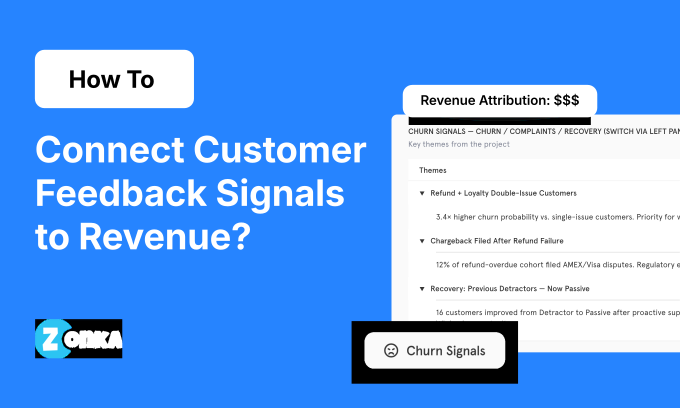
What connects the detection layer to the decision layer is AI Signals — a dedicated view inside Intelligence Hub that takes everything the three pillars detect and pre-classifies it into operational signal buckets. Instead of handing teams a list of 50 themes with sentiment scores to interpret, Signals sorts every sub-theme into one of five categories: Key Drivers (with New, Trending, Positive, Negative, and Emerging sub-states), Churn Signals (Churn, Complaints, Recovery Opportunities), Feedback Queries (Suggestions, Questions & Requests), Praise & Recommendations, and Mixed Signals (where a customer's words contradict their score). Each sub-theme shows volume, sentiment, and change over time, with a toggle between the two as the primary metric. That's the prescriptive layer sitting on top of the detection layer — the seven capabilities above feed into a single screen where every theme is already sorted by what it means operationally and who should act on it first.
-
Full-volume processing (Way 6) happens at ingestion: every response is analyzed in real time, with no sampling and no batch delays. Predictive pattern recognition (Way 3) surfaces emerging theme trends through the Impact × Trend prioritization model. And contextual intelligence (Way 7) connects detected themes to NPS, CSAT, churn, and revenue through impact analysis and role-based dashboards where each team sees signals specific to their area of responsibility.
The result: feedback doesn't sit in a dashboard waiting for someone to check it. It flows through the system, gets enriched with signals, pre-classified into operational categories, and reaches the person who can act on it, with the context they need to respond effectively.
The Net Effect Across All 7 Shifts
| Metric | Before AI | After 7 Shifts |
| Time to insight | Weeks (quarterly reports) | Hours (real-time classification) |
| Theme coverage | 15-20 manual categories | 40-60+ auto-discovered themes and sub-themes |
| Sentiment granularity | 1 label per response | Multi-signal per theme (sentiment + effort + urgency + churn + emotion) |
| Feedback analyzed | 10-20% (sampled) | 100% (every response, every channel) |
| Routing | Manual (someone reads a report, decides who should see it) | Automatic (intent-based, role-based, urgency-weighted) |
| Signal classification | None (themes left unclassified) | Pre-built (every sub-theme sorted into Key Drivers, Churn Signals, Feedback Queries, Praise, or Mixed Signals) |
| CX-to-revenue connection | Anecdotal ("we think feedback helped") | Traceable (theme detected → signal classified → action taken → metric moved) |
The organizations that will define the next era of CX aren't the ones collecting the most feedback. They're the ones that have closed the gap between what customers say and what teams do about it. All seven transformations point in the same direction: turning feedback from a reporting exercise into an operating system where every signal drives a specific, measurable action.
The trajectory is clear. 81% of CX leaders call it a top priority. Only 7% have arrived. The gap between those numbers is where the opportunity lives, and every month of delay is a month your competitors use to close it first.
That system is no longer aspirational. It's operational. And the teams building it today are the ones their customers will remember tomorrow.